🔧 Hydraulic Pump Displacement Calculator
Size pump cc/rev from flow, rpm, gear ratio, and efficiency, then verify actual output
📊 Pump Displacement Results
Required displacement, actual flow, pump speed, and shaft power
85-92% VE
1000-3000 rpm
88-94% VE
1000-2500 rpm
92-97% VE
1000-3600 rpm
94-97% VE
600-3000 rpm
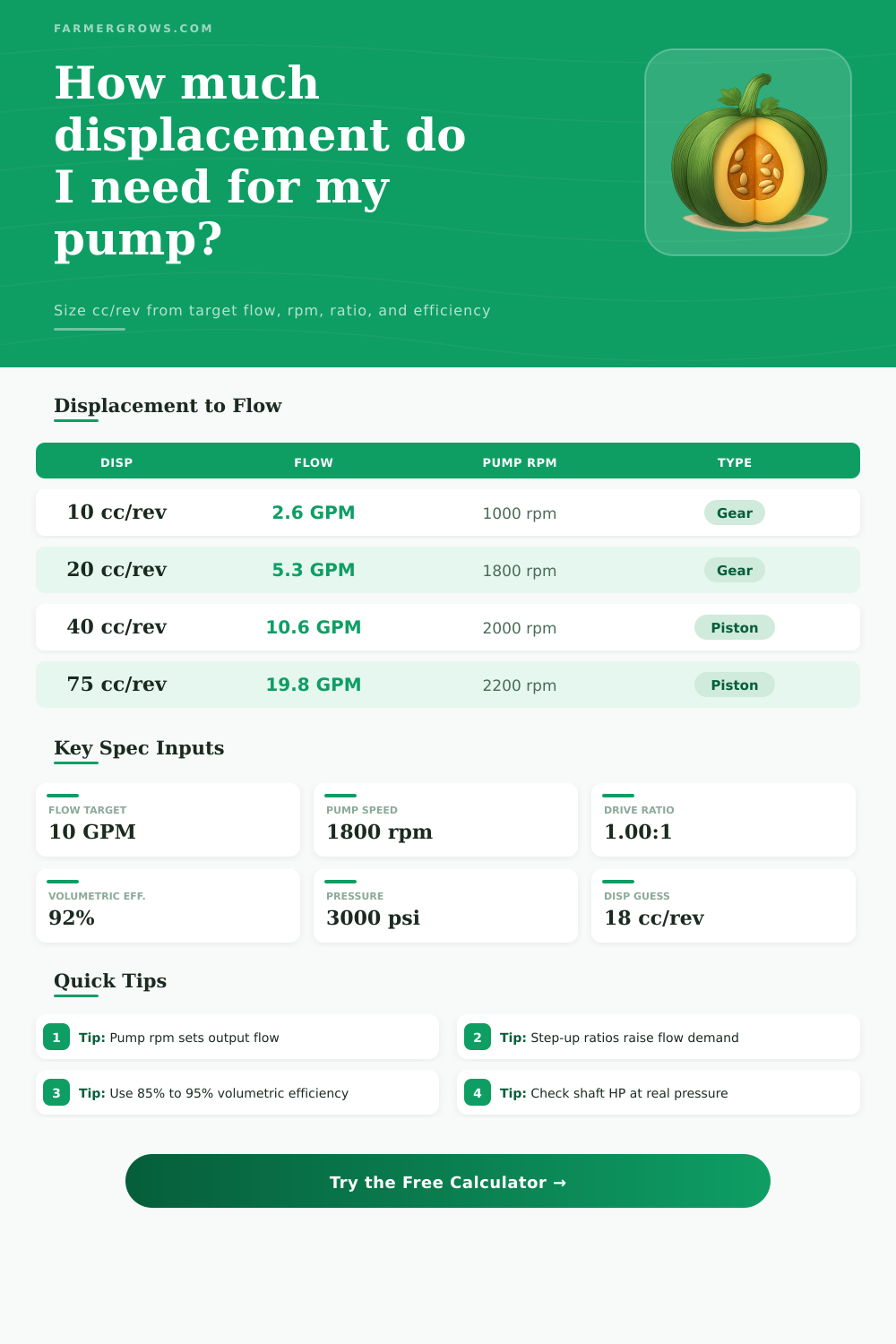
| Displacement | @ 1000 rpm | @ 1800 rpm | @ 2500 rpm |
|---|---|---|---|
| 5 cc/rev | 1.3 GPM | 2.4 GPM | 3.3 GPM |
| 10 cc/rev | 2.6 GPM | 4.8 GPM | 6.6 GPM |
| 20 cc/rev | 5.3 GPM | 9.5 GPM | 13.2 GPM |
| 40 cc/rev | 10.6 GPM | 19.0 GPM | 26.4 GPM |
| Ratio | Pump rpm | 20 cc/rev flow | Note |
|---|---|---|---|
| 0.75:1 | 1350 | 6.4 GPM | Underdrive |
| 1.00:1 | 1800 | 8.6 GPM | Direct |
| 1.25:1 | 2250 | 10.7 GPM | Step-up |
| 1.50:1 | 2700 | 12.9 GPM | Faster |
| VE | Flow | Loss vs 100% | Use case |
|---|---|---|---|
| 100% | 9.5 GPM | 0% | Ideal |
| 95% | 9.0 GPM | -5% | Fresh pump |
| 90% | 8.6 GPM | -10% | Normal |
| 85% | 8.1 GPM | -15% | Warm/worn |
| Flow | 1500 PSI | 2500 PSI | 3000 PSI |
|---|---|---|---|
| 5 GPM | 4.4 HP | 7.3 HP | 8.8 HP |
| 10 GPM | 8.8 HP | 14.6 HP | 17.5 HP |
| 20 GPM | 17.5 HP | 29.2 HP | 35.1 HP |
| 30 GPM | 26.3 HP | 43.8 HP | 52.4 HP |
Hydraulic pump displacement is the measurement of amounts of fluid that a hydraulic pump will move during one single revolution of the hydraulic pump. The unit of measurement for displacement is cc/rev (cubic centimeters per revolution). If a hydraulic pump has a displacement of 20 cc/rev, then that hydraulic pump will move a specific amount of fluid when it completes one revolution.
If the displacement of the hydraulic pump is increase to 40 cc/rev, then the hydraulic pump will move twice as much fluid as compared to the pump with the 20 cc/rev displacement. Because higher displacement ratings causes the hydraulic pump to move more fluid, the engine will require more torque to be provided to the pump by the engine. Thus, the selection of the displacement for a hydraulic pump is a balance between providing enough flow for the hydraulic system components, while not over-specifying the pump so as to waste engine power.
How to Size a Hydraulic Pump
Hydraulic pump flow is directly related to the displacement and the engine speed of the engine that is driving the hydraulic pump. Flow can be calculated by the following equation: Flow = Displacement × RPM. However, because of slippage within the hydraulic pump, the actual flow will be less than the flow calculated by this equation.
Additionally, hydraulic pumps often are connect to engines with a drive ratio. A direct drive ratio between the engine crankshaft and the hydraulic pump shaft will have a ratio of 1:1. If a step-up drive ratio is used (such as 1.25:1), then the hydraulic pump will rotate at a faster rate than the engine crankshaft.
Because flow is a function of the rotational speed of the hydraulic pump, using such a drive ratio will increase the flow produced by the hydraulic pump without having to increasing the displacement of the hydraulic pump. However, higher flow rates will create more heat within the hydraulic system, which could lead to increased wear of the hydraulic pump components. Efficiency is an important factor for hydraulic pumps.
The efficiency of the hydraulic pump can be expressed as volumetric and mechanical efficiency. Volumetric efficiency accounts for internal leakage within the hydraulic pump. Because hydraulic pumps lose some of their volumetric efficiency due to internal leakage, the displacement of the hydraulic pump should be selected to be larger than what is required to provide the desired flow.
For example, if the system require a flow rate of 100 cc/min, the displacement of the hydraulic pump may have to be 5 to 15 percent larger to compensate for internal leakage within the hydraulic pump. Mechanical efficiency accounts for friction within the hydraulic pump components. Because of mechanical inefficiencies, the power that is provided to the shaft of the hydraulic pump will be greater than the hydraulic power created by the hydraulic pump.
There are different types of hydraulic pumps, and different types of hydraulic pumps can have different efficiency ratings. For example, gear pumps are a common type of hydraulic pump due to their low cost and reliability, but their volumetric efficiency is relatively low (between 85 and 92 percent). Vane pumps are often used for medium duty applications, and have higher volumetric efficiencies than gear pumps (between 88 and 94 percent).
Axial piston pumps can provide high levels of volumetric efficiency (between 92 and 97 percent), as well as can handle higher revolutions per minute than other types of pumps. Each type of pump has its uses, and if not selected properly for the system requirements, the hydraulic pump may not perform in accordance with the requirement of that system. In order to properly size the hydraulic pump for a hydraulic system, there are a few factor that must be considered.
First is the target flow that is required of the hydraulic system; this flow will be measured in gallons per minute. The second factor is the hydraulic system pressure. Hydraulic horsepower can be calculated using flow and system pressure.
Additionally, the target hydraulic pump speed can be calculated by dividing the engine rpm by the drive ratio of the engine to the hydraulic pump. Using these values, the displacement of the hydraulic pump can be calculated. Additionally, efficiency factors should also be considered; if the calculated flow by the hydraulic pump is higher than the target flow for the hydraulic system, then the system will have a positive flow margin.
A positive flow margin is useful in allowing the hydraulic fluid to expand in temperature; if the flow calculated by the hydraulic pump is less than the target flow of the hydraulic system, the system will have a negative flow margin, which may lead to stalling of the hydraulic system. In addition to the factors that must be considered when sizing a hydraulic pump, there are also some mistake that should be avoided when sizing the hydraulic pump for a hydraulic system. One such mistake would be to assume 100% efficiency of the hydraulic pump; due to internal leakage, a hydraulic pump will always have less flow out of the pump than the flow that is provided to the hydraulic pump.
Another mistake is to not account for the fact that the fluid in a hydraulic system becomes less viscous with increased heat; if hydraulic oil becomes thin, it will lead to increased internal leakage of the hydraulic pump, which will reduce its volumetric efficiency. High drive ratios to the hydraulic pump will cause the hydraulic pump to reach high rpm rates, which can damage the bearing and seals within the hydraulic pump. Finally, any calculations of hydraulic pump sizing should also be compared to power tables for the engine to ensure that the engine will have enough shaft horsepower to turn the hydraulic pump at the required rates.
By avoiding these mistakes, and by properly sizing the hydraulic pump, the hydraulic system will function accordingly.