Aquaponics Pump Size Calculator
Size circulation for fish tanks, grow beds, and sumps with turnover targets, head loss, fitting allowances, and a pump curve-friendly safety margin.
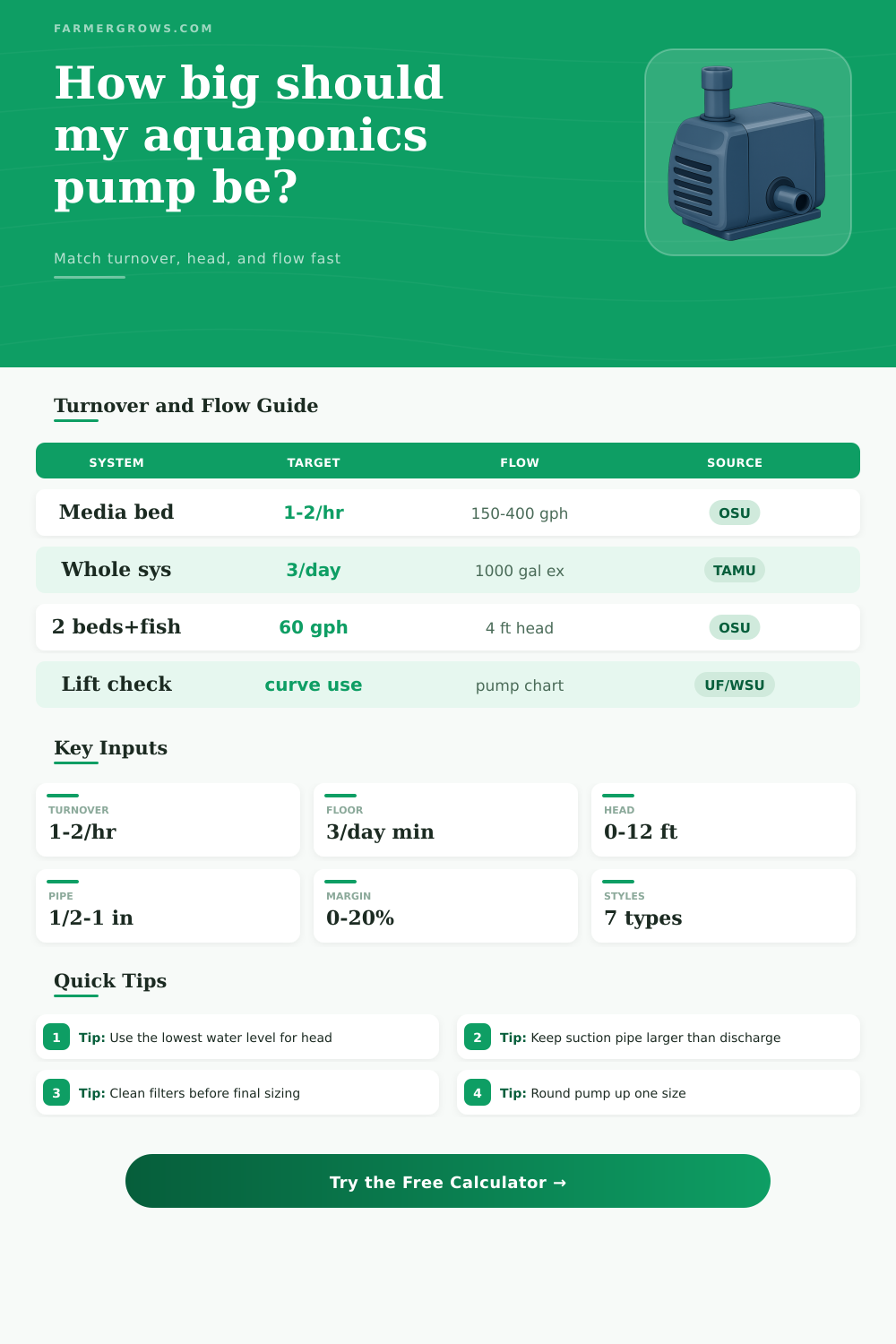
The calculator uses the greater of the fish-tank turnover target and a three-times-per-day whole-system minimum, then adds head and friction losses from the plumbing route.
Pump Sizing Results
These results combine flow demand, turnover guidance, and total dynamic head so you can choose a pump curve that actually fits the loop.
| Turnover rule | Target | Example flow | Source |
|---|---|---|---|
| Media bed loop | 1-2 times/hr | Fast cycling for beds | Oklahoma State |
| Whole system floor | 3 times/day | Minimum circulation floor | Texas A&M |
| Two 10-gal beds | About 20 gph | Bed fill once each hour | Oklahoma State |
| 1,000-gal loop | 300 gph @ 3 ft | 7.3 turnovers/day | Texas A&M |
The turnover rules above come from university extension guidance. The calculator uses the larger of the flow targets so the final pump choice is conservative enough for real plumbing.
| Head item | Count it? | Why it matters | Source |
|---|---|---|---|
| Static lift | Yes | Vertical rise to the outlet | WSU / NDSU |
| Pipe friction | Yes | Loss in straight pipe length | NDSU / UF |
| Elbows and tees | Yes | Fittings add real resistance | UF / NDSU |
| Filters and valves | Yes | Can dominate the final head | UF / WSU |
Head loss is the sum of elevation change and friction loss. Aquaculture and irrigation references both stress that fittings, filters, and pipe speed must be included.
| Pipe size | 100 gph | 300 gph | 500 gph |
|---|---|---|---|
| 1/2 in | 3.20 ft | 24.46 ft | 62.94 ft |
| 3/4 in | 0.44 ft | 3.40 ft | 8.74 ft |
| 1 in | 0.11 ft | 0.84 ft | 2.15 ft |
| 1.25 in | 0.04 ft | 0.28 ft | 0.73 ft |
These pipe-loss figures are calculated planning values for smooth pipe using Hazen-Williams C150 over 100 ft of run, so you can compare how quickly smaller pipe loses head.
| Example loop | Volume | Head | Flow clue |
|---|---|---|---|
| Small backyard | 190 gal | 4-5 ft | 350-450 gph |
| Raft greenhouse | 650 gal | 5-7 ft | 900-1,300 gph |
| Hybrid production | 1,200 gal | 6-9 ft | 1,500-2,300 gph |
| Long pipe run | 1,000 gal | 8-11 ft | 1,400-2,000 gph |
Use these example loops as starting points only. The actual pump curve matters more than the name on the motor, especially once head loss starts climbing.
Best when the selected pump runs near the middle of its curve.
Good for quiet systems with steady flow.
Useful when the route has extra elbows or a dirty filter.
Adds reserve without forcing the pump to max out.
Great for seasonal tuning, night flow, and future expansion.
Lets you trim flow while keeping headroom.
Strong choice when fish survival depends on circulation.
One pump can carry the system if the other stops.
When you are selecting an aquaponics pump, you must understand how to calculate the correctly size for your system. Many people looks at the flow rates that are printed on the pump boxes to determine the flow of there system, but the flow rate printed on the box is typicaly a theoretical maximum flow rate of the pump. The actual flow of water that will move through the system due to a effects of gravity and friction will be less than the maximum flow rate indicated by the manufacturer.
If you select a pump that is too small to handle the demands of your system, then the water wont effectively move through the system, and you risk the life of your fish or the health of your plant. The turnover rate is a measurement of how much water move through your system in a given period of time. Fish require constant water movement to provide them with the fresh oxygen that they requires to survive and to remove the waste that they produce.
How to Choose the Right Pump for Your Aquaponics System
Plants require a steady supply of nutrient rich water to perform well in the aquaponics system. The turnover rate of most aquaponics systems are set to allow the tank to cycle its total volume once or twice every hour. Maintaining a consistent turnover rate in the system will allow the water chemistry to remain consistent and will prevent the growth of toxic zone in which the water chemistry can become unfavorable for the life in the system.
The type of aquaponics system that you create will dictate the type of water flow that you require for that system. For instance, media bed systems require the use of a flood and drain cycle for the media to effectively perform its biological functions. Your flow rate should be sufficient to flood the media bed in a reasonable time period, but you must ensure that too much flow will overwhelm the plumbing system.
For raft systems, a constant and gentle flow of water is required in order to ensure that the plant roots remains in contact with the oxygenated water in which they must remain for adequate growth. For NFT systems, you must maintain the flow of water through the system at a precise velocity so that the water do not stagnate within the NFT channels. The total dynamic head of the system is the total amount of resistance that the pump must overcome to move the water from the lowest point to the highest point in the system.
Total dynamic head is comprised of vertical lift and friction loss. Vertical lift is the height that the water must be moved from the lowest point (such as the sump) to the highest point in the system (such as the grow beds). The friction loss in the system is the resistance to the movement of water caused by every elbow, tee, and valve in the plumbing system.
Any turns in the plumbing system will increase the friction loss in the system. As a result, the total flow rate of the pump will decrease. The diameter of the pipe in which the water will travel through the system will have an effect upon the friction loss within the system.
Friction loss will significantly increase in pipes of smaller diameter. Thus, if the total dynamic head of your system is too high, you should increase the size of the pipe rather than increasing the size of the pump. Moving water through a wider pipe is more efficient than moving water through a narrow pipe.
Additionally, moving water through a wider pipe will place less strain upon the pump motor. The resistance of the filters that is installed into the system will also contribute to the total dynamic head of the system. The water will have to push through a swirl filter, a radial flow settler, or a biofilter.
Friction loss results from the water pushing through the filters. This friction will drop the actual flow rate of the pump. For instance, the pump may be rated at 500 gallons per hour, but the resistance created by the filters may reduce the actual flow rate of the system to 200 gallons per hour.
Finally, you should include a safety margin in the determination of the size and flow rate of the pump. Over time, the pump will lose efficiency. The efficiency of the pump will decrease again if the filters becomes clogged with waste from the fish.
Thus, the pump should be able to meet the requirements of the system while operating at a flow rate that is below the maximum flow rate of the pump. Additionally, its a good idea to include a backup pump for the system. Should the primary pump fail, the oxygen levels in the system will drop, and the plants will begin to wilt if the water movement stop.
A backup pump will provide a safety net for the system in case of the failure of the primary pump.