Green Onion Growth Time Calculator
Estimate rooting time, cut-and-come-again regrowth, harvest windows, and bunch yield for scallion rows, trays, hydro setups, and grocery-root regrows.
Use this for green onions harvested as slender bunching scallions. It focuses on leaf and shank harvest timing, not bulb sizing, storage onions, or seed-to-bulb schedules.
Green Onion Growth Estimate
Timing is adjusted for start method, scallion type, root-zone temperature, light, fertility, and cut height.
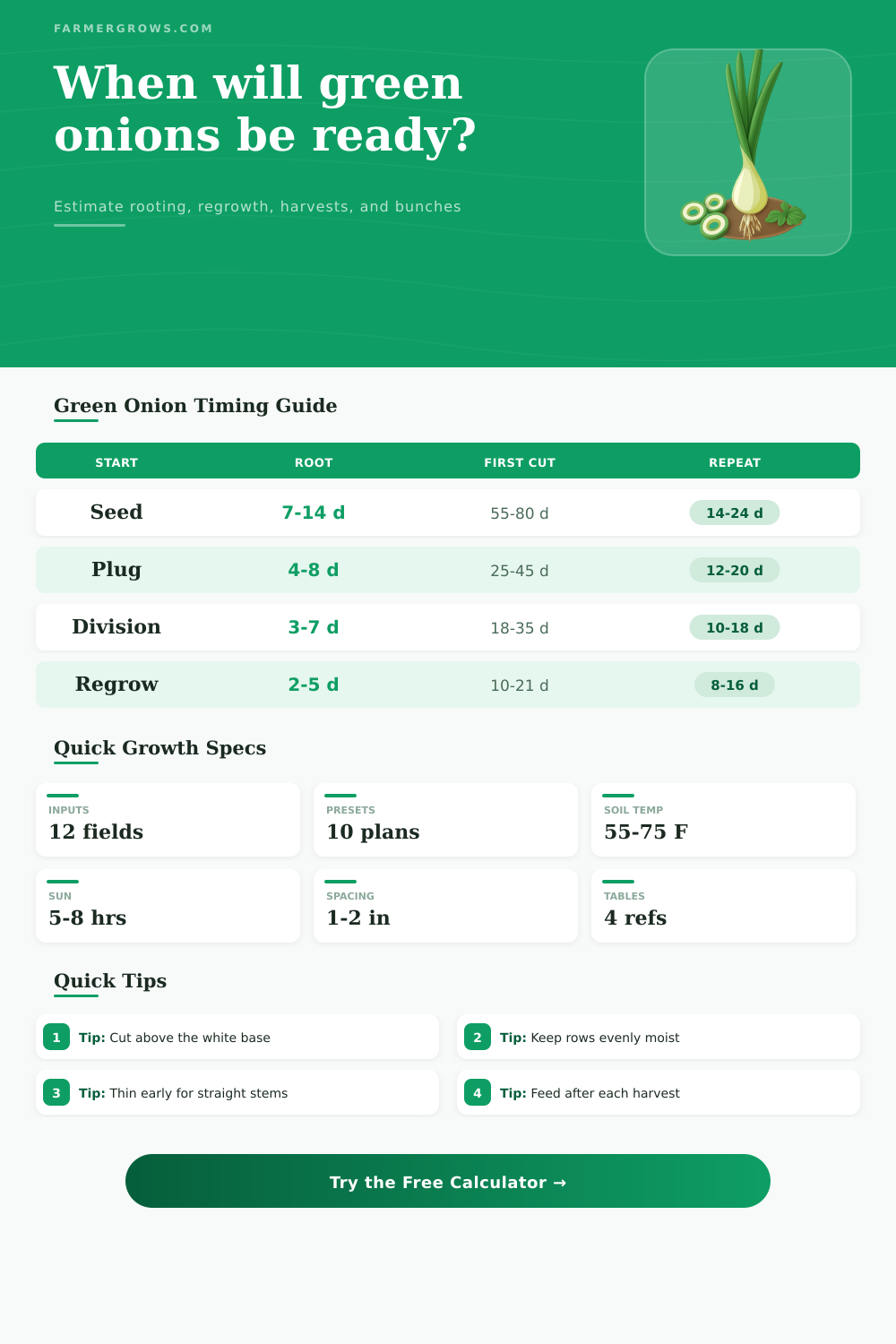
| Start method | Rooting or emergence | First scallion cut | Best use |
|---|---|---|---|
| Direct seed | 7 to 14 days for emergence in warm soil | 55 to 80 days | Full rows, trays, and succession sowing |
| Plug transplant | 4 to 8 days to resume strong growth | 25 to 45 days | Uniform bunching and faster field turns |
| Clump division | 3 to 7 days for fresh feeder roots | 18 to 35 days | Perennial bunching patches and split clumps |
| Grocery-root regrow | 2 to 5 days if roots are alive | 10 to 21 days | Kitchen windowsills, jars, and small pots |
| Hydroponic start | 3 to 6 days in oxygenated solution | 18 to 32 days | Rafts, channels, and indoor bunching crops |
| Root-zone range | Growth effect | Calculator factor | Notes |
|---|---|---|---|
| Below 50°F / 10°C | Very slow rooting and leaf push | 1.45x to 1.70x | Use cover or wait for warmer beds |
| 50 to 59°F / 10 to 15°C | Slow but workable | 1.18x to 1.45x | Good for hardy types, slower regrowth |
| 60 to 72°F / 16 to 22°C | Preferred scallion growth | 0.92x to 1.08x | Best balance of leaf growth and quality |
| 73 to 82°F / 23 to 28°C | Fast with enough water | 0.88x to 1.00x | Watch moisture and leaf tip stress |
| Above 82°F / 28°C | Stress can slow usable growth | 1.08x to 1.30x | Shade and steady water help quality |
| In-row spacing | Plants per 10 ft row | Likely stem size | Bunching note |
|---|---|---|---|
| 0.75 in / 1.9 cm | 160 plants | Very thin | Baby scallions and tray production |
| 1.0 in / 2.5 cm | 120 plants | Thin to standard | High bunch count with frequent cutting |
| 1.5 in / 3.8 cm | 80 plants | Standard | Balanced home and market spacing |
| 2.0 in / 5.1 cm | 60 plants | Thicker shank | Better airflow and stronger stems |
| 3.0 in / 7.6 cm | 40 plants | Large scallion | Useful for long-shank types |
| Stubble left | Regrowth speed | Quality effect | Calculator use |
|---|---|---|---|
| Under 1 in / 2.5 cm | Slow or uneven | Higher plant loss risk | Adds time to the next cut |
| 1 to 1.5 in / 2.5 to 3.8 cm | Fast | Good white base retention | Default cut-and-regrow setting |
| 2 in / 5.1 cm | Fastest | More green left below cut | Shortens repeat harvest interval |
| Whole-pull harvest | No regrowth | Cleanest bunch roots | Set planned cut cycles to zero |
| Hydro trim | Very fast with light | Needs nutrient balance | Works best at 6 or more light hours |
For faster repeat cuts: leave a living white base, water immediately after cutting, and feed lightly once new leaf tips are visible.
For straighter bunches: keep spacing consistent, thin crowded seedlings early, and count bunch yield from usable stems rather than seeded spots.
Green onions are your favorite fast food: On demand, whenever hunger strikes. I chop the tops of scallions from grocery and put roots in a saucer of water on the window. After three days they’re looking lively again. After a week? Maybe you’ll get one more meal from them. It is fine if you just want a garnish. If you are hoping to market or feed a family this way, it will not work.
The trick is to understand that what you have is an engine; a plant. To make a reliable crop you must feeds that engine (fuel), give it room (space) and allow it to recover its energy (time). After you input how much space (inches) you leave between rows, how long the rows are, and what environment they’re in, the calculator figure out the rest. No more guessing if an extra inch of stubble will make a difference, or if leaving it can slash your regrowth time by half.
How to Grow Strong Green Onions
Most folks don’t know: Leaving an inch of white underneath; called the base, can halve the time it takes to regenerate. Why? Because there’s no need for the plant to waste energy growing new versions of its primary leaves. Cut too low to the soil surface and it’ll slow right down. This is a small thing, but it is important if you plan to get a few crops off the same bed.
Based off the state of the “energy bank” (whether you started from seed or plugs or whatever you had on hand at the grocery store), the calculator tweaks those countdown timers accordingly. If you want to start from seed to have the most control over stem thickness, you will have to wait the longest (fifty-five to eighty days until the first actual harvest). You will need to be patient, as it takes time for a plant to grow a full root system in cool spring soil if you plant the seeds directly. Starting with plugs bypasses the risky beginning, saving weeks on the calendar. That’s valuable when your focus span is less than that of a seedling determined to survive, or frost dates are tight.
Onions don’t grow the same way at sixty degrees as they do at eighty. Warmer temperatures mean faster cell division, but they can triggers bolting if days get too warm and long. Getting things growing fast has to compete with getting them good-looking; generally speaking, that equates to slow-growth for better-stemmed, crunchier scallions.
Most home gardeners don’t realize they’re losing yield to spacing. Yes, planting seedlings only a half-inch apart seems like good use of space. But they’ll be competing for light and nutrients. This creates a race for the prize: thin stems that eventualy break off instead of bending over. Spacing them farther apart, by two or more inches… Results in fewer plants overall, but each is stronger and grows faster. Your final bunch count depends directly on density (the numbers on the page’s reference table reflect this). Want thick, market-grade scallions? Go wide. Got salad greens in mind? Crowd ’em closer (and cut back sooner for baby green onions). There is no such thing as right spacing. It is a tradeoff between producing many weak plant or fewer strong ones, and you decide based on your kitchen needs.
Moisture and fertility are critical factors in any regrowth cycle. Remember that green onions are hungry plants, particularly for nitrogen; they’ll benefit from a light fertilization each time around after you cut them back, to encourage another flush of growth. Unless you top up the area surrounding the stubbles with some food, that second crop won’t be as good as initial one. And there may well be no third.
Because regrowth halts abruptly if the soil is dry, the calculator presumes regular watering. That means frequent watering (more often than suggested by the standard model) if your weather is dry or the soil in those beds happens to be sandy. Not so much to keep the foliage firm, but so the roots can takes up whatever food you provide.
There’s another slight but critical factor: how long they are exposed to light. Green onions require exposure to direct sun to develop structure (and flavor). They’ll do okay with six hours daily; eight hours yields those sturdy stems that we all know to love. Any less and you’ll get the weak, watery-stemmed type that won’t hold up in a dish and don’t have any flavor, either. The tool takes that into account, too… When you tell it how many hours of sun you have, it tweaks the growth factors accordingly. It says: Yes, technique is key. But so is where you put them. Even if you baby the roots, a south-facing windowsill or even an open garden spot will always beat a shady nook.
So yes: To grow green onions successfully means to learn, and ultimately manage, expectations about when to expect results, and when to look for the resource renewal process again. No matter how hungry we might be for garnish, there’s no getting around rushing biology. Knowing the interaction between cut height, temperature, and spacing makes it all a predictable system as opposed to a casual experiment. When you give the roots what they need, rather than only demand more from them, they’ll know and respond accordingly. What’s below, the white base left in the soil or the jar, isn’t waste; it’s the engine for everything that comes after.