Aquaponics System Calculator
Balance tank volume, fish biomass, daily feed, grow bed media, filtration ratio, pump turnover, and plant capacity from one practical aquaponics plan.
Choose a real-style layout to seed the calculator, then adjust the tank, fish, feed, bed, and pump assumptions for your own build.
System Sizing Results
These cards recalculate from the same tank volume so you can compare conservative, balanced, intensive, and plant-heavy operating styles.
| Planning level | Fish biomass guide | Best use | System caution |
|---|---|---|---|
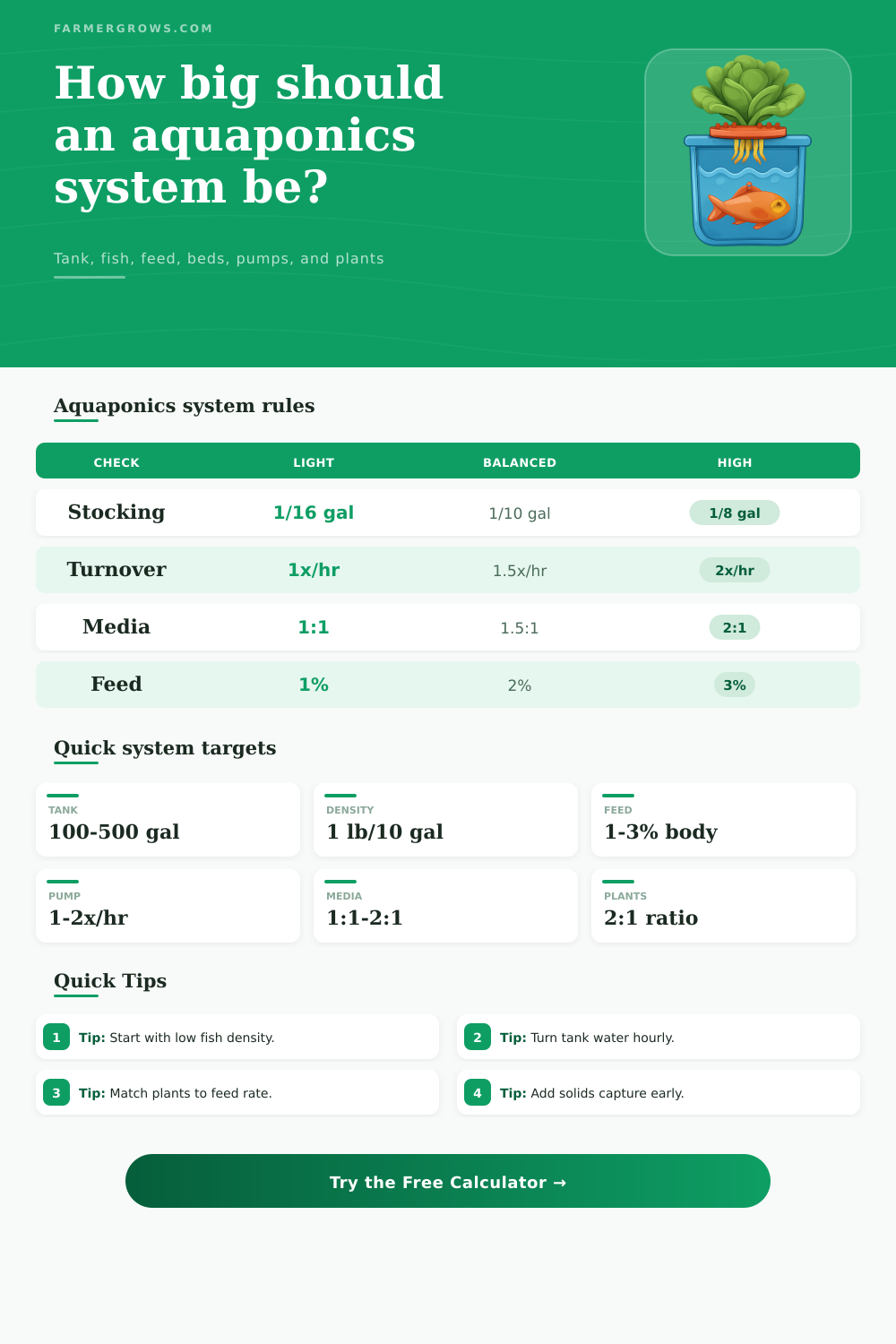
| Starter or cycling | 1 lb per 16 gal | New media, new keeper, small tanks | Leaves room for learning and test swings |
| Moderate | 1 lb per 12 gal | Home food systems with regular testing | Needs dependable aeration |
| Balanced | 1 lb per 10 gal | Established backyard aquaponics | Good solids removal matters |
| Intensive | 1 lb per 8 gal | Mature systems with extra filtration | Use backup air and careful feeding |
| Planting style | Feed-rate ratio | Spacing estimate | Use in calculator |
|---|---|---|---|
| Leafy greens and herbs | 60 g per m2 per day | 3.0 plants per sq ft | Best for lettuce, basil, Asian greens |
| Mixed crops | 80 g per m2 per day | 2.0 plants per sq ft | Balances greens and compact fruiting plants |
| Fruiting crops | 100 g per m2 per day | 1.0 plant per sq ft | Use for tomatoes, peppers, cucumbers |
| Raft lettuce | 70 g per m2 per day | 4.0 plants per sq ft | Dense raft boards with steady nutrients |
| Bed ratio | Media volume for 100 gal tank | Water held at 40% | Best fit |
|---|---|---|---|
| 0.75:1 | 10.0 cu ft media | 30 gal flood volume | Light fish load with separate filter |
| 1:1 | 13.4 cu ft media | 40 gal flood volume | Simple media-bed aquaponics |
| 1.5:1 | 20.1 cu ft media | 60 gal flood volume | More roots and nitrification margin |
| 2:1 | 26.7 cu ft media | 80 gal flood volume | Plant-heavy layouts with sump space |
| Tank size | 1x hourly turnover | 1.5x hourly turnover | With 25% pump allowance |
|---|---|---|---|
| 100 gal | 100 gph | 150 gph | 125-188 gph pump rating |
| 250 gal | 250 gph | 375 gph | 313-469 gph pump rating |
| 500 gal | 500 gph | 750 gph | 625-938 gph pump rating |
| 1,000 gal | 1,000 gph | 1,500 gph | 1,250-1,875 gph pump rating |
An aquaponics system is a single organism. An aquaponics system consists of a fish tank and plant grow beds. These two components is often considered to be separate components of an aquaponics system, but they are actualy connecting to one another through the cycle of nutrients that exists between the fish, the water, and the plants.
If there are too many fish in the tank, there will be too much waste from those fish, the waste creates ammonia fumes that the plants cant process. If there are too many plants, however, with not enough fish to provide enough nitrogen to those plants, the plants will suffer from a lack of nutrient. Because the fish and plants are connected to one another, the amount of each species must be balanced within the system.
How to Balance Fish and Plants in an Aquaponics System
The number of fish that live within the tank determine both how much water the tank should hold, and how much food the grower should provide to those fish. If too much food is added to the tank, the fish will eat the food, but there will be some remaining food that will turn into ammonia. Too much ammonia is bad for the fish.
To avoid this situation, biofiltration media is used to convert the ammonia to nutrients for the plants. If there is not enough biofiltration media in the tank, however, the ammonia will build up to the point of poisoning the fish. To avoid this situation, a calculator can be used to ensure that the volume of the fish tank, the number of fish within it, and the amount of biofiltration media are all within a balance relationship with one another.
The stocking density of an aquaponics system is the number of pounds of fish that live in each gallon of water within the tank. High stocking densities should of been avoided when starting an aquaponics system. If too many fish live in the tank, the system leaves room for error; should something happen to the water pumps that circulate the water in the tank, or if the water temperature within the tank change, all of the fish can die quick.
Using a low stocking density, however, provides a buffer for the system. A low stocking density permits the aquaponics system to be learned without the risk of the entire system crash. The feed rate within an aquaponics system is the amount of food that is provided to the fish.
The feed rate is the primary source of nutrients for the plants within the system. If more food is provided to the fish, they will grow, and the plants will grow as the plants receive more nutrients. However, feeding too much food to the fish, however, will create more waste to move through the system.
Each gram of food that the fish do not eat becomes waste that the systems bacteria and roots of the plants must break down. Therefore, the feed rate should be matched to the capacity of the plants within the system. The grow beds has two purposes within an aquaponics system.
One of the purposes of the grow beds is to act as the home for the plants. However, the grow beds also act as a biological filter for the water in which the fish live. If the grow beds are too small, the ammonia that the fish create will become harmful to the fish.
If, however, the grow beds are too large for the amount of fish in the tank, the plants may not recieve the nutrients necessary to survive. Furthermore, another consideration is the size of the water pumps that circulate the water through the system. The goal for most aquaponics systems is to move the entire volume of the fish tank through the system once or twice each hour.
However, the flow rate at which the water is pushed through the system will decrease with head loss. Head loss is the reduction of the flow of water from the fish tank to the grow beds when the water pump pushes the water uphill. Therefore, you should consider head loss within the construction and management of the aquaponics system.
The species of fish that are contained within the system may require different condition than other species of fish. For instance, tilapia require warm water to survive, but trout require cold water and high amounts of dissolved oxygen to survive. Similarly, the requirements of basil plants may differ from the nutrient requirements of tomato plants.
Therefore, plants may require different levels of nutrients than other plants within the system. Another consideration is the physical space requirement of the aquaponics system. For instance, the system must be constructed to permit the addition of water to the grow beds, the addition of chemicals to treat the water, the cleaning of the filters, and the access to the systems valves.
To manage an aquaponics system effective, the person who manages the system must frequently watch the fish, test the water, and adjust the feed rate to ensure the health of the fish and plants. Using tables that list the water, biological, feeding, and other requirements for each species of fish and plant can allow for the construction of an aquaponics system that is both stable and capable of handling the mistake that may occur during it’s operation.