Aquaponics Grow Bed Calculator
Estimate grow-bed area, media volume, water-holding capacity, fish tank sizing, and safe stocking load using published aquaponics rules.
Use a preset to seed the calculator. Each one sets shape, dimensions, depth, media type, fish ratio, and buffer for a common aquaponics layout.
Grow Bed Results
Current layout uses published aquaponics rule-of-thumb values for media depth, ratio, displacement, and safe stocking range.
Media density affects handling, stand load, and how much material you will move by hand. These are practical bulk weights for common aquaponics media.
| Rule | Published value | Why it matters | Source |
|---|---|---|---|
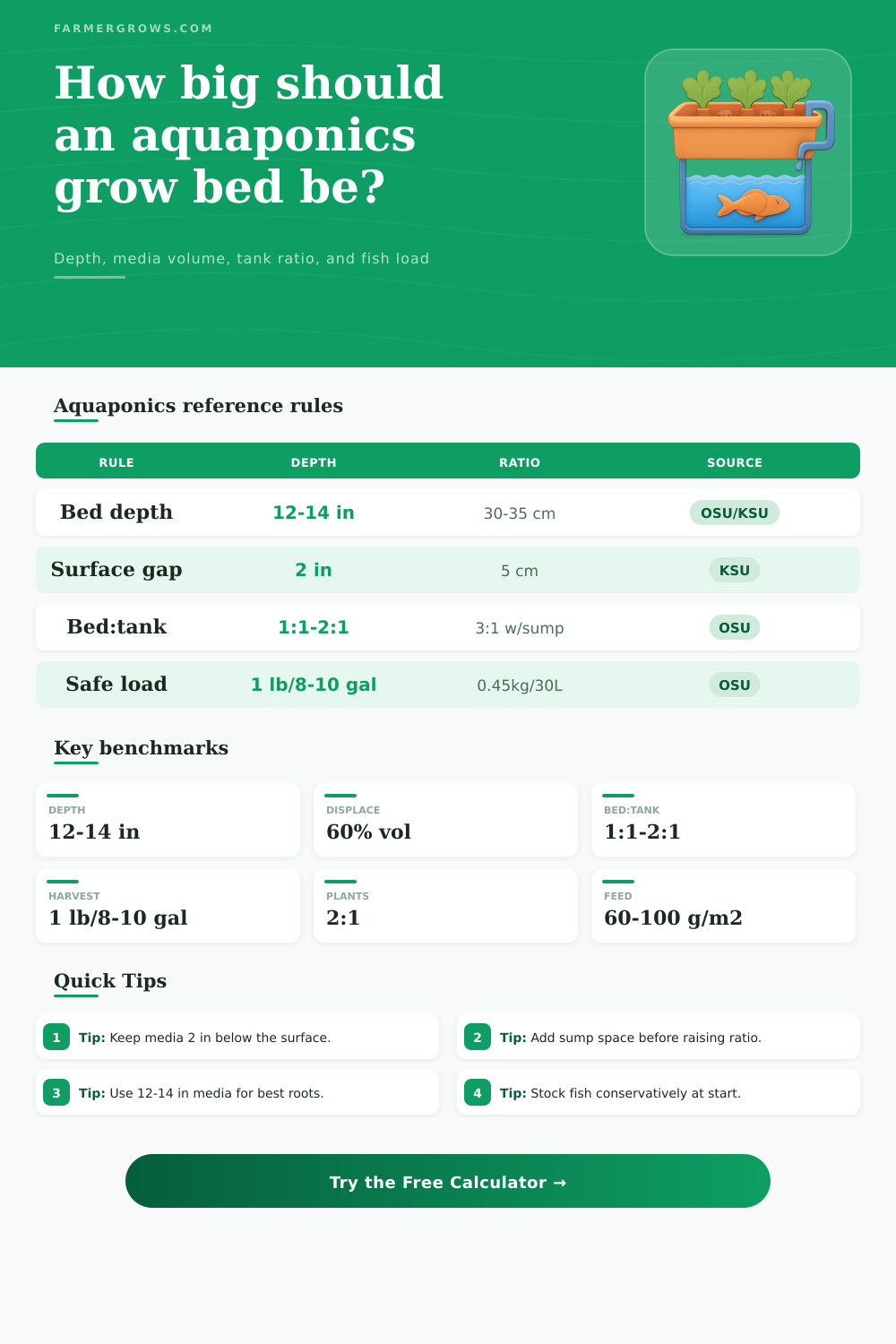
| Bed depth | 12-14 in | Supports roots and bacteria | OSU, KSU |
| Surface gap | 2 in below top | Helps stop algae on media | KSU |
| Water share | 40% water | Media displaces 60% | KSU |
| Simple ratio | 1:1 bed:tank | Lowest complexity | OSU |
| System style | Ratio | Use case | Source |
|---|---|---|---|
| Basic flood and drain | 1:1 | One bed, one tank | OSU |
| CHIFT PIST / CHOP | 2:1 or 3:1 | Sump adds flexibility | OSU, KSU |
| Gravel media design | 1 cu ft tank : 2 cu ft media | Reciprocating beds | OSU |
| Hybrid grow-out | 3:1 to 4:1 | More plant area buffer | OSU |
| Guide | Published range | Practical use | Source |
|---|---|---|---|
| Safe harvest load | 1 lb / 8-10 gal | Beginner-safe stocking | OSU |
| Plant to fish | 2:1 | One fish for two plants | OSU |
| Commercial ratio | 3:1 or 4:1 | Crop and feed dependent | OSU |
| Feed band | 60-100 g/m2/day | Raft and hybrid planning | OSU/UVI |
| Depth | Gross cover | Water held | Derived from |
|---|---|---|---|
| 12 in | 27 sq ft / yd3 | 10.8 sq ft / yd3 | 60% displacement |
| 14 in | 23.1 sq ft / yd3 | 9.2 sq ft / yd3 | 12-14 in rule |
| 18 in | 18 sq ft / yd3 | 7.2 sq ft / yd3 | Depth extension |
| 24 in | 13.5 sq ft / yd3 | 5.4 sq ft / yd3 | Deep custom fill |
When you design your aquaponics system, you must calculate the volume of water that will be in the fish tank and the grow beds. The water in the grow beds are taken from the fish tank. Thus, every gallon of water that flow from the fish tank into the grow beds is a gallon of water that is removed from the fish tank.
You must account for how many gallon of water flow from the fish tank into the grow beds to ensure that the fish tank doesnt empty completely. Aquaponics systems involves biology, and biological systems must have a balance between the volume of water in the system, the requirements of the plants, and the waste output from the fish. The depth of the grow media is important in your aquaponics system.
How to Plan Water, Grow Beds and Fish in Your Aquaponics System
The depth of the grow media have an effect on the plants and the bacteria that live in the system. You want to use a depth of approximately one foot for your grow beds. This depth allow the plants to properly anchor there roots into the media.
Too shallowly a depth for the grow media will cause the plants to struggle to anchor their roots. Additionally, if the depth is too deep into the grow media, it is possible for anaerobic zone to be created in the system. Anaerobic zones will cause the roots of the plants to develop root rot.
Therefore, ensuring that the depth of the grow media is the correct depth will allow for the system to properly function for the plants in the grow beds. Another factor to account for is the media displacement in your system. Media displacement is the amount of space that the grow media takes up in the grow beds.
Most grow media will displace 60% of the total volume of the grow beds. This means that 40% of the grow beds will be filled with water. It is important to calculate the media displacement in your system because the grow media take up some of the space for the water in the system.
Additionally, the media displacement for your grow beds will determine how many gallon of water your fish tank will lose each time the grow beds fill with water. Another factor to consider is the weight of the grow media. One of the lighter types of grow media is expanded clay.
Because expanded clay is light in weight, those who would like to place there aquaponics system on a balcony or a rooftop can easily move it. Another heavy grow media is river gravel. River gravel is heavy and take up alot of the weight of the system.
Additionally, river gravel is much less expensive than expanded clay. However, the weight of the river gravel can threaten the structural integrity of the stand that supports the aquaponics system. Therefore, individuals must decide what grow media to use.
It could be the lightweight expanded clay or the heavy river gravel. One of the calculation that must be performed is the ratio between the grow beds and the fish tank. One common ratio is a one-to-one ratio between the two.
However, using a sump tank can increase the area of the grow beds without increasing the water in the fish tank. Using a sump tank allow for the system to have increased stability in regard to the chemistry of the water. Slow changes to the chemistry of the water is better for the fish than rapidly changes to the chemistry of the water.
The number of fish in the system must be managed so that the plants can process the waste from the fish. If there are too many fish in the system, the fish will create an amount of ammonia that will be difficult for the plants to process. Additionally, if the system does not process the ammonia, the ammonia will be toxic to the fish.
To avoid this situation, a stocking guide should of one pound of fish for every ten gallon of water in the tank. Following such a stocking guide will ensure that there is a balance between the fish, the plants, and the water. The type of plant that you decide to grow will impact the amount of nutrients that is required of your aquaponics system.
Plants such as leafy greens requires less nutrients than plants such as tomatoes and peppers. If you decide to grow plants that contain high nutrient requirements, you will need to add more fish or add more fish feed to the system to provide the necesary amount of phosphorus and potassium to those plants. The different types of plants has different metabolic needs within the system.
Therefore, the amount of fish and the amount of fish feed that is added to the system will change according to the type of plant that are to be grown in the aquaponics system.