Hydraulic PSI to Ton Calculator
Convert pressure into extend and retract force with clear tonnage breakdowns
Hydraulic Force Results
| Pressure | Bore | Force | Short Tons |
|---|---|---|---|
| 1500 psi | 3 in | 10,603 lbf | 5.30 |
| 2000 psi | 3 in | 14,137 lbf | 7.07 |
| 2500 psi | 3 in | 17,671 lbf | 8.84 |
| 3000 psi | 3 in | 21,206 lbf | 10.60 |
| Bore | Area | At 3000 psi | Short Tons |
|---|---|---|---|
| 2.0 in | 3.142 in2 | 9,425 lbf | 4.71 |
| 2.5 in | 4.909 in2 | 14,726 lbf | 7.36 |
| 3.0 in | 7.069 in2 | 21,206 lbf | 10.60 |
| 4.0 in | 12.566 in2 | 37,699 lbf | 18.85 |
| Rod | Rod Area | Retract Area | At 3000 psi |
|---|---|---|---|
| 0.75 in | 0.442 in2 | 6.627 in2 | 9.94 tons |
| 1.00 in | 0.785 in2 | 6.283 in2 | 9.42 tons |
| 1.25 in | 1.227 in2 | 5.841 in2 | 8.76 tons |
| 1.50 in | 1.767 in2 | 5.301 in2 | 7.95 tons |
| Scenario | Bore / Rod | Pressure | Extend Tons |
|---|---|---|---|
| Shop press | 2.5 / 1.25 | 3000 psi | 7.36 |
| Log splitter | 4.0 / 2.0 | 2500 psi | 12.57 |
| Loader pair | 3.5 / 1.5 | 2800 psi | 13.09 |
| Forklift pair | 2.75 / 1.25 | 3000 psi | 8.95 |
In order to size a hydraulic cylinder apropiately, an understanding of the relationship of pressure, area, and force are required. Pressure alone isnt a factor in determining how much force a hydraulic cylinder will create. Force is equal to the pressure applied multiplied by an area of the cylinder bore.
If the bore size is too small, the cylinder will not be able to create enough forces to perform a required task. However, if the bore size is too large, the cylinder may require too much oils to fill the cylinder from the hydraulic pump. The bore size of the hydraulic cylinder is the diameter of the cylinder that is in contact with the pressure during the extension stroke of the cylinder.
How to Size a Hydraulic Cylinder
The pressure are applied to the full face of the piston within the cylinder, and the bore size of the cylinder will create a certain amount of force with a specific diameter at a given pressure. For instance, a 3-inch bore size at 3000 psi will create a certain amount of force in tons, and a bore size that is larger will create more ton of force at that same 3000 psi pressure. However, the amount of force created during the retraction stroke will be less than the extension stroke.
The reason for this is that the rod diameter will reduce the area within the cylinder that creates force during the retraction stroke. Therefore, you should of accounted for the diameter of the rod within the hydraulic cylinder sizing process. In addition to the diameter of the rod, there is also loss within the hydraulic system that must be accounted for.
There are losses within the hydraulic hoses due to friction, small amounts of fluid that may leak out at the seals of the hydraulic components, and the hydraulic pumps may not maintain the same pressure throughout the system. Therefore, 92% efficiency can be assumed within the system, and there must be a safety margin of at least 10% within the system to ensure the safety of the hydraulic system and its components. If the safety margin is not provided for the system, the hydraulic cylinder may fail due to heat or dirty oil within the system.
Additionally, longer hoses or smaller diameter hoses will create a line loss within the system; thus, a pump that register 3000 psi may not be able to deliver that same pressure to the hydraulic cylinder. The length of stroke that the hydraulic cylinder will travel is another factor that will determine the work that it can perform. While the length of stroke will not increase the amount of force that the hydraulic cylinder creates, the length of stroke does create a certain amount of total work that is performed by the cylinder.
The total work is calculated by multiplying the force in tons that the cylinder will create by the distance that the cylinder will travel in inches; the product of these two measurements will be the total ton-inches of work that the cylinder can perform. For instance, a hydraulic cylinder with a 12-inch stroke will perform twice as much work as a hydraulic cylinder with a 6-inch stroke, assuming that the hydraulic cylinders has the same force creating capability. There are some common mistake that should be avoided when sizing the components of a hydraulic cylinder.
For instance, oversizing the cylinder to gain more force will result in an increase in the time that the cylinder will take to perform its stroke. An undersize rod will save some weight for the machine to which the hydraulic cylinder is attached; however, it may lead to buckling of the rod under heavy compressive loads. Therefore, it is important to calculate the hydraulic force that will act on the cylinder for both extension and retraction stroke.
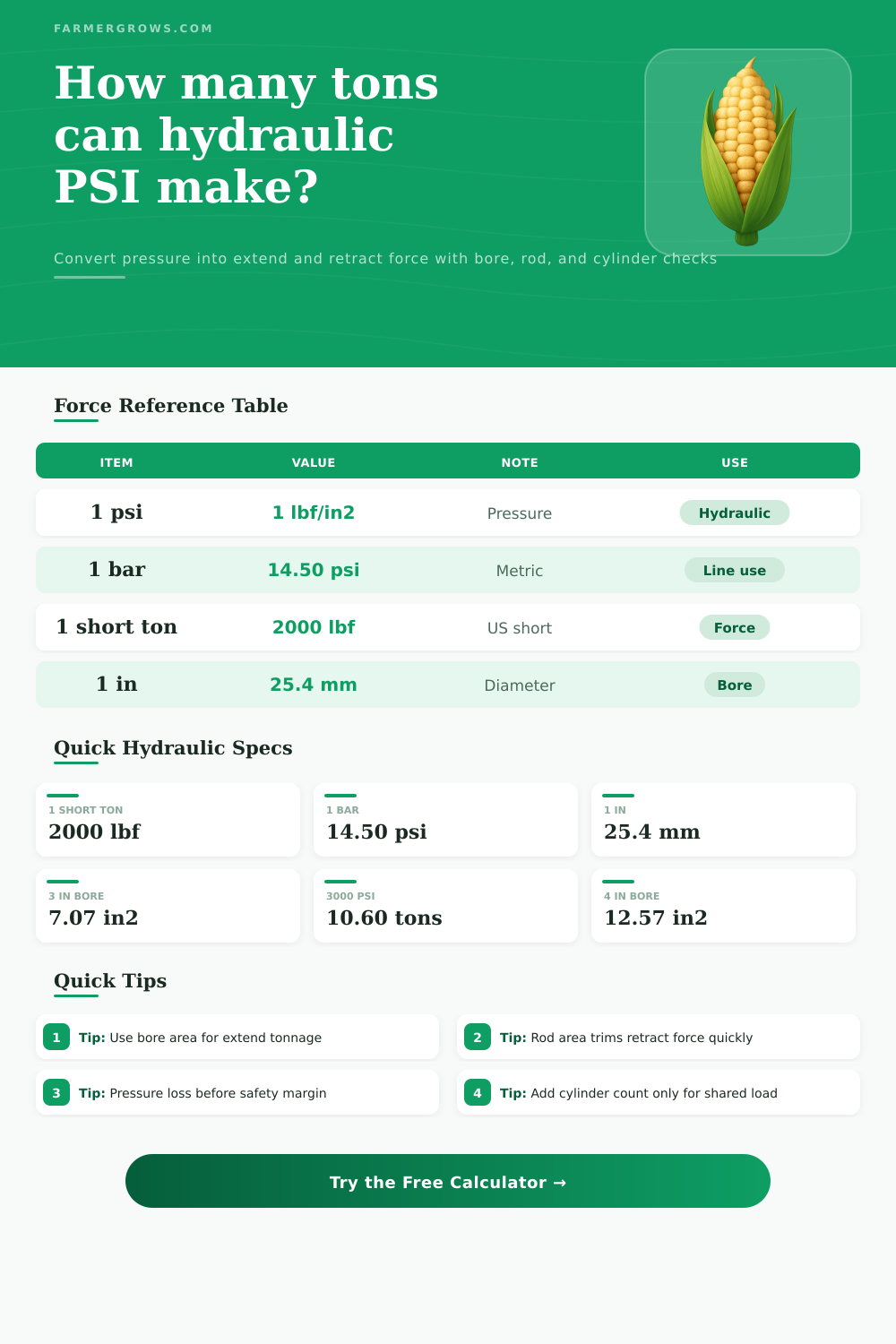
Finally, it is important to be aware that most machines will use imperial units for sizing the components of a hydraulic system; however, many other machines will use metric units. For example, instead of psi, the pressure may be in bar, and the length of the stroke may be in metric unit such as millimeters. One bar is equal to 14.5 psi.
These units must be accurately convert to ensure that the sizing of the hydraulic cylinder and the amount of force that it will create are within the necessary range. If the units are incorrectly converted, the area of the cylinder will be calculated incorrectly, leading to error in the force that the hydraulic cylinder creates (in tons).