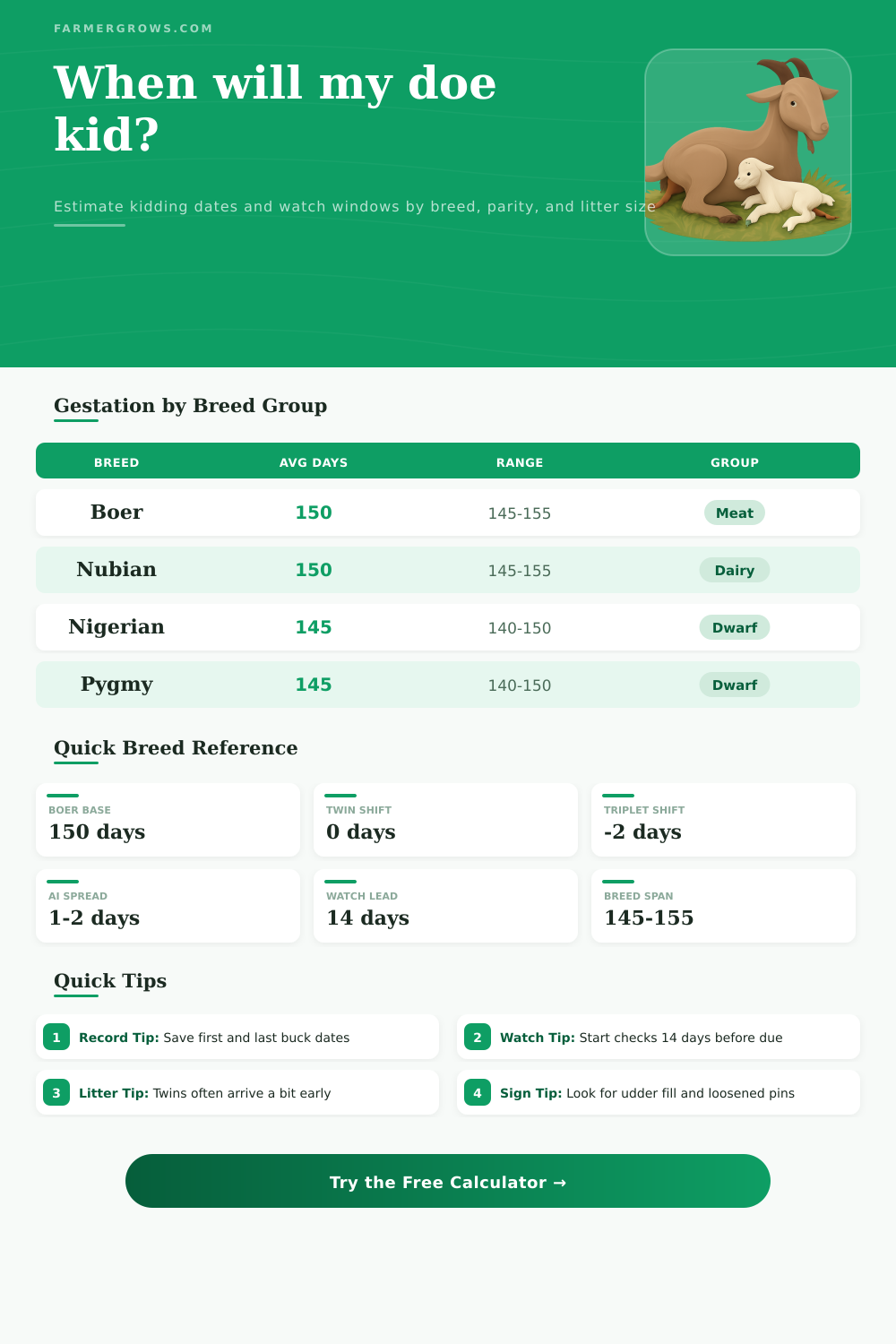
🐐 Goat Kidding Calculator
Estimate kidding dates, date windows, and breed-based watch timing
📊 Calculation Breakdown
| Breed | Avg Days | Range | Management Note |
|---|---|---|---|
| Boer | 150 | 145-155 | Meat line, watch for big kids |
| Nubian | 150 | 145-155 | Dairy line, strong milk focus |
| Alpine | 148 | 145-152 | Dairy line, steady timing |
| Saanen | 150 | 146-154 | Dairy line, keep records clean |
| Kiko | 152 | 147-156 | Hardy meat line, wider range |
| Nigerian Dwarf | 145 | 140-150 | Small frame, often early watch |
| Pygmy | 145 | 140-150 | Compact doe, prepare kidding pen |
| LaMancha | 149 | 145-153 | Dairy line, moderate range |
| Toggenburg | 149 | 145-153 | Dairy line, cool-weather hardiness |
| Oberhasli | 150 | 146-154 | Balanced dairy timing |
| Stage | Days | Focus | Clues |
|---|---|---|---|
| Early | 1-50 | Confirm breeding | Quiet, little change |
| Mid | 51-100 | Hold condition | Steady flank fill |
| Late | 101-140 | Plan kidding pen | Udder starts to build |
| Final | 141-term | Watch closely | Bagging, ligaments relax |
| Litter | Shift | Watch Lead | Note |
|---|---|---|---|
| Single | +1 day | 10-14 days | Often a cleaner window |
| Twins | 0 days | 12-14 days | Most common timing |
| Triplets | -2 days | 14-18 days | Check more often |
| Quads | -4 days | 18-21 days | Need extra pen prep |
| Method | Spread | Best Use | Note |
|---|---|---|---|
| Natural exposure | 3-5 days | Pasture breeding | Use a wider window |
| Hand breeding | 1-2 days | Recorded service | Good for tight records |
| AI or timed service | 1 day | Scheduled breeding | Best for exact tracking |
| Buck pen exposure | 4-7 days | Short breeding groups | Expect the widest spread |
Goat gestation are the length of time between when a goat becomes pregnant and when the kid is born. The gestation period for goats can vary based off many differents factors. While many people may believe that the gestation period for a goat lasts for five months, the gestation period for goats can last for more or less then five months.
Goat gestation is a flexible process, and the owner must prepare for the birth of the kids between an range of dates rather than a specific date. For example, the breed of the goat can have an impact on the length of the gestation period, as can the number of kids that the doe is to born from. The breed of the goat can have an impact upon the length of the gestation period.
How Long Is a Goat Pregnant and How to Prepare
For example, the gestation period for a Nigerian Dwarf goat may be shorter than the gestation period for a Boer goat. Therefore, the owner may have to begin to monitoring the health of the Nigerian Dwarf goat prior to the gestation period of the Boer goat. Additionally, another factor that may impact the length of the gestation period is the parity of the goat.
A goat that has not yet given birth to any kids may have a longer gestation period than a goat that has given birth to several kids prior to this pregnancy. Another factor that may impact the gestation period of a doe is the number of kids that the goat is to born from. If the doe is carrying triplets, for example, her gestation period may begin earlier in the year than if she were only carrying a single kid.
This is due to the fact that the kids take up more room within the doe’s body, and the body may begin to exhibit sign of kidding due to the physical space that the kids take up in the body of the doe. In this case, the owner would of have to use a calculator that accounts for the litter size to determine the birth date of the kids. Another factor that could impact the gestation period of the doe is the method in which the doe was bred.
If artificial insemination bred the doe, for example, the owner will have a precise date of when the doe became pregnant. However, if pasture breeding bred the doe, then the owner will only know the time period during which the doe became pregnant. During this time period, the doe could have become pregnant on several different days.
Therefore, the owner would have to prepare for a range of dates during which the doe may give birth to her kid. Beyond accounting for the factors described above, it is also important for the owner to monitor the physical signs of the doe in addition to calculating the length of the gestation period of the doe. For example, the owner can look for indications that the doe is beginning to give birth, such as when the udder of the doe becomes filled with milk, or the doe’s ligaments begin to relax.
These physical sign can indicate that the goat is within the time period of giving birth. In some does, these physical signs may manifest themselves several week prior to kidding the kids. In others, however, these physical signs may not emerge until the doe has begun to give birth to her kids.
Beyond the breed of the goat and the parity of the goat, another factor that could impact the gestation period is the nutritional health of the doe. If the goat is too thin or too heavy for a doe of its breed and age, the gestation period for that doe may not adhere to the average for gestation periods. This is due to the fact that the nutritional value of the doe will impact how the kids grow within her body.
Therefore, again, the owner should expect a flexible gestation period in comparison to a fixed gestation period of preparation for the kids to be born. Within any goat pregnancy, the purpose for calculating and monitoring the gestation period is to ensure that the doe is in a safe and clean environment when she gives birth to her kids. If the owner is to move the doe into a kidding pen, it is best to do so during the watch lead for the goat.
If the kidding pen is too early during the watch lead, it is possible for the kidding pen to become messy. However, if the owner moves the doe into the kidding pen after the watch lead, it is possible for the owner to struggle in finding the goat altogether. Using the data regarding the breed and parity of the goat will provide the owner with a baseline upon which to base the movement of the doe into the kidding pen.
However, it is also important for the owner to have a kidding kit ready well in advance of the date that the doe is to born the kids from. Its important to have everything ready so you dont have to rush. Making sure you have all the furnitures ready is also a good idea.
Youll want to recieve the kits comfortably. Don’t forget that the goats size might matter too.