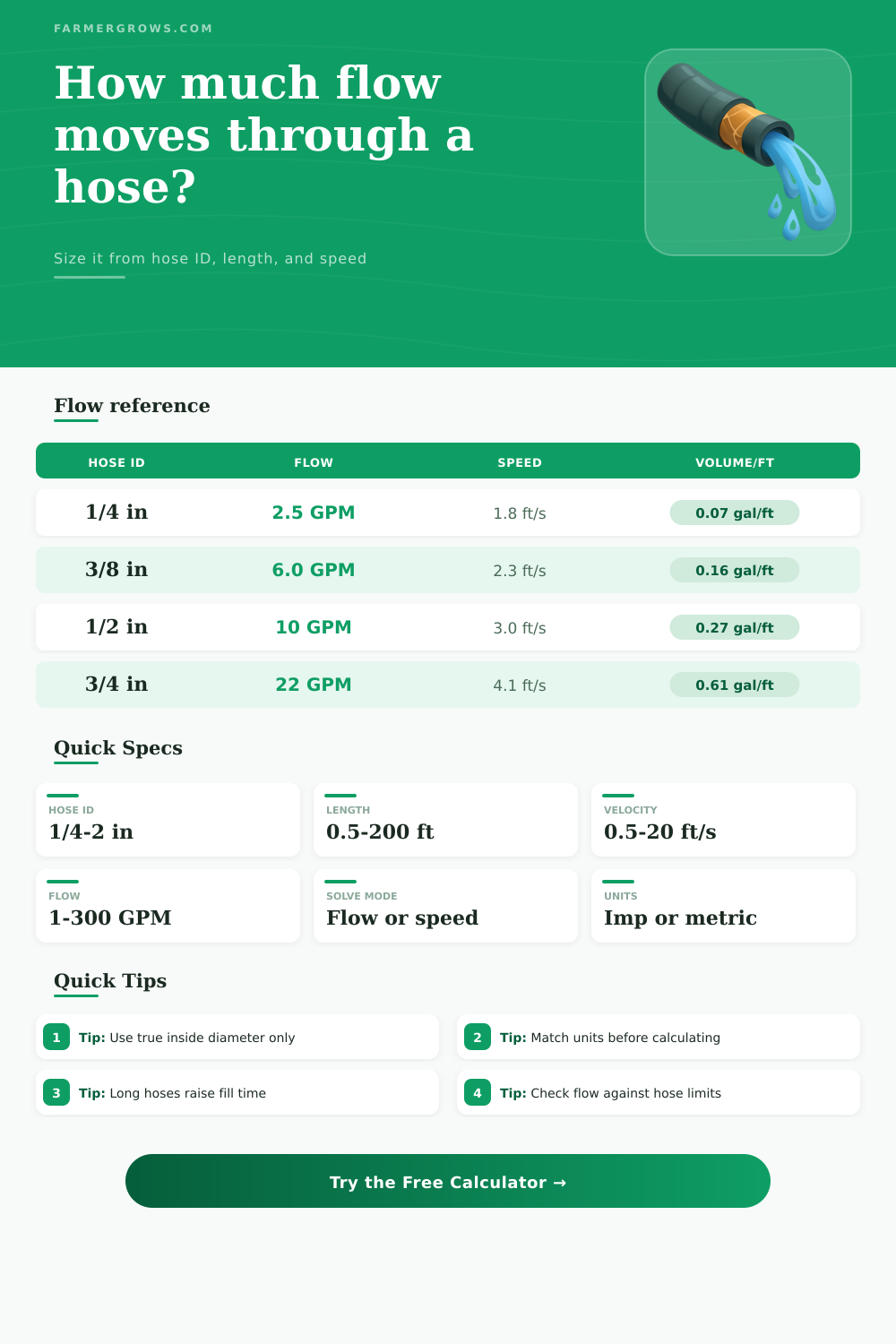
Hydraulic Hose Flow Rate Calculator
Estimate hose flow from diameter and speed, or solve velocity from a known flow rate.
| Hose ID | Area in2 | Flow at 5 ft/s | Volume per ft |
|---|---|---|---|
| 1/4 in | 0.049 | 1.5 GPM | 0.025 gal |
| 3/8 in | 0.110 | 3.5 GPM | 0.057 gal |
| 1/2 in | 0.196 | 6.4 GPM | 0.102 gal |
| 3/4 in | 0.441 | 14.3 GPM | 0.229 gal |
| Dash size | ID in | ID mm | Common use |
|---|---|---|---|
| -4 | 1/4 in | 6.35 | Return |
| -6 | 3/8 in | 9.53 | Pilot |
| -8 | 1/2 in | 12.70 | Work |
| -12 | 3/4 in | 19.05 | High flow |
| Hose ID | gal/ft | gal/10 ft | L/10 ft |
|---|---|---|---|
| 1/4 in | 0.025 | 0.25 | 0.95 |
| 3/8 in | 0.057 | 0.57 | 2.16 |
| 1/2 in | 0.102 | 1.02 | 3.86 |
| 3/4 in | 0.229 | 2.29 | 8.67 |
| Service | ft/s | m/s | Guidance |
|---|---|---|---|
| Suction | 2-4 | 0.6-1.2 | Keep low |
| Return | 4-8 | 1.2-2.4 | Runs cool |
| Pressure | 8-12 | 2.4-3.7 | Balanced |
| Test rig | 12-20 | 3.7-6.1 | Short runs |
Tip: Measure inside diameter, not the dash label, when exact flow matters.
Tip: Longer hoses do not change flow by themselves, but they do add volume and fill time.
Hydraulic hose flow rate is key so that hydraulic system operate effectively and safely. It estimates the amount of fluid that moves through the hose during a set time and affect the performance of the gear and its reaction. Imagine it as water that flows from a garden hose the flow rate shows how many gallons exit in a minute.
In hydraulics this matters because it decides where haste rolls extend, engines twist and other parts work.
Choose the Right Hydraulic Hose by Flow Rate
If you choose the wrong hose size for hydraulic system, unexpected damages can happen and the gear will become bad. Flow means the motion of fluid that divides in two kinds: flow rate and flow velocity. The size of the tube that bears the pressed fluid affect the flow rate and the pace.
Too high pace shortens the life of the tube. Ideally the oil in the tube should move betwen 3 until 6 metres in second.
For 10 gpm flow rate in 10 fps velocity advocates a 5/8-inch tube. Unless the hydraulic flow is only casual or intermittent, you should not surpass the advocated velocities. Truly the flow velocity is the main cause.
Pump of 22 gpm through half-inch lines moves oil in 35 until 36 feet in second. Then appear many problems of liquid dynamics, which causes that the pump loses power much more quickly than you expect.
The flow rate depend widely of the smallest diameter in the whole wetted system. According to the law of Poiseuille, if you preserve same hose radius, same fluid and same pressure difference across the tube, the volumetric flow rate are opposite proportional to the hose length. So if you do bad changes, as diminish the diameter or extend the tube, the flow and the outflow will diminish.
Calculator for hydraulic hose flow rate is a computer tool that helps to estimate the flow of fluid through a set hydraulic hose. It combines mathematical and physical principles, especially the tie between pressure, flow rate, hose dimensions and liquid viscosity. You enter the flow rate in liters in minute, choose the hose type, point the pace in the advised range and click for count.
Like this you escape too little or too big tubes, reduce energy loss and extend the life of hydraulic parts.
By means of linking flow rate, hose size and flow velocity, sizing chart helps to quickly find the right tube. Using it, you identify the recommended pace for the application and choose the right tube for right flow capacity and system reliability. The biggest tube inside the budget will give the maximum gpm without overloading the pump.
First need to estimate the flow rate from the horsepower and pressure. This will simplify the choice and escape costlymistakes.