Hydrated Lime per Acre Calculator
Estimate hydrated lime pounds per acre, tons per acre, total field pounds, total tons, safety-cap splits, and calcium carbonate equivalent need from soil pH, texture, depth, neutralizing value, and acreage.
Choose a planning scenario, then replace the defaults with a current soil test and the hydrated lime label value. Hydrated lime is calcium hydroxide, reacts quickly, and is caustic, so the cap and split fields are central to the estimate.
Hydrated Lime Estimate
Enter soil-test values to calculate the hydrated lime rate.
High neutralizing value, fast reaction, caustic handling, and better suited to small or controlled applications than broad routine field liming.
Lower neutralizing value per pound, slower reaction, easier bulk spreading, and usually the normal field choice when time allows.
Convenient spreading and high fineness, but still commonly based on carbonate material rather than calcium hydroxide chemistry.
Very concentrated and reactive; it is not interchangeable with hydrated lime and needs stricter professional handling controls.
| Material value | Meaning | Calculator use | Planning effect |
|---|---|---|---|
| Neutralizing value | Acid-neutralizing strength compared with calcium carbonate | Entered as percent CCE or ENV | Higher values reduce the required pounds per acre. |
| Usable dry matter | Dry active portion after moisture or inert material | Multiplies the label neutralizing value | Wet or diluted product raises the as-applied rate. |
| Effective NV | Neutralizing value after dry matter adjustment | Pure CCE need is divided by this value | This is the quality number used in the final rate. |
| Safety cap | Maximum planned hydrated lime in one pass | Compares against split pounds per acre | Rates above the cap trigger more split applications. |
| Soil condition | Texture factor | Buffer effect | Hydrated lime note |
|---|---|---|---|
| Sand or loamy sand | 0.70 to 0.82 | Often lower reserve acidity | Use conservative caps because pH can overshoot quickly. |
| Loam or silt loam | 1.00 to 1.12 | Medium reserve acidity | Good fit for split planning and short reaction windows. |
| Clay loam | 1.30 | High reserve acidity common | Large corrections should be split and retested. |
| Clay or high organic matter | 1.55 | Very high reserve acidity possible | Use local lab guidance before applying high caustic rates. |
| Per-pass hydrated lime | Calculator status | Common split action | Handling cue |
|---|---|---|---|
| 50 to 250 lb/ac | Light correction | Often one pass if soil test supports it | Avoid dust and wash equipment after spreading. |
| 251 to 500 lb/ac | Moderate correction | One or two passes depending on crop sensitivity | Keep material off foliage and seed contact zones. |
| 501 to 750 lb/ac | High caustic load | Two or more passes are usually safer | Water in or incorporate uniformly where appropriate. |
| Above 750 lb/ac | Strong warning | Use multiple splits and local professional guidance | Retest pH before finishing the whole correction. |
| Hydrated lime rate | Tons per acre | Equivalent kg/ha | 50 lb bags per acre |
|---|---|---|---|
| 250 lb/ac | 0.125 ton/ac | 280 kg/ha | 5 bags/ac |
| 500 lb/ac | 0.250 ton/ac | 560 kg/ha | 10 bags/ac |
| 750 lb/ac | 0.375 ton/ac | 841 kg/ha | 15 bags/ac |
| 1000 lb/ac | 0.500 ton/ac | 1121 kg/ha | 20 bags/ac |
Use the cap as a handling limit. Hydrated lime is much more caustic than ground limestone, so a mathematically valid rate can still be too aggressive for one pass.
Retest before finishing a large correction. When the pH gap is large, apply a split, allow reaction time and moisture, then retest before adding the remaining material.
So there you stand, in a field that appears normal to the naked eye, yet your plants aren’t growing well; your soil test came back as acidic (pH: 5). The soil has locked up, denying your plants access to calcium and phosphorus. What’s your first instinct? Run out and pick up whatever lime product is handy and hope for the best. Problem solved, right? Not so fast.
Hydrated lime doesn’t work like conventional agricultural limestone. Instead, it works quick rather than slowly like regular limestone. While this is its biggest asset, it is also the biggest potential danger. Applying too much all at once will burns seedlings. It will raise the pH beyond what’s useful. This can also cause even more serious cases of nutrient lockout then the ones you were trying to fix.
How to Use Hydrated Lime Safely
So here’s where it gets tricky: How do I neutralize but not overdo it? Calcium hydroxide (hydrated lime) have about 135 percent the neutralizing power of pure calcium carbonate. This means it will work harder by weight, but requires caution. Apply too little and nothing changes; apply too much and the pH might go past neutral instead of just up to six point five, which is ideal.
I’ve worked out all the calculations for you above. It converts everything. It takes how deep your soil is, what type of soil you have, and what kind of hydrated lime you purchased, and applies it to the pounds per acre and total amount of tons needed. No more guesswork…guessing costs you money and crops.
The soil type is very important: How fast does the soil react? How will it absorb materials and reject excess? Low-buffer capacity (like sandy soil) will accept changes rapidly, but also move the pH around a lot; you need to apply more often and in smaller increments or risk a jump in one direction then another. High-reserve-acidity soils (such as clay) is spongy. They’ll take on large amounts of lime without even registering a change of one digit on the pH scale. Loams fall nicely into place between those two extremes.
And that’s where the tool comes in, taking all this into account by adjusting your input based off the texture factor of your soil. You tell it your soil type, and it adjusts the starting point from there. You will no longer miscalculate when dealing with a heavy clay area compared to a sandy garden bed.
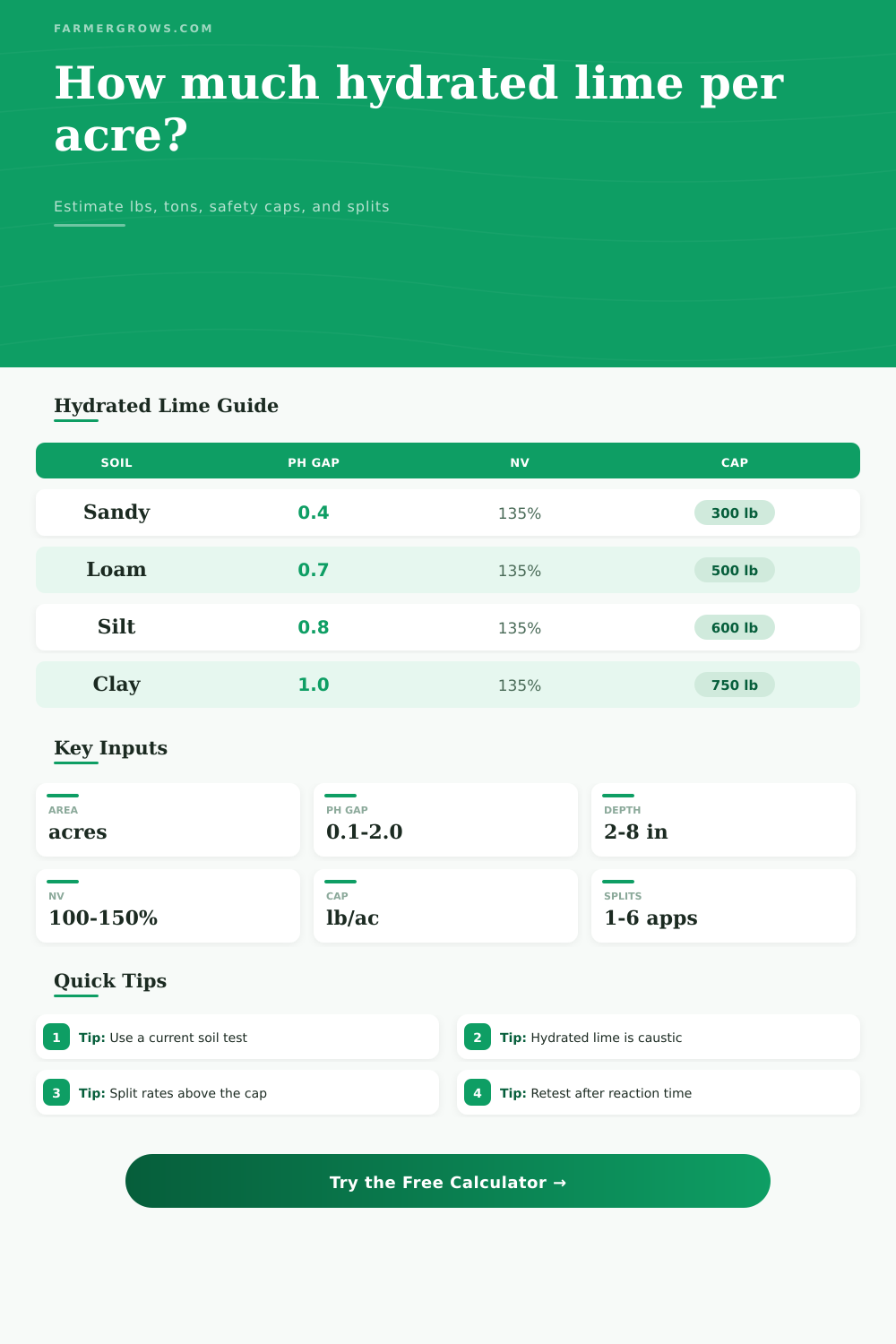
The key is safety caps. You don’t just come along and dump five hundred pounds of hydrated lime onto an acre and go home. That would also be difficult. It wouldn’t work well because the stuff is caustic. Too much applied at once will harm the soil biology and even damage roots. To do this, the calculator has safety caps, which frequently sets the maximum rate at five hundred pounds per acre per pass. When the math indicate otherwise, the tool will tell you so and recommend splitting it up.
That’s where the split schedule comes into play. Apply half of what you need, then water it in. Wait. Apply the other half. It’s a way of giving yourself some leeway while copying how nature adjust slowly over time.
Many growers trip over the other input: Buffer pH, which measures how resistant the soil is to change. This tells you whether your stubborn soil is still acidic (even though the pH says otherwise) if the buffer is high. Ignore the buffer and you’ll think you lime but won’t have any results for a year. The calculator asks for this so you can be sure the rate makes a big enough change. Otherwise, you’re treating the symptom, not the cause.
As for quantity, there’s no shortage of that either (but timing is crucial). When applied to bare soil prior to planting, the hydrated lime has time to fully react with water and organic material before vulnerable root systems are formed. If applying to existing turf, be careful not to burn the leaves.
A word about visualization: The tool also translates pounds into either tons or the number of bag. This makes ordering easy because you know exactly how many bags to buy. There is no guesswork on whether you need a ton or not.
Soil pH management is as much about skill as it is patience. It’s not about dumping powder on the ground. It’s about changing the chemical world that all organisms there inhabit. That means taking care when using hydrated lime. It is a powerful solution, but it requires attention. With the right precautions (and a split application), you gain the benefit without the consequence. Stunted field, balanced productive soil. A few numbers here, a little self-control there, and the equation could of been different.