
Hydrangeas are plant that will produce flowers. However, if you prune the hydrangeas incorrect, the hydrangeas may not produce flowers. One of the most common mistake when pruning hydrangeas is to cut the stems that contains the flower buds on the hydrangeas.
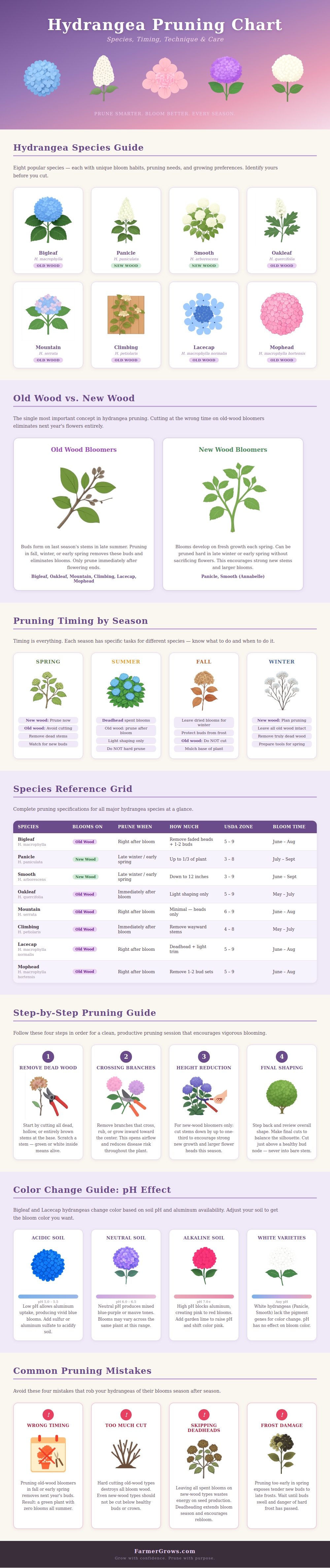
To successfuly grow hydrangeas, you need to be aware of the difference between old wood hydrangeas and new wood hydrangeas. Old-wood hydrangeas produce there flower buds on the old wood of the plant during the previous summer. Examples of old-wood hydrangeas are bigleaf hydrangeas and oakleaf hydrangeas.
When and How to Prune Hydrangeas
Because these flowers forms on the old wood, you should not prune these plants during the winter and spring month when the old wood is producing flowers. If you do prune the old wood, you will remove the flower buds and the hydrangea will only produce leaf. New-wood hydrangeas, on the other hand, form their flower buds on the new wood of the plant during the spring.
Examples of new-wood hydrangeas are panicle hydrangeas and smooth Annabelle hydrangeas. Since the flower buds is on the new wood, you can prune these type of hydrangeas in the late winter or early spring months before the new wood begins to produce flowers. Pruning these plants will encourage them to grow more larger flowers.
When pruning hydrangeas, make sure to use the correct pruning tools. You should use sharp bypass pruners to cut the stems of the hydrangeas. Avoid using anvil pruners as these can crush the stems of the hydrangea plants.
The crushed stems can lead to diseases entering the plant. Additionally, when pruning the hydrangeas, always make your cut just above an outward facing bud on the plant. If you make your cuts at an angle, the excess water will run off of the cut stem and not remain on the cut stem.
The soil chemistry will impact the color of some type of hydrangeas blooms. For instance, bigleaf and lacecap hydrangeas will change color depending on the soil’s pH. If the soil in which you planted your hydrangea is acidic, the blooms of the bigleaf and lacecap hydrangeas will turn blue.
The acidic soil provide the plant with aluminum. However, if the soil is alkaline, the blooms will turn pink as the alkaline soil does not allow for the aluminum to reach the plant. If the soil is neutral in pH, the blooms will be purple.
White blooms do not change color as they do not respond to the soil’s pH level. When pruning your hydrangeas, follow a step by step process to ensure the health of the hydrangea plant. First, remove any stems that is dead or hollow.
Second, remove any branches that cross over each other to allow for the proper growth of the hydrangeas in the center of the plant. Third, if you have a new-wood hydrangea, prune the height of the plant. Finally, shape the hydrangeas to your preference but ensure that there are no stub left on the stems.
Stubs can rot and can infect the hydrangea plant with disease. Finally, many people make mistakes when pruning there hydrangeas. For instance, many people prune their old-wood hydrangeas in the fall.
By pruning these plants in the fall, they are removing the flower buds that will form the following summer. Additionally, many people dont deadhead their repeat blooming hydrangeas. By removing the spent flowers on these plants, they will encourage the hydrangea to produce new bloom.
If you prune your hydrangea at the wrong time or with the wrong pruning technique, your hydrangea will not produce flowers as you had intend.