Conveyor Power Calculator
Estimate drive horsepower, kilowatts, torque, and throughput for farm belt conveyors. Test presets, then fine tune width, speed, lift, and material load.
Pick a real setup first. Each preset sets width, speed, lift, length, material, fill, duty, pulley size, efficiency, and buffer for a common farm conveyor.
Power Results
These values update from your conveyor geometry, material density, duty factor, efficiency, and buffer.
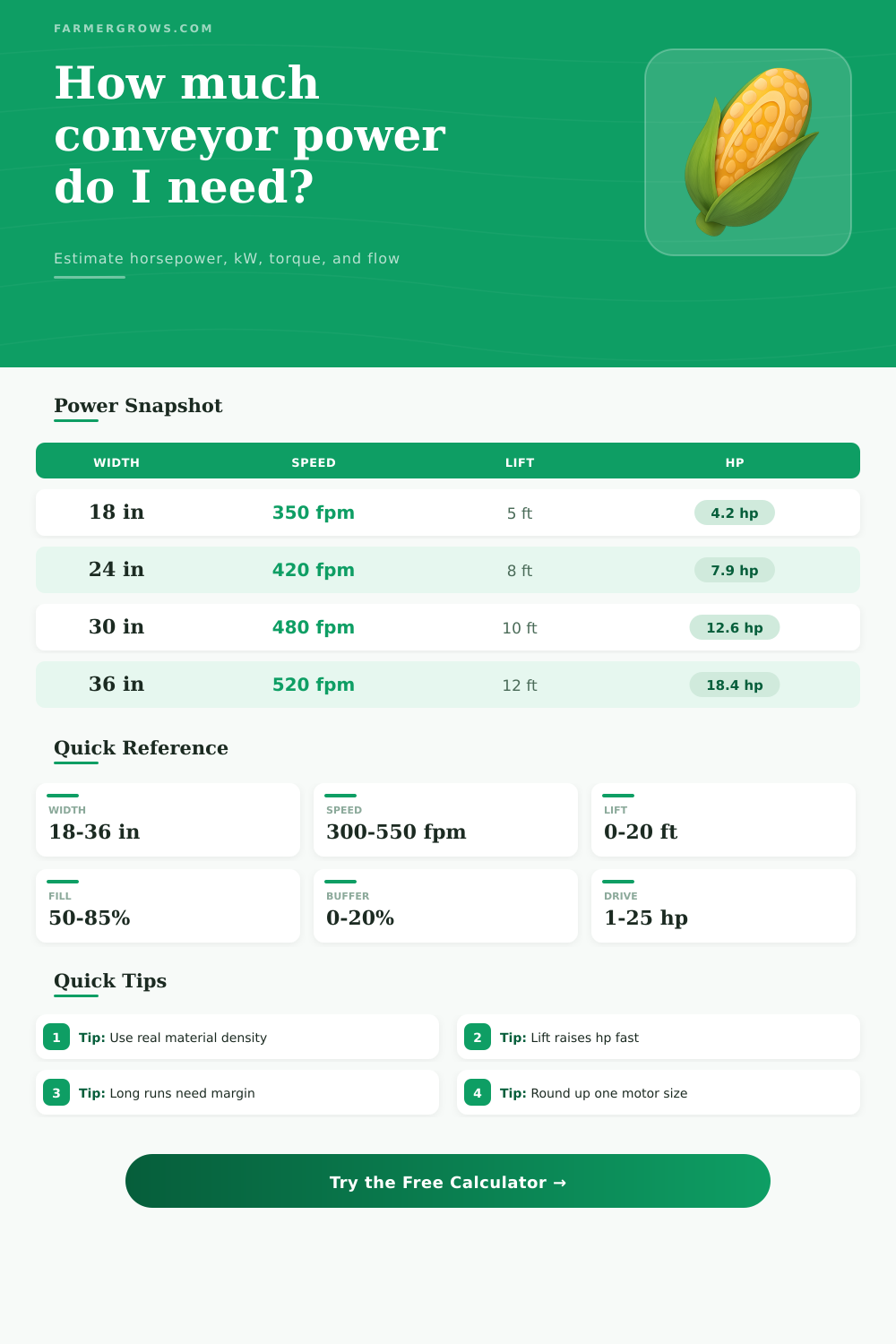
| Run | Width | Speed | Lift | Power |
|---|---|---|---|---|
| Grain bin unload | 24 in | 420 fpm | 8 ft | 8 hp |
| Feed line | 18 in | 360 fpm | 5 ft | 4 hp |
| Fertilizer run | 30 in | 480 fpm | 10 ft | 13 hp |
| Mulch transfer | 36 in | 520 fpm | 12 ft | 18 hp |
Sizing a conveyor drive require an understanding of the relationship between motor power and material load. The drive must be sized for the weight of the material that are to be conveyed, the distance that it must travel, and the vertical lift that the material must make during its movement. If the drive is too small for the requirements of the conveyor system, it will overheat and possibly fail to move the materials.
If the drive is too large, however, too much fuel or electricity will used to operate the drive. The capacity of a conveyor system is determined by several factors. The width of the belt is one factor in determining how much material can move along the belt.
How to Size a Conveyor Drive
The angle of the trough is another factor in that more material can be on the conveyor belt with a deeper trough, but fragile items requires shallower troughs. For instance, a 20 degree angle trough is used for the transportation of fragile seed, while a 45 degree angle trough is used for gravel. The fill factor of the trough is yet another determining factor for the capacity of the system.
Fill factors represent the percentage of the trough that is to be occupied by the conveyed material. Typical fill factors are 70 percent, which ensures even movement of the material without spillage from the conveyance of the material. Speed is a third factor that can affect the operation of a conveyor system.
By increasing the speed of the belt, the throughput of the system will increase, but so will the friction against the motor that move the belt. Friction created by the belt increases as the speed of the belt increases. The length of the conveyor system will also have an effect upon the requirements of the system in regard to the power required to move the conveyor belt.
The weight of the belt must be moved. Additionally, the vertical lift of the system is another significant factor in the determination of the power requirements of the system; vertical lifts require more horsepower to move the load against gravity. Thus, every foot of vertical lift will increase the amount of horsepower required to convey the pounds of material and the belt against gravity.
The density of the materials that are to be conveyed must also be calculated in the determination of the size of the conveyor drive. For instance, corn has a density of 45 pounds per cubic foot, but fertilizer has a density of 65 pounds per cubic foot, and sand has a density of 100 pounds per cubic foot. The density of the material to be conveyed will impact the amount of torque that the drive must produce to convey that material.
Additionally, the duty factor of the system must be accounted for in the determination of the size of the drive. For instance, a heavy-duty factor will be used for materials that is abrasive upon the system components. Finally, the efficiency of the drive must also be accounted for.
The efficiency of a drive is typically between 85 and 90 percent for good gearboxes. You should also include a safety buffer of approximately 10 percent because a 10 percent safety buffer accounts for cold starts or unexpected loads. A conveyor calculator can assist you in determining the necessary specifications of the conveyor that you would need to build.
All you would have to do is input your specific numbers into the calculator. The calculator will provide you with the horsepower requirements of the conveyor, the motor kilowatts, the drive torque, and the actual throughput of the conveyor. These specifications are based off formula within the calculator.
The drive torque will allow you to determine if the pulley can grip the conveyor belt, and the RPM will tell you if the motor will reach the proper speed for the belt. Additionally, the calculator can provide you with an estimate of the energy use of the conveyor during each shift. There are several trade-offs that you can make in the building of your conveyor system.
For instance, increasing the speed of the conveyor system will increase the number of tons of materials that can be moved each hour, but at a linear rate of increase in friction. Another trade-off is between the width of the conveyor belt and the power requirements of the system. Although wide belts allow for the movement of more tons of material per foot of conveyor, the increased width of the belt will increase the weight of the belt which increases the power draw of the system.
Thirdly, increasing the angle of the trough will increase the capacity of the system by 20 to 30%, so changing the trough angle is one method of increasing the capacity of your system. Finally, you must also consider the startup torque of the conveyor. For sticky materials that tend to stick to the belt, 25% more startup torque is required than the amount required for the system to run normal.
Many people make mistakes when they size the drive for a conveyor system. For instance, one of the most common mistakes that people make is to not include a safety buffer for the system; by leaving a safety buffer out, there is no room for the conveyor system to account for wear or overloaded conditions. Another common mistake is to overlook the size of the pulley; if the pulley is too small for the belt, it will slip and the system will not be able to provide the needed torque.
Conveyor systems also tend to lose efficiency over time; for instance, a conveyor that starts at 88% efficiency may drop to 75% after one season of operation. Thus, the efficiency drop will require more power to move the same amount of tons of material per hour. Finally, there are several environmental factors that will impact the efficiency of the conveyor.
For instance, moisture content of the material will change the density of that material; therefore wet corn will weigh more than dry corn. Another factor is that cold weather will reduce the efficiency of the motor that is used to power the conveyor system. Thirdly, there may be drag within the system created by the bearings or idlers that must turn to allow the system to move; these components will add to the power requirements of the conveyor system.
Finally, it is also important to ensure that the electrical voltage is consistent because a voltage drop will reduce the power that is available to the motor.