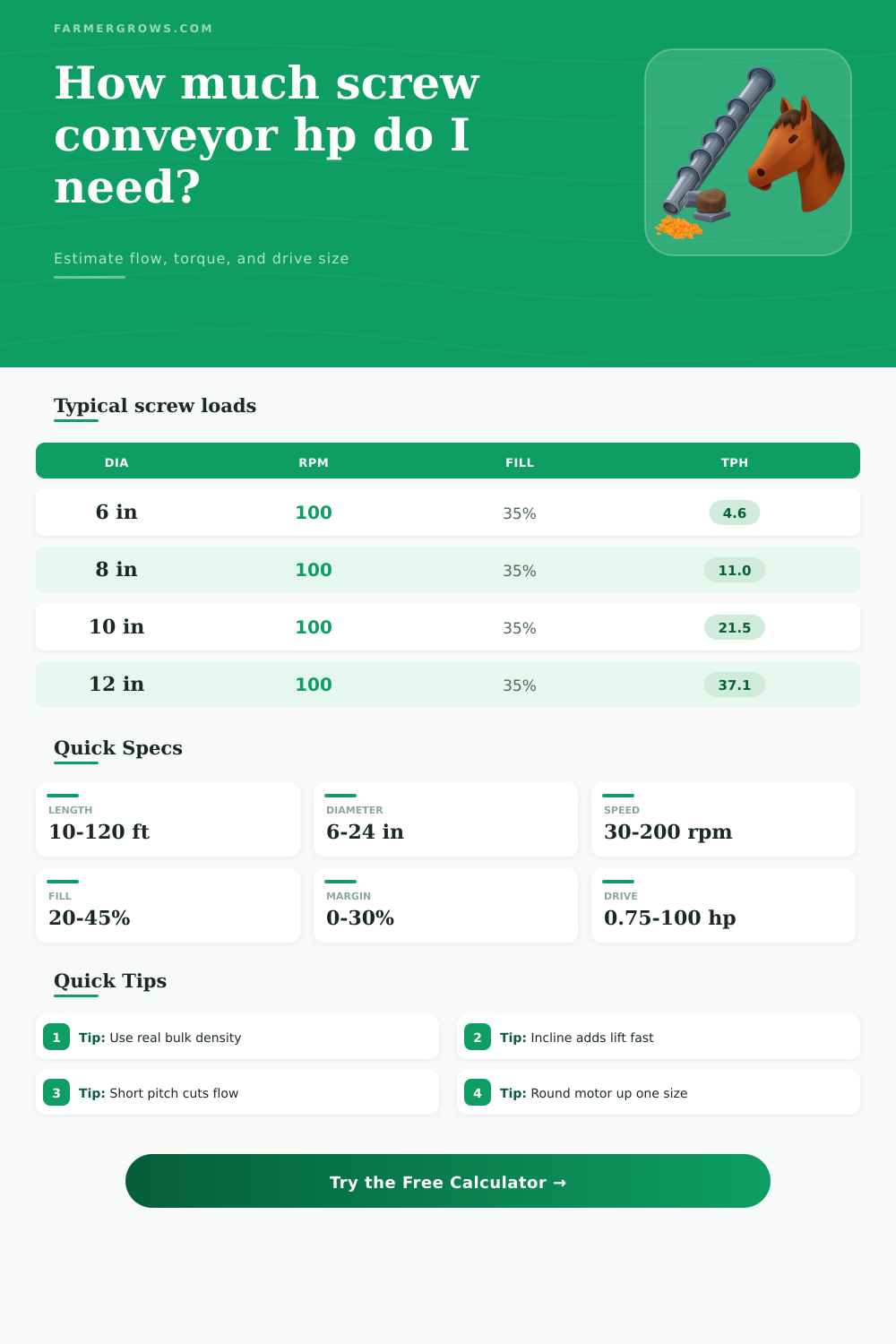
Screw Conveyor Horsepower Calculator
Estimate throughput, horsepower, torque, and motor size for grain, feed, fertilizer, and other bulk materials. Test presets, then fine tune the screw drive.
Pick a real layout first. Each preset sets diameter, pitch, speed, length, incline, fill, and drive margin for a common screw conveyor job.
This calculator is tuned for farm and bulk screw conveyors, so it prioritizes throughput, density, lift, and shaft torque instead of cost or purchase guidance.
Screw Conveyor Output
Estimated throughput, horsepower, torque, and drive size from the settings above.
| Diameter | Pitch ratio | Fill band | Use |
|---|---|---|---|
| 6 in | 50% | 20-30% | Light duty |
| 8 in | 75% | 25-35% | Small line |
| 10 in | 100% | 30-40% | Common farm |
| 12 in | 125% | 35-45% | High flow |
| Diameter | Pitch | Fill | Use |
|---|---|---|---|
| 6 in | 50% | 20-30% | Seed line |
| 8 in | 75% | 25-35% | Bin unload |
| 10 in | 100% | 30-40% | Feed mill |
| 12 in | 125% | 35-45% | Bulk yard |
| Size | Speed | Torque | Use |
|---|---|---|---|
| 6 in | 100 rpm | 2 hp | Light torque |
| 8 in | 120 rpm | 4 hp | Balanced |
| 10 in | 120 rpm | 8 hp | Common run |
| 12 in | 100 rpm | 14 hp | High flow |
Screw conveyor are machines used to move bulk material. Screw conveyors move bulk materials by using a rotating helical screw. The screw conveyor push the bulk materials forward and the screw conveyor can push the bulk materials up an incline.
Because screw conveyors is simple machines, many people use screw conveyors to move materials on the farms, in feed mills, and fertilizer yards. When purchasing a screw conveyor, the motor must be sized according to the specification of the screw conveyor. If the motor is underspecified, the screw conveyor will stall under a load.
How to Choose a Screw Conveyor
If the motor is too large, the customer will spend more money than necesary to purchase and operate the screw conveyor. One of the factor to consider when purchasing a screw conveyor is the density of the materials that the conveyor will move. The density of the material will determine the weight that the screw conveyor will move.
For instance, corn have a density of 45 pounds per cubic foot while sand has a density of 100 pounds per cubic foot. The bulk density of the material will change the tonnage of the bulk material that the screw conveyor can move. If the bulk material is wet, the weight will increase; in this case, you should increase the density specifications by 10 to 15 percent.
The friction of the bulk material should also be considered when purchasing a screw conveyor. For instance, materials like fertilizer will grip the flight of the screw conveyor more than materials like wheat. Another factor to consider when purchasing a screw conveyor is the diameter of the conveyor.
The diameter will determine the capacity of the screw conveyor. A 6-inch diameter screw conveyor is suitable for moving light seed lines while a 12-inch diameter screw conveyor will move larger volume of bulk material. The speed of the screw conveyor is measured in revolutions per minute (RPM).
The RPM will determine the rate at which the screw conveyor will move the bulk material. However, there should be a balance between RPM and the percentage of the screw conveyor that is filled with bulk material. If the RPM is set to a high number, the screw conveyor will wear out quick or produce too many fine in the bulk material.
Most farm screw conveyors operate between 100 and 150 RPM to strike a balance between the speed at which the conveyors move and the wear on the component of the conveyor. The length of the screw conveyor is another important factor to consider in the design of the conveyor system. Friction build up over the distance that the screw conveyor travels.
Thus, each additional foot of screw conveyor add to the horsepower needed to move the materials along the belt. In addition to length, the incline of the screw conveyor will increase the amount of power required by the screw conveyor. If the tail end of the screw conveyor is lift, the screw conveyor will have to fight the force of gravity.
If the lift height is multiplied by the tonnage and the result added to the horizontal drag of the screw conveyor, the result will be the total horsepower requirements for the screw conveyor. Another factor to consider with screw conveyors is the pitch of the screw conveyor. The pitch is the distance that the screw move the material during one complete revolution.
Standard pitches are 100 percent of the diameter of the screw. For conveyors that are moving at high rates on level ground, 125 percent pitch can be used. For screw conveyors that have inclines in the design, shorter pitch must be used to prevent the materials from rolling back towards the screw conveyor.
The third factor to consider with screw conveyors is the fill percentage of the screw conveyor. Fill percentage is the amount of the diameter of the screw that is filled with material. Typically, the fill percentage should be between 20 and 45 percent of the diameter of the screw conveyor to avoid overloading the conveyor.
The fourth factor to consider with screw conveyors is the torque that must be applied to the shaft of the conveyor. The shaft must be large enough to handle the torque that is applied to the screw conveyor. If the screw shaft is too small for the amount of torque that must be applied, the shaft will fail due to fatigue.
The pound-feet of the torque must be calculated to ensure that the coupling and bearings can handle the load. In calculating the horsepower requirements of the screw conveyor, a design margin of 10 to 20 percent should be added to the total to account for any unknown factor that may impact the conveyor system. Finally, any calculation should be rounded up to the next size of standard motor to ensure that the motor has enough power to operate the screw conveyor.