Conveyor Speed Calculator
Find required belt speed or actual throughput for grain, feed, fertilizer, sand, mulch, and other bulk material runs. Test presets, then fine tune the line.
Pick a real setup first. Each preset sets material, width, speed, length, lift, trough, fill factor, and buffer for a common farm conveyor.
This calculator is tuned for agricultural and yard conveyors, so it prioritizes flow, density, lift, and pulley speed instead of cost or purchase guidance.
Conveyor Output
Estimated belt speed, throughput, belt loading, and pulley demand from the settings above.
| Belt width | Typical speed | Common flow | Best fit |
|---|---|---|---|
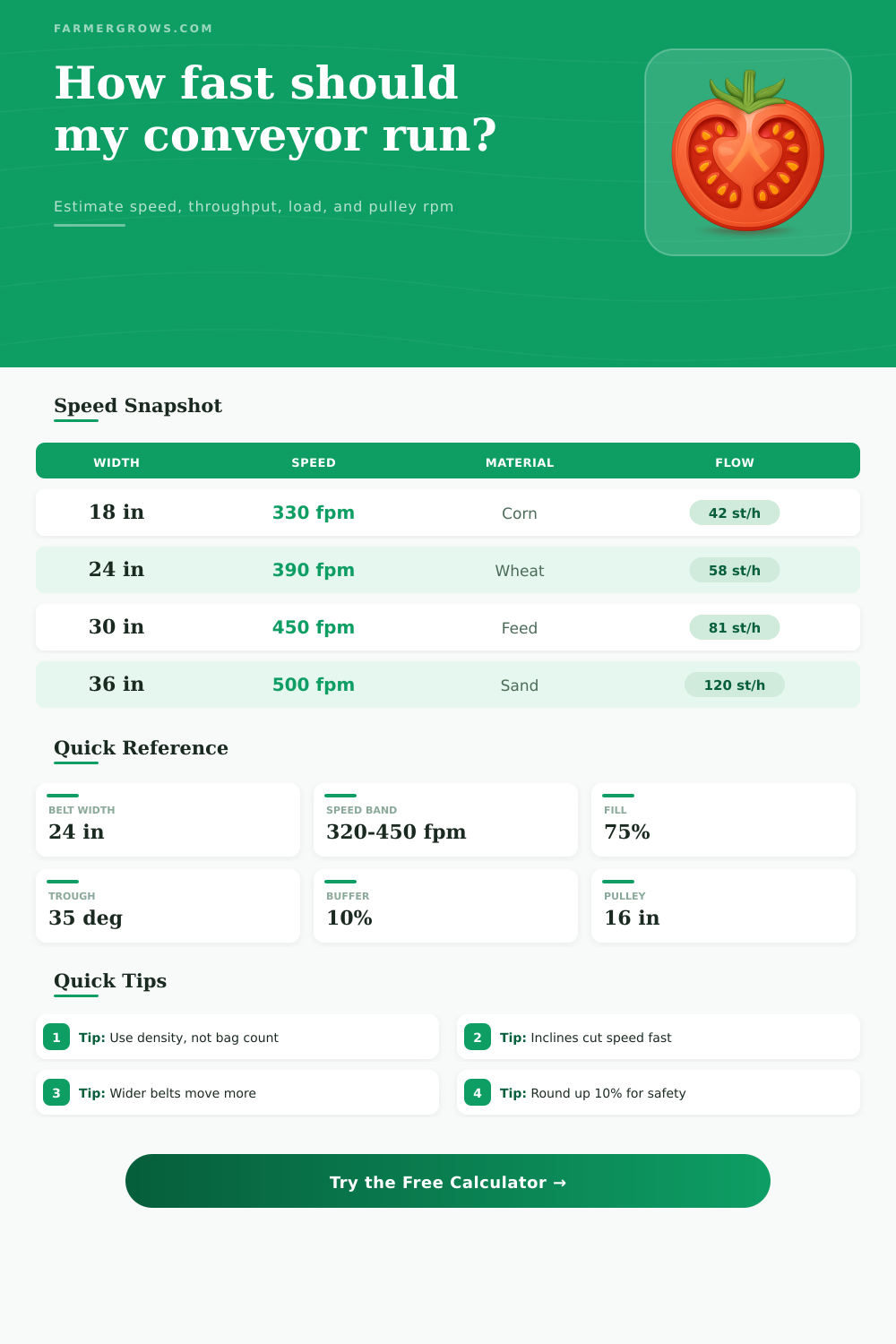
| 18 in | 300-375 fpm | 35-55 st/h | Seed line |
| 24 in | 325-410 fpm | 55-85 st/h | Bin unload |
| 30 in | 350-455 fpm | 85-120 st/h | Feed run |
| 36 in | 375-500 fpm | 120-175 st/h | Bulk yard |
| Material | lb/ft³ | kg/m³ | Speed note |
|---|---|---|---|
| Corn | 45 | 721 | Balanced flow |
| Wheat | 48 | 770 | Slightly slower |
| Feed pellets | 40 | 641 | Gentle handling |
| Fertilizer | 69 | 1106 | Cut speed a bit |
| Wood chips | 24 | 385 | Longer load zone |
| Sand | 100 | 1602 | Use lower speed |
| Gravel | 109 | 1748 | Heavy drag load |
| Soybeans | 47 | 752 | Round seed flow |
| Pulley | At 2 m/s | Lap time | Note |
|---|---|---|---|
| 12 in | 318 rpm | 1.9 min | Fast feed |
| 16 in | 239 rpm | 2.6 min | Balanced run |
| 20 in | 191 rpm | 3.2 min | Gentle load |
| 24 in | 159 rpm | 3.8 min | Slow bulk |
| Job | Width | Speed band | Use case |
|---|---|---|---|
| Seed line | 18 in | 300-360 fpm | Gentle seed |
| Bin unload | 24 in | 330-410 fpm | Grain flow |
| Feed mill | 30 in | 360-450 fpm | Mixed feed |
| Bulk yard | 36 in | 380-500 fpm | Heavy move |
Conveyor belt speed is a measurement of how fast a conveyor belt moves. Conveyor belt speed is a critical piece of information in calculating the throughput of the conveyor belt system. Should a person set the conveyor belt speed to move at too slow of a rate, the material will back up on the conveyor belt system, and the unloading schedule will be delayed.
Alternatively, should a person set the conveyor belt to move at too fast of a speed, the material may be damaged on the conveyor belt system. Throughput is the amount of material that pass over a conveyor belt in a specific amount of time. The throughput of a conveyor belt system depend upon the speed of the conveyor belt, the density of the material to be transported, and the fill level of the conveyor belt system.
Conveyor Belt Speed and What Affects It
The shape of the conveyor belt system will impact the amount of material that it can hold. The most common shape of a conveyor belt system is a V-shaped trough. A V-shape trough is often inclined at a 35-degree angle.
This angle allow the conveyor belt system to hold the material in place, so that the material will not spill off of the sides of the conveyor belt system. The fill level of a conveyor belt system is the percentage of the V-shaped trough that is filled with material. For most conveyor belt systems, the target fill level of the trough is between 75 percent of its capacity.
The different type of materials that the conveyor belt system will transport require different speeds of the conveyor belt. For instance, wood chips are a light material, and require a slower conveyor belt speed so that the material does not spill off of the conveyor belt system. Gravel, on the other hand, is a heavy material, and will require an even slower conveyor belt speed for the same reasons that light materials require slower conveyors.
The incline of the conveyor belt system will impact the throughput of the system. If the conveyor belt system have an incline, gravity will work against the movement of the material on the belt system. Thus, if a person increases the rise of the conveyor belt system, the friction created between the belt and the material, as well as the gravitational force against the movement of the materials will decrease the throughput of the system.
Therefore, a person cannot use the same speed of a conveyor belt for flat conveyor belts as inclined conveyor belts. In order to calculate the appropriate speed of a conveyor belt system, a person can use the density of the material that the conveyor belt system will move. For instance, if a person wants to move 60 short tons of material per hour through a conveyor belt system, the person can calculate the appropriate conveyor belt speed by using the known density of the material.
In addition to the density of the material, a person should also factor in a buffer into these calculations. For example, creating a 10 percent buffer will allow for the conveyor belt system to still reach the target throughput in the hour despite variations in the density of the material. Additionally, the pounds of the material per foot of the conveyor system will factor into the calculations of the required belt speed because it will allow the person to determine whether the drive motor for the conveyor belt is capable of move the load.
The width of the conveyor belt will impact the capacity of the system, but the width of the belt does not necessarily impact the speed of the conveyor belt system. For instance, an 18-inch conveyor belt system may move between 300 and 375 feet of material per minute, while a 36-inch conveyor belt system can move between 375 and 500 feet of material per minute. Thus, the relationship between the width of the conveyor belt system and the speed at which it moves is not linear; if the width of the belt is changed, the person must recalculate the speed of the belt.
Many different individuals in a facility may manage conveyor belt systems. These individuals may make many mistakes with these systems. For instance, they may not account for the incline of the conveyor belt if they had set the speed of the conveyor belt for a flat conveyor belt.
Additionally, those who overloading the conveyor belt system by exceeding 85 percent of the V-shaped trough of the system may experience problems with the system. Finally, those who believe that all grains have the same rate of movement on conveyor belts do not account for difference in the densities of materials like soybeans and corn; therefore, soybeans will require a different speed of conveyor belt than corn. Finally, the size of the pulley that a conveyor belt system uses will impact the reliability of that system.
Small pulleys have a small diameter. Thus, the small pulley will need to spin at a high number of revolutions per minute in order to move the conveyor belt. For instance, a 12-inch pulley will spin at a high rate of revolutions per minute compared to a 20-inch pulley.
The larger the diameter of the pulley, the more slower the pulley will spin. Larger pulleys will provide less stress on the drive motors and the bearings of the conveyor belt system. Finally, vibrations and heat are two indicators of the reliability of the system.
Vibrations indicate that the conveyor belt is unbalance, while heat within the pulleys indicates that there is friction between the two moving components.