🌸 Aluminum Sulfate for Hydrangea Calculator
Calculate exactly how much aluminum sulfate your hydrangeas need for beautiful blue, purple, or pink blooms
| Soil pH Range | Aluminum Available? | Resulting Color | Action Needed |
|---|---|---|---|
| 5.0 – 5.5 | Yes – highly available | Blue | Maintain with aluminum sulfate |
| 5.5 – 6.0 | Partially available | Purple / Mixed | Transition zone |
| 6.0 – 6.5 | Mostly locked out | Pink | Add lime to maintain |
| 6.5 – 7.0+ | No – locked out | Deep Pink | Add lime or do nothing |
| Plant Size | Granular (per plant) | Soil Drench | Frequency |
|---|---|---|---|
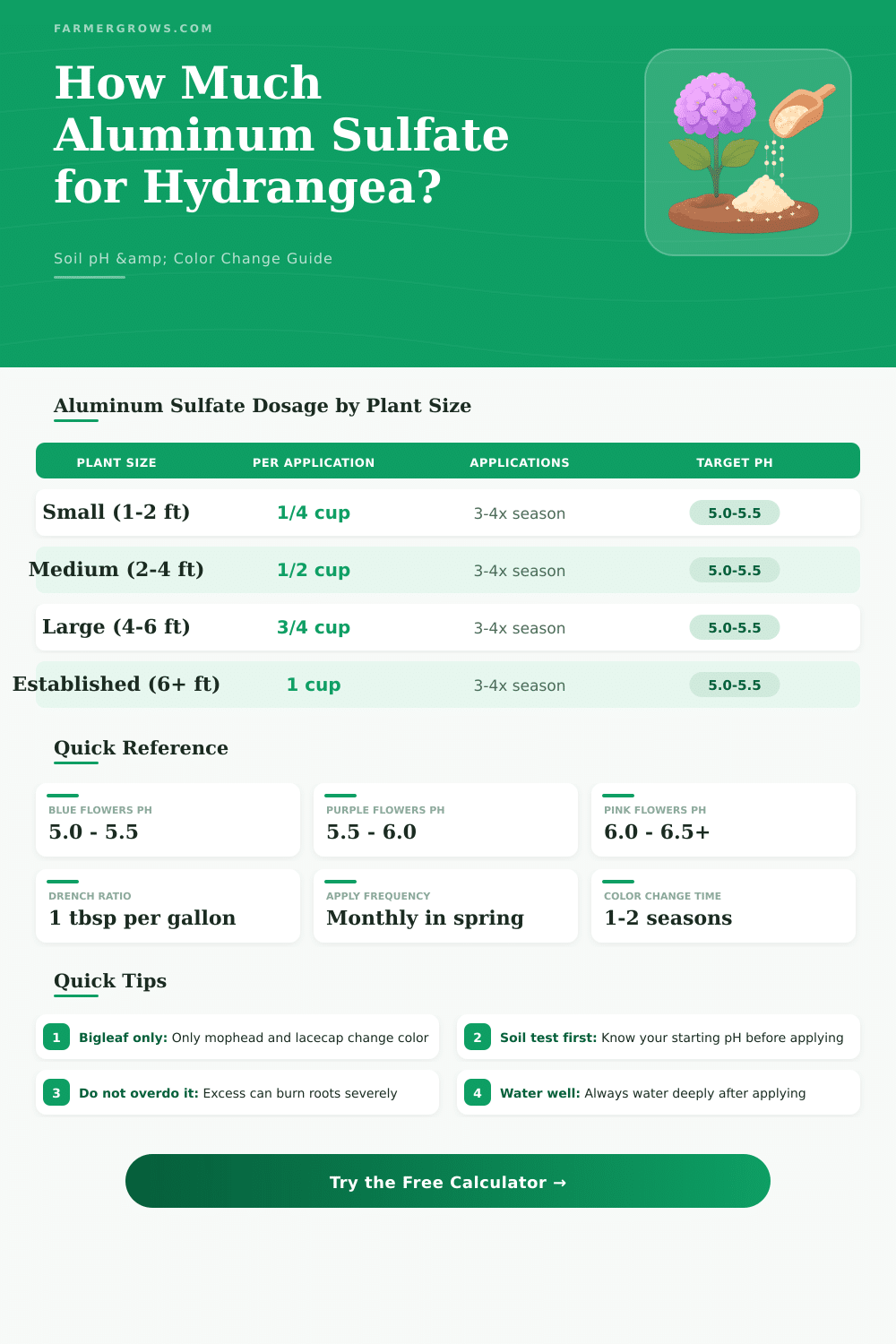
| Small (1–2 ft) | 1/4 cup (60 g) | 1 tbsp per gal, 1 gal | Monthly, 3–4x |
| Medium (2–4 ft) | 1/2 cup (120 g) | 1 tbsp per gal, 2 gal | Monthly, 3–4x |
| Large (4–6 ft) | 3/4 cup (180 g) | 1 tbsp per gal, 3 gal | Monthly, 3–4x |
| Established (6+ ft) | 1 cup (240 g) | 1 tbsp per gal, 4 gal | Monthly, 3–4x |
| Current pH | Target pH | Sandy Soil | Loamy Soil | Clay Soil |
|---|---|---|---|---|
| 7.0+ | 5.0–5.5 | 1.5x base rate | 2x base rate | 3x base rate |
| 6.5–7.0 | 5.0–5.5 | 1.25x base rate | 1.5x base rate | 2.5x base rate |
| 6.0–6.5 | 5.0–5.5 | 1x base rate | 1.25x base rate | 2x base rate |
| 5.5–6.0 | 5.0–5.5 | 0.5x base rate | 0.75x base rate | 1x base rate |
| 5.0–5.5 | 5.0–5.5 | Maintenance only | Maintenance only | Maintenance only |
| Month | Action | Expected Result |
|---|---|---|
| March – April | First application as buds swell | Soil pH begins to lower |
| May | Second application | Aluminum becomes available |
| June | Third application | Slight color shift possible |
| July | Fourth application (if needed) | Blooms may show partial change |
| Year 2 Spring | Resume monthly applications | Full color change in new blooms |
Feed your Hydrangea regularly to make a real difference about its look and activity during the growing season. Many soils lack the nutrients that those plants truly need for health and produce nice flowers. With fertilizer, you fill those gaps, so Hydrangea can form more strong roots and give more flowers.
Naturally, they will grow also without that, but you will risk to face nutrition troubles later. At the base plants require those nutrients for growing thick leaves and rich flowers.
How to Fertilize Hydrangeas
Here the reason even so, Hydrangea do not want tons of fertilizer. More important is what already is in your soil. All species of Hydrangea are quite strong growers, and honest, moderate help does more than too much feeding when deal about feed them.
It is easily overdone. Adding too much slow release fertilizer, you can stop and reduce your flower output. More does not settle, extra nutrients simply will wash away from the soil and ultimately will pollute the nature.
The best way is use granular fertilizer special for shrub plants. Slow release, balanced mix applied only once yearly is simple and works for everything. You can choose also 10-10-10 granuler variant or set compost.
Anything done for trees and bushes does the task well. Only mind the nitrogen amounts, if too much here, you will have a lot of leaf growth, but less flowers. Formula stressing phosphorus and potassium, as 10-15-10, usually give better flowers.
For acid loving species as bigleaf, oakleaf and mountain Hydrangea, organic product as Holly-tone truly works. Both Espoma Holly-tone and Rose-tone has many followers between the growers. Rose-tone is less bitter, although honest, they are quite alike and both work well.
If you need to lower the pH of your soil, Aluminum Sulfate or sulfur powder can help move things in the write direction.
Organic methods work surprisingly also. Worm castings, bird manure, compost or alike natural resources feed your plants slowly. Mix from sulfur, compost and peat moss cares about Hydrangea well.
The simplest way? Simply mix a bit of compost in the soil. It releases nutrients slowly, but you will have to repeat it over time for truly strengthen the plants.
Coffee grounds and liquid seaweed or fish mix are gentle options, that can serve double as mulch.
Spring is the time for start fertilizing, when new growth appears. The right times depend on your climate zone and species of Hydrangea that you have. Halt from July…
Avoid feeding after that, for do not push growth when the plant should prepare for sleep. For new bought plants in jars, do not fertilize right away, because they already have enough slow release nutrients. Leave them rest some days first.
Middle of summer, boosters help reblooming species form shoots for the coming year, but oakleaf, panicle andclimbers care for themselves quite well.