🔧 Hydraulic Pump Sizing Calculator
Size flow, pump displacement, horsepower, and torque from a direct flow demand, cylinder motion, or hydraulic motor speed.
Presets load a real-world demand mode, pressure, speed, efficiency, and a candidate pump size so you can compare the target to a likely pump choice.
📊 Pump Sizing Results
Load demand, required pump flow, displacement, horsepower, and candidate flow check
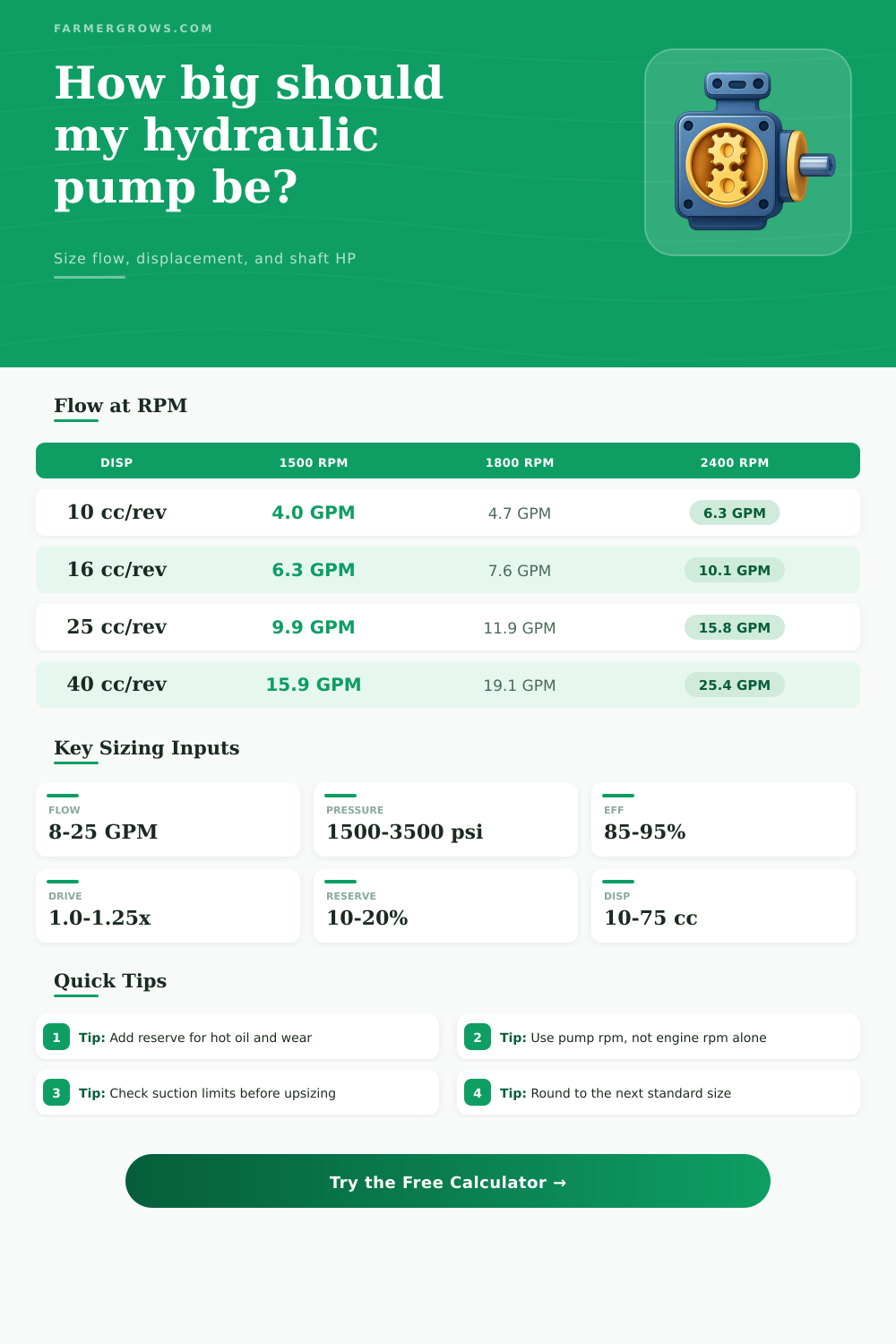
| Displacement | 1500 rpm | 1800 rpm | 2400 rpm |
|---|---|---|---|
| 10 cc/rev | 4.0 GPM | 4.7 GPM | 6.3 GPM |
| 16 cc/rev | 6.3 GPM | 7.6 GPM | 10.1 GPM |
| 25 cc/rev | 9.9 GPM | 11.9 GPM | 15.8 GPM |
| 40 cc/rev | 15.9 GPM | 19.1 GPM | 25.4 GPM |
| Flow | 1500 psi | 2500 psi | 3500 psi |
|---|---|---|---|
| 5 GPM | 4.4 HP | 7.3 HP | 10.2 HP |
| 10 GPM | 8.8 HP | 14.6 HP | 20.4 HP |
| 20 GPM | 17.5 HP | 29.2 HP | 40.8 HP |
| 30 GPM | 26.3 HP | 43.8 HP | 61.1 HP |
| Family | Range | Pressure | Best use |
|---|---|---|---|
| Gear | 5-80 cc/rev | 2000-3000 psi | Utility and loaders |
| Vane | 10-70 cc/rev | 1500-2500 psi | Smoother medium duty |
| Axial piston | 18-250 cc/rev | 3000-6000 psi | High pressure work |
| Bent-axis | 25-250 cc/rev | 3500-7000 psi | Heavy mobile loads |
| Application | Flow | Pressure | Typical pump |
|---|---|---|---|
| Loader lift | 8-15 GPM | 2200-2800 psi | Gear or vane |
| Small splitter | 10-18 GPM | 2500-3000 psi | Gear pump |
| Orchard spray | 4-8 GPM | 1200-1800 psi | Vane or gear |
| Auger fan | 6-20 GPM | 1500-2500 psi | Gerotor or piston |
When you are trying to size a hydraulic pump for your equipment, you must consider several factor. Many people want to use the largest pump that they can find for their machines. However, using the size of the pump as the factor to determine the pump that you will use will lead to inefficiency.
You must consider the requirements of the equipment you are manufacturing to find the correct displacement and rotational speed of the hydraulic pump. The first of the factors to consider is the flow demand. The flow demand of the equipment is the amount of fluid that must move to complete the tasks.
How to Size a Hydraulic Pump
Using too little flow will not allow the machine to complete it’s task. Using too much flow will waste fuel. For cylinders, you can calculate the flow demand by taking the area of the cylinder bore and the length of its stroke, then dividing that by the amount of time that the cycle should take.
For motor, the flow is calculated by taking the motor displacement and multiplying it by the target RPM that the motor should reach. If the machine use a direct flow system, you can measure the flow from the equipment since the system has already been metered. The next factor to consider is the pressure requirements for the equipment.
You can calculate the horsepower for the equipment by multiplying the flow by the pressure. For example, 10 gallons per minute at 1500 psi will use less fuel for a machine than another hydraulic system using the same flow at 3500 psi. You must consider the working pressure of the system to determine the horsepower needs.
Efficiency will also have an impact on the system since this will reduce the amount of ideal hydraulic fluid output that the pump can create. There will be losses due to volumetric slip, which is the leaking of oil back to the suction side of the pump. This can result due to wear and mechanical drag that turns the shaft’s power to heat.
The volumetric efficiency of a pump can be between 85% and 95% while the mechanical efficiency is between 85% and 90%. These values can and should be included in your calculations to determine the actual horsepower that will be needed for the shaft of the engine or power take-off. Pump speed is also one of the considerations for pump sizing.
The revolutions per minute of a tractor does not necessarily mean that the pump will reach that amount of rpm. For example, if the drive ratio for the tractor is 1.0, the two will be the same. However, using a drive ratio of 0.8 will create a pump speed lower than that of the tractor.
Additional factor of reserve and duty can also be included in the calculations. You should use a 10% to 20% reserve in the system to allow for expansion of the hydraulic fluid as it heats during operation. Additionally, you can use a multiplier of 1.08 for mixed farm duty to prevent the pump from reaching its maximum capacity on a warm afternoon when the hydraulic fluid is heated to operating temperatures.
For factors related to the cylinder, you must look at the specific details of the cylinder. For instance, a post driver with a 4.5-inch bore may require 18 inches of stroke in 5 seconds at 3000 psi. In this example, a high flow rate of fluid will be required for the extension side of the cylinder.
For the retraction side, the flow will be less due to the diameter of the rod. The focus should be on the stroke time of the cylinder since this will determine the productivity of the machine. Motors will require a different calculation than cylinders to determine the flow needs of the machine.
For instance, a grain auger motor can run at 300 rpm with a displacement of 12 cc. The calculations for the other components of the auger will allow the selection of another pump with a different displacement, such as 16 cc. By calculating the requirements for the motor, another value will be created that expresses the margin or shortfall in the selection of that pump.
The next consideration is horsepower. By multiplying the flow and the system pressure and dividing by 1714, you can find the hydraulic horsepower for the system. Divide that by the total efficiency of the system to find the shaft horsepower for the engine.
By comparing that to the power curves for the tractor, you can determine the appropriate engine and rpm for the tractor. Additionally, the torque of the tractor will also be important to ensure the engine’s needs is met at low rpms. A variety of reference tables can assist with sizing the hydraulic pump.
Displacement to flow charts can help determine how much flow will be created by a pump of a specific size. For instance, a 25 cc hydraulic pump can create 9.9 gpm at 1500 rpm. At 2400 rpm, it will create 15.8 gpm.
Another chart that can help with pump selection is a horsepower chart. This chart can pair the flow with the system pressure, such as requiring 20 gpm at 2500 psi will require 29 horsepower on the hydraulic side. You can choose the different pump families based on the needs of the equipment.
Gear pumps are an inexpensive option for utility equipment up to 3000 psi. Axial piston pumps are better for high-duty work at 5000 psi. Common mistakes must be avoided when sizing the hydraulic pump.
One of the most common is using too large of a pump for your hydraulic system. Using a large pump will send the fluid pressure too high for the limits of the suction inlet for the pump. This can result in the pump starving for fluid.
Another mistake is focusing on the maximum rpm for the engine. The volumetric efficiency will drop for pumps that go beyond 3000 rpm. Additionally, you must also consider the duty cycle.
Tools that are used intermittently will require less hydraulic pump sizing than tools that are continuous in their operation. Finally, ensure that you round up to the nearest displacement for the pump since manufacturers dont make fractional displacement pumps for hydraulic systems. Heat is another common problem for hydraulic systems.
Reserves for expansion of the fluid will help control this, but you should also consider the size of the tank for the system along with the size and needs of the oil cooler. High flow rate may require strainers to prevent clogging of the system. Variable displacement pumps allow for tractors to have more than one hydraulic circuit.
However, fixed displacement pumps are better suited for implements that will only have one function. To correctly size the hydraulic system for your implement, consider the demand for the implement first, calculate the flow of the pump with efficiency considerations, and then size the pump according to that calculation. You should of checked these values twice.
Its important to be accurate when your workin with such expensive furnitures.