Hydraulic Motor Torque Calculator
Estimate hydraulic motor torque, speed, and shaft power from flow, displacement, pressure, and efficiency for gear, vane, orbital, and piston motors.
Quick start: Pick a real machine profile and the calculator fills the fields, switches units if needed, and runs the math automatically.
Note: The unit system toggle can switch the measurement set to imperial or metric, while the individual unit fields stay visible for precision.
| Flow | 1 ci/rev | 2 ci/rev | 4 ci/rev |
|---|---|---|---|
| 5 gpm | 1039.5 | 519.8 | 259.9 |
| 10 gpm | 2079.0 | 1039.5 | 519.8 |
| 15 gpm | 3118.5 | 1559.3 | 779.6 |
| Pressure | 1.5 ci/rev | 3.0 ci/rev | 6.0 ci/rev |
|---|---|---|---|
| 1000 psi | 203 lb-in | 406 lb-in | 812 lb-in |
| 2000 psi | 406 lb-in | 812 lb-in | 1624 lb-in |
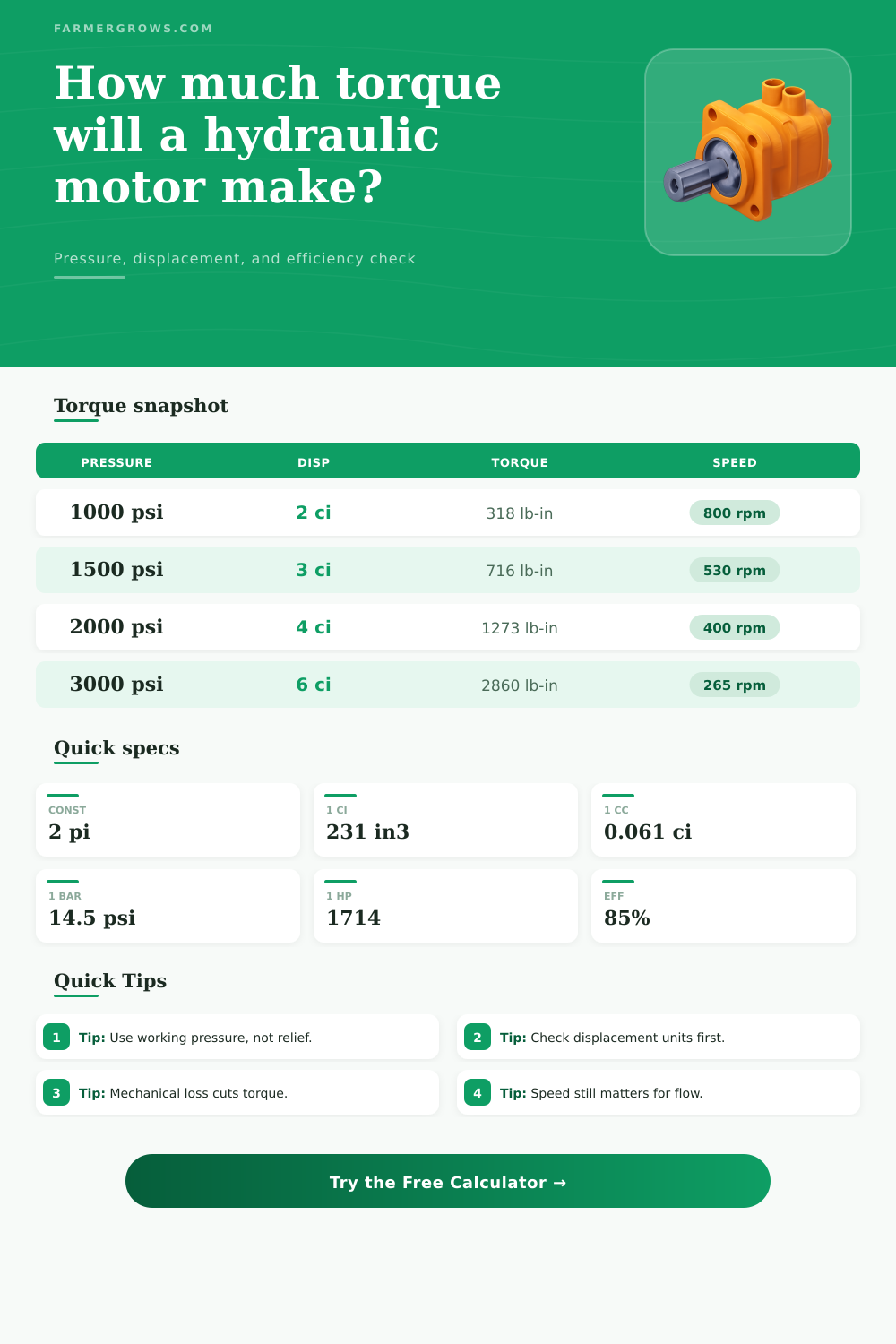
| 3000 psi | 609 lb-in | 1218 lb-in | 2436 lb-in |
| Flow | in³/min | L/min | RPM @ 2 ci |
|---|---|---|---|
| 2 gpm | 462 | 7.6 | 207.9 |
| 5 gpm | 1155 | 18.9 | 519.8 |
| 10 gpm | 2310 | 37.9 | 1039.5 |
| 15 gpm | 3465 | 56.8 | 1559.3 |
| Type | Speed band | Torque band | Best for |
|---|---|---|---|
| Gear motor | 250-2500 rpm | Moderate | Fans, conveyors |
| Vane motor | 300-1800 rpm | Smooth | Small power units |
| Orbital motor | 20-1000 rpm | High | Augers, wheels |
| Piston motor | 100-6000 rpm | Very high | Heavy duty drives |
Use the working pressure and real displacement. Published ratings can overstate the torque you will see in service.
When torque is critical, confirm the pressure reserve too. Small changes in displacement or efficiency can shift the output more than expected.
The torque of a hydraulic motor are the turning force that the motor will create. The torque of a hydraulic motor is necessary to complete the work that are required within the hydraulic system. The relationship between pressure, displacement, and efficiency is important to understand because these three variable will determine the actual torque that the hydraulic motor can produce.
The pressure that is create within the hydraulic motor is the force that push the hydraulic fluid through the internal components of the motor. The more higher the pressure of the hydraulic fluid, the more work that will be performed during each revolution of the hydraulic motor. While the manufacturer may list the peak pressure rating for the motor, such as 3000 psi, the machine will use a lower working pressure than the peak pressure ratings.
What Affects the Torque of a Hydraulic Motor
As a result of the working pressure of the hydraulic system being lower than the expected pressure, the hydraulic motor will produce less torque than that which is calculated for the motor. The displacement of a hydraulic motor is the amount of fluid that is displaced during one revolution of the motor. The displacement of a hydraulic motor are measured in cubic inches or cubic centimeters.
If the displacement of a hydraulic motor is increased, the speed at which the motor will operate will decrease, but the amount of torque that is created will increase. If the displacement is decreased, the speed at which the motor will operate will increase, but the amount of torque that is created will decrease. The flow rate of hydraulic fluid to the motor will determine the speed at which the motor will operate, while the pressure of the fluid will determine the force of the motor.
Thus, the flow and pressure of the fluid will determine the power of the motor. The efficiencies in which the hydraulic motor operate will reduce the theoretical output of the motor. The volumetric efficiency of the motor is the measure of the leakage of hydraulic fluid past the pistons or vanes of the motor.
The lost fluid prevent the motor from reaching the same speed as the theoretical speed of the motor. The mechanical efficiency is the measure of the energy that is lost due to friction in the gears or bearings within the motor. The lost energy reduce the actual torque of the motor.
If you dont account for the efficiency of the motor in the calculations of the motor, the actual torque will be overestimated. Thus, users should use conservative figures for efficiency in the calculations of the motor to ensure that it does not be overestimated. Within the different types of hydraulic motors, each motor is manufactured with different design features that allow the motor to perform specific types of tasks.
Gear motors are often use for applications where the motor is to be used at high speeds, such as fans. Gear motors do not, however, typically create the high amounts of torque necessary to turn at low revolutions per minute (rpm). Vane motors are often used in portable power units.
Vane motors tend to provide smoothly operation of the motor. Orbital motors are created with high amounts of torque and low speeds, and, therefore, are often used in applications like wheel drive. Piston motors are used in extreme application, such as crawler tracks or the heads used in forestry equipment.
Piston motors can handle high amounts of pressure and high amounts of torque. Finally, the type of motor that is selected for a given task is important; using the wrong type of motor will cause either the motor to stall or to waste some of the hydraulic fluid within the system while idling. One of the issue that often develops within hydraulic motors is heat.
Heat often builds quickly in hydraulic systems. Heat may build within the motor if the backpressure on the motor is high, which restricts the amount of fluid that pass through the motor. Additionally, high speeds at which the motor is to revolve may lead to damage of the seals within the motor.
Should the pressure within the motor be too low, the motor will not be able to produce the amount of torque necessary to perform the work. Finally, both imperial (gallons per minute and psi) and metric (liters per minute and bar) units of measurement can be used to describe the systems. A constant can be used to convert one unit to the other to ensure accuracy in the calculations of hydraulic systems.
In addition to manufacturing considerations, there are steps that can be taken to ensure that the hydraulic motors that are manufactured are performing as well as they should. For instance, a pressure gauge can be attached to the inlet to measure the pressure created by the motor. Additionally, a flow meter can be used to measure the flow of the hydraulic fluid.
Should the motor feel like it is not providing enough torque to the connected equipment, it is possible that cavitation is occurring within the system; air can enter the lines and reduce the displacement of the fluid in the motor. Fluid efficiency often decrease with time in motors that are frequently used. Therefore, you can test the efficiency of a used motor by comparing its performance with a new motor to its theoretical specifications.
The power output of the hydraulic motor is the output of the hydraulic horsepower that is converted into work. Should the motor be supplied with a certain amount of horsepower, the amount of horsepower that the motor actually outputs will always be less than the amount that is supplied. For instance, if 12 horsepower is supplied to a hydraulic motor that has a pressure of 2000 psi and a flow of 10 gpm, the motor may output 9 horsepower.
To increase the torque provided by a hydraulic motor, the displacement of the motor should be increased. To increase the speed of a hydraulic motor, the pressure of the motor should be increased. Finally, a safety margin of 15% should be included in any calculations associated with the efficiency of the hydraulic motor.