Hose End Sprayer Dilution Calculator
Calculate how much concentrate to add to your sprayer jar based on siphon ratio, jar size, application rate, and lawn area.
✅ Dilution Results
Ounces of concentrate to put in the jar (at 100% strength)
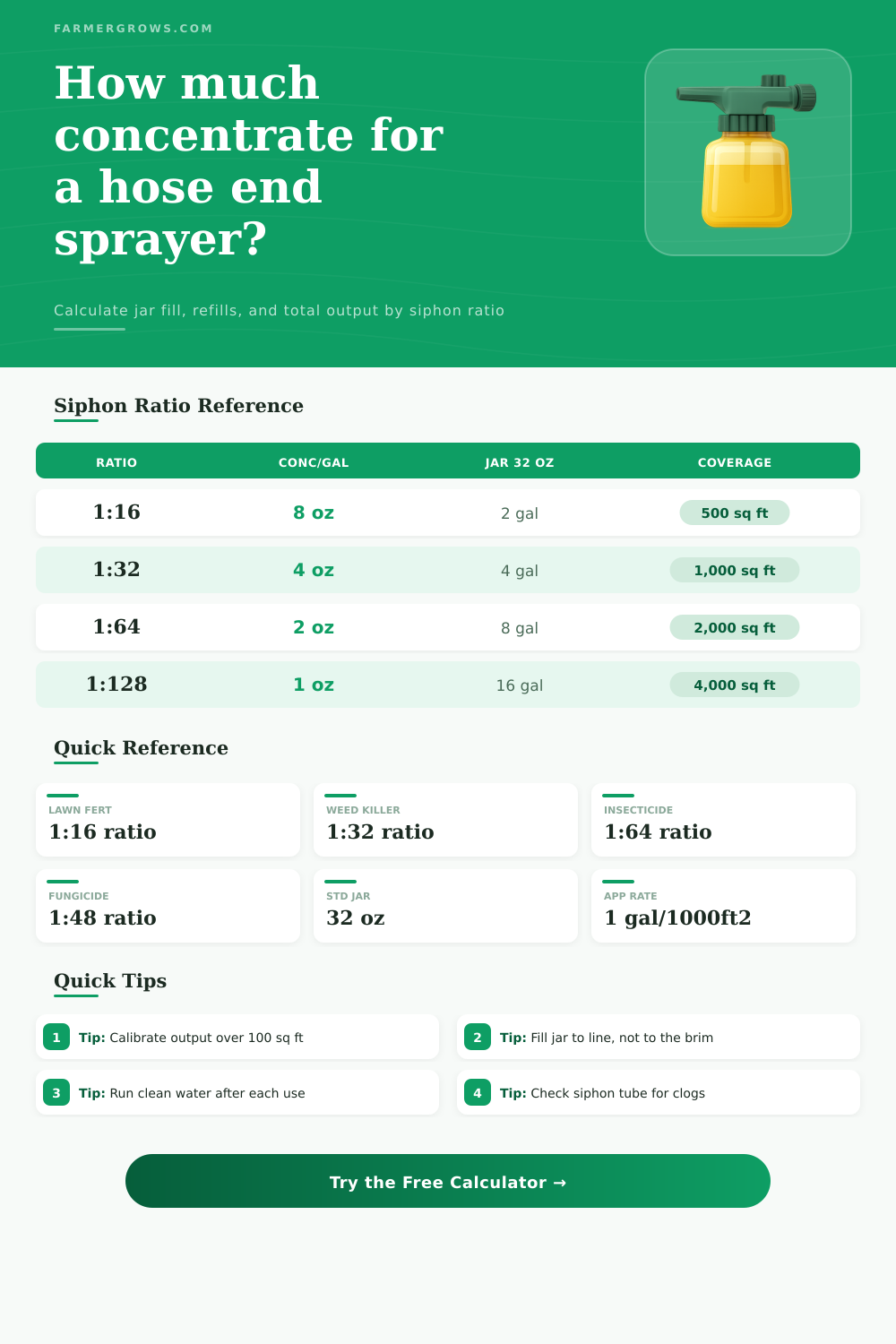
| Siphon Ratio | 20 oz Jar | 32 oz Jar | 48 oz Jar | Mixed Output Per Fill |
|---|---|---|---|---|
| 1:8 | 20 oz | 32 oz | 48 oz | 1.25 – 3 gal |
| 1:16 | 20 oz | 32 oz | 48 oz | 2.5 – 6 gal |
| 1:32 | 20 oz | 32 oz | 48 oz | 5 – 12 gal |
| 1:64 | 20 oz | 32 oz | 48 oz | 10 – 24 gal |
| 1:128 | 20 oz | 32 oz | 48 oz | 20 – 48 gal |
The jar always holds pure concentrate. The siphon ratio determines how much water mixes with it. A higher ratio means more water per ounce of concentrate.
Square feet covered per single 32 oz jar fill
| Siphon Ratio | 1 gal/1000 ft² | 2 gal/1000 ft² | 3 gal/1000 ft² | 4 gal/1000 ft² |
|---|---|---|---|---|
| 1:16 | 4,000 ft² | 2,000 ft² | 1,333 ft² | 1,000 ft² |
| 1:32 | 8,000 ft² | 4,000 ft² | 2,667 ft² | 2,000 ft² |
| 1:48 | 12,000 ft² | 6,000 ft² | 4,000 ft² | 3,000 ft² |
| 1:64 | 16,000 ft² | 8,000 ft² | 5,333 ft² | 4,000 ft² |
| 1:128 | 32,000 ft² | 16,000 ft² | 10,667 ft² | 8,000 ft² |
Coverage assumes even walking pace. Actual coverage varies with nozzle pattern, overlap, and wind conditions.
| Product Type | Typical Ratio | Rate / 1,000 ft² | Jar Fill Note |
|---|---|---|---|
| Liquid lawn fertilizer | 1:16 | 2 – 4 oz mixed | Fill jar with concentrate |
| Broadleaf weed killer | 1:32 | 1 – 2 oz mixed | Follow label mixing rate |
| Lawn insecticide | 1:64 | 1 – 2 oz mixed | Dilute concentrate in jar |
| Fungicide spray | 1:48 | 2 – 3 oz mixed | Even coverage critical |
| Iron / micronutrient | 1:16 | 3 – 4 oz mixed | May stain concrete |
| Tree & shrub drench | 1:128 | 1 – 2 oz mixed | Soak root zone thoroughly |
Always read the product label for exact mixing instructions. Rates vary by brand and formulation.
A hose end sprayer allow a person to mix liquid concentrate with water and apply the mixture to there lawns or garden. To accomplish this tasks, a hose end sprayer use a siphon system to move the liquid concentrate from a jar into a stream of water. A dial on the hose end sprayer allow the user to adjust the ratio of the mixture between the water and the concentrate.
For instance, if the ratio are set to 1:16, for every one part of concentrate by volume, the hose end sprayer will add sixteen part of water to the mixture. Consequently, the total number of parts of the mixture will be the volume of the concentrate plus the volume of the water. Using a hose end sprayer dilution calculator can be helpful for those that is looking to determine the amount of concentrate that is required for their desired area.
How to Use a Hose End Sprayer and Find the Right Mix
To utilize the dilution calculator, a person must know the size of their lawn and the rate at which the product need to be applied to that lawn. If a person adds too much concentrate to their lawn, the grass may become scorched. If they add too little, it may not have a proper effect on the lawn.
Thus, using this dilution calculator can prevent these type of mistakes. Another factor that can influence the amount of area that can be treated with a hose end sprayer is the size of the jar. Most hose end sprayers come with a 32-ounce jar, though some brand have 20-ounce or 48-ounce jars.
When using the hose end sprayer, the person must fill the jar with the liquid concentrate. If the person adds a liquid that has already been mixed with water to the jar, the ratio of concentrate to water will be incorrect. Additionally, the pickup tube on the hose end sprayer must not be kink; if the pickup tube is kinked, the hose end sprayer will not be able to pick up as much concentrate as it should of be able to.
The type of product that is to be diluted with water can also influence the type of ratio that are used with the hose end sprayer. For instance, liquid fertilizers tend to require stronger ratios, such as 1:16, different than other products. Weed killers and insecticides, on the other hand, may require weaker ratios, such as 1:32 or 1:64.
The instructions for the product will tell the user the proper ratio to use. Consequently, if an individual ignores the product label, they may add too much or too little of the product to there lawn. Another factor that can influence the amount of area that is treated with the hose end sprayer is the walking speed of the individual when applying the solution.
If an individual walks too quick with the hose end sprayer, they will apply too little liquid to their lawn. If they walk too slowly, they will apply too much liquid to their lawn. Consequently, an individual should ensure that they walk at a steady speed and ensure that each pass that they take with the hose end sprayer is overlapped by about twenty percent with the next pass.
This ensures that each portion of the lawn is treated, and there are no stripes of untreated grass in the lawn. Lastly, it is necessary to flush the hose end sprayer with water after each use. If the concentrate or water that is applied to the grass is not flushed from the hose end sprayer, it may lead to the clogging of the pickup tube or the nozzle of the hose end sprayer.
If the pickup tube or the nozzle becomes clogged with grass or other substances, the hose end sprayer will not function proper during its next use.