Horse Feed Calculator
Estimate daily hay, grain, protein, water, salt, and transition steps from horse weight, body condition, workload, forage quality, and feed analysis values.
This calculator gives a planning ration, not a veterinary prescription. Use actual hay tests, label values, dental status, pasture access, and veterinarian guidance for horses that are thin, obese, growing, pregnant, lactating, laminitic, or ill.
Daily Feeding Estimate
Use these results as a starting ration and adjust with body weight tape trends, manure quality, appetite, workload, weather, and professional nutrition advice.
| Horse situation | Total dry matter intake | Minimum forage dry matter | Practical note |
|---|---|---|---|
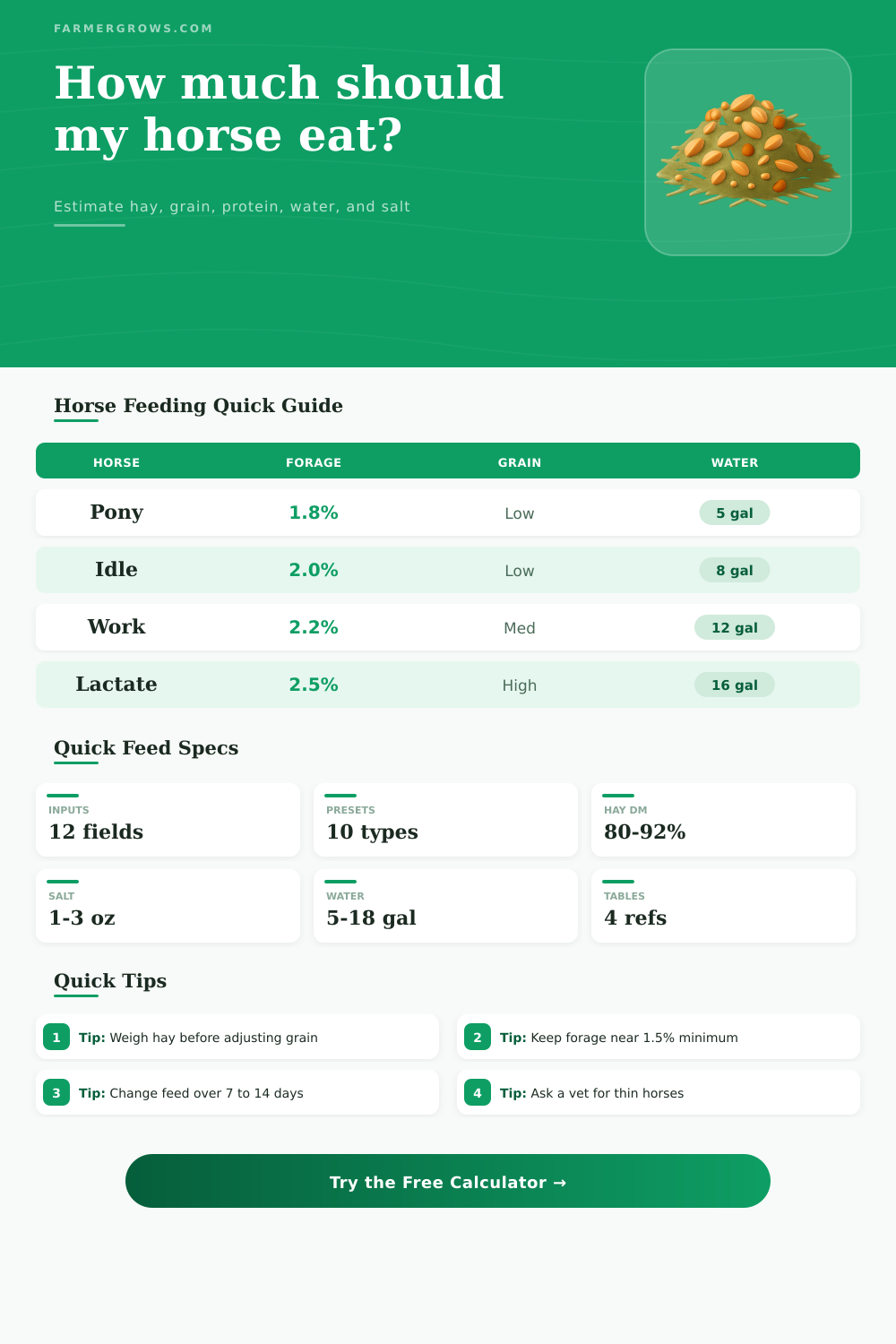
| Weight loss program | 1.5% to 1.8% body weight | 1.5% body weight | Use slow feeders, test hay, and avoid abrupt restriction. |
| Idle adult | 1.8% to 2.1% body weight | 1.5% to 1.8% body weight | Most easy keepers need forage control before grain. |
| Working horse | 2.0% to 2.5% body weight | 1.5% to 2.0% body weight | Raise calories gradually as work increases. |
| Lactating mare | 2.4% to 3.0% body weight | 1.5% to 2.0% body weight | Higher quality forage reduces large grain meals. |
| Workload | DE multiplier | Typical exercise | Feeding implication |
|---|---|---|---|
| Maintenance | 1.00 | Turnout, no regular work | Forage and minerals often cover calories. |
| Light work | 1.20 | 1 to 3 hours weekly light riding | Small concentrate or better hay may be enough. |
| Moderate work | 1.40 | 3 to 5 hours weekly schooling | Split grain and watch hydration closely. |
| Heavy work | 1.70 | Ranch, racing, eventing, endurance prep | Use calorie dense feed while protecting meal size. |
| Very heavy work | 1.90 | Intense daily conditioning | Professional ration balancing is strongly advised. |
| Hay or forage type | Typical dry matter | Estimated DE | Estimated protein | Best use |
|---|---|---|---|---|
| Mature grass hay | 86% to 90% | 0.75 to 0.85 Mcal/lb | 7% to 9% | Easy keepers and controlled calorie plans. |
| Average grass hay | 85% to 90% | 0.85 to 0.95 Mcal/lb | 8% to 11% | Baseline hay for many adult horses. |
| Grass alfalfa mix | 84% to 89% | 0.95 to 1.05 Mcal/lb | 11% to 15% | Working horses, seniors, and broodmares. |
| Leafy alfalfa | 84% to 90% | 1.00 to 1.10 Mcal/lb | 15% to 20% | High protein support when calcium fits the diet. |
| Pasture plus hay | 20% to 35% pasture DM | Variable | Variable | Account for grass intake before adding grain. |
| Condition | Water guidance | Salt guidance | Field note |
|---|---|---|---|
| Idle cool weather | 5 to 10 gal per day | 1 to 2 oz per day | Provide clean water and plain loose salt. |
| Light to moderate work | 8 to 14 gal per day | 1.5 to 2.5 oz per day | Increase salt when sweating or trailering. |
| Hot weather or heavy work | 12 to 20 gal per day | 2 to 4 oz per day | Electrolytes may be needed for heavy sweat. |
| Lactating mare | 12 to 18 gal per day | 2 to 3 oz per day | Water intake drives milk production and appetite. |
| Soaked feeds | Track bucket water too | Keep salt available | Useful for seniors, dust control, and choke risk plans. |
Forage first: Weigh several flakes from each hay lot. Flake size varies widely, so the scale is more useful than counting flakes when you adjust a ration.
Change slowly: Spread hay, grain, pasture, and supplement changes across the transition days. Watch manure, attitude, appetite, and body weight while the gut adapts.
Determining an amount of hay and grain to feed to a horse require a series of small decisions. A horses body weight, its workload, its age, and the quality of the forage will all change the amount of nutrition that a horse require. Because these factors can change, the amount of hay and grain that a person provide to a horse must change as well.
If a person provides hay and grain that contains too little nutrition for a specific horse, that horse may exhibit change in its energy levels, the quality of its coat, and even its attitude. Each of the factors that are consider in the calculator will change the mathematical result for the horse. The calculator will use the weight of the horse as a starting point for the calculation of the amount of hay and grain that should be provided to the horse.
How to Calculate Hay and Grain for a Horse
The body condition score of the horse will allow the calculator to determine whether the horse needs more calorie in its diet or fewer calories. The calculator will use the workload of the horse to mathematicaly increase the amount of energy that is required of a horse according to its workload. The life stage of the horse will allow the calculator to increase the amount of energy and protein requirements of a younger horse in comparison to an older horse.
Forage quality will be an important parameter in the calculator because two types of hay can contain different amount of digestible energy. The dry matter percentage of the hay will allow the calculator to determine how much water should be factored into calculating the amount of nutrition of the hay. If these corrections are not accounted for in the calculator, the amount of hay, grain, and nutrients that is calculate will not be accurate for the horse.
The calculator will provide several different output as a result of the calculation of the amount of hay and grain that should be provided to the horse. The calculator will provide the amount of hay and the amount of concentrate that should be fed to the horse in both pound and kilograms. Estimates of the amount of water and the amount of salt that should be provided to the horse will also be provided.
The calculator will calculate the amount of protein in the ration and compared it to the target amount of protein for the horse. The meal count will display how many meals of concentrate should be provided to the horse based off the amount of concentrate that a horse can eat in one meal. Each of these outputs will provide a starting point for feeding the horse, but these figure are not the finished prescription for the horses ration.
Each person should use these calculations to start to develop a plan for feeding the horse and then to observe how the horse respond to that plan. A series of reference tables are also provided for the horse owner. Idle adult horses require a dry matter content of approximately 2% of the horse’s body weight.
Lactating mares, however, require approximately 2.5% of the body weight of the mare to meet its nutritional needs. Working horses require more energy than idle horses, but that energy should come from forage if at all possible. The tables indicate that horses require more water and salt when they are losing sweat (working) or producing milk.
These tables are not rules, but they do allow a person to see if a calculated ration fall outside of normal bounds for a horse. The needs for hay and pasture change with the environment. Lots fill and pastures change with the changing of the season.
A horse that weigh the same in spring may not have the same amount of weight in fall. A calculator cannot determine the horse’s teeth, manure quality or starch level in feed. A calculator can remove the arithmetic for these feeds, but a person must know the condition of the horse.
Mistakes are made with forage. Not providing enough may lead to gut problem in the horse. A common mistake is to change the ration too quick.
However, the calculator includes a transition field to allow for several day to allow the hindgut microbes to adjust to the change in ration. If done too fast, the horse may develop loose manure or a lack of appetite. Water intake is essential and limits other nutritional processes in the horse body.
A horse will require more water when working, warm weather or producing milk. Because salt increases thirst, the amount of salt and water intake will go together. If a horse is not drinking enough water, check the water for cleanliness and temperature before changing the ration.
The value of the calculator is in observing the horse over a period of time. Enter the ration into the calculator and feed the horse for two week. If the horse’s weight change in the correct direction, the ration is probably correct.
If not, change one of the inputs to get the proper ration for the horse. This cycle will help establish the proper feeding program for the horse.