Hoop House Calculator
Estimate hoop count, bow pipe length, purlin footage, plastic cover area, enclosed volume, end wall area, and usable bed space from your structure dimensions and layout.
Use measured width and planned center height when possible. The calculator treats each bow as a circular segment, then adjusts the arc for hoop style so pipe, plastic, and bed formulas stay transparent.
| Hoop style | Arc factor | Volume factor | Use case |
|---|---|---|---|
| Quonset round bow | 1.00 x circular segment arc | 0.67 x width x height x length | General season extension and simple bending layouts. |
| Gothic peak bow | 1.08 x circular segment arc | 0.72 x width x height x length | Better snow shedding and taller shoulder feel. |
| Caterpillar tunnel | 1.02 x circular segment arc | 0.64 x width x height x length | Light seasonal tunnels with fewer permanent parts. |
| Low tunnel | 0.94 x circular segment arc | 0.60 x width x height x length | Bed-scale row cover, low crops, and temporary protection. |
| Spacing | Typical structure | Hoops per 100 ft | Planning note |
|---|---|---|---|
| 3 ft | Heavy snow, nursery starts, exposed sites | 35 including end hoops | More pipe and clips, but less unsupported plastic span. |
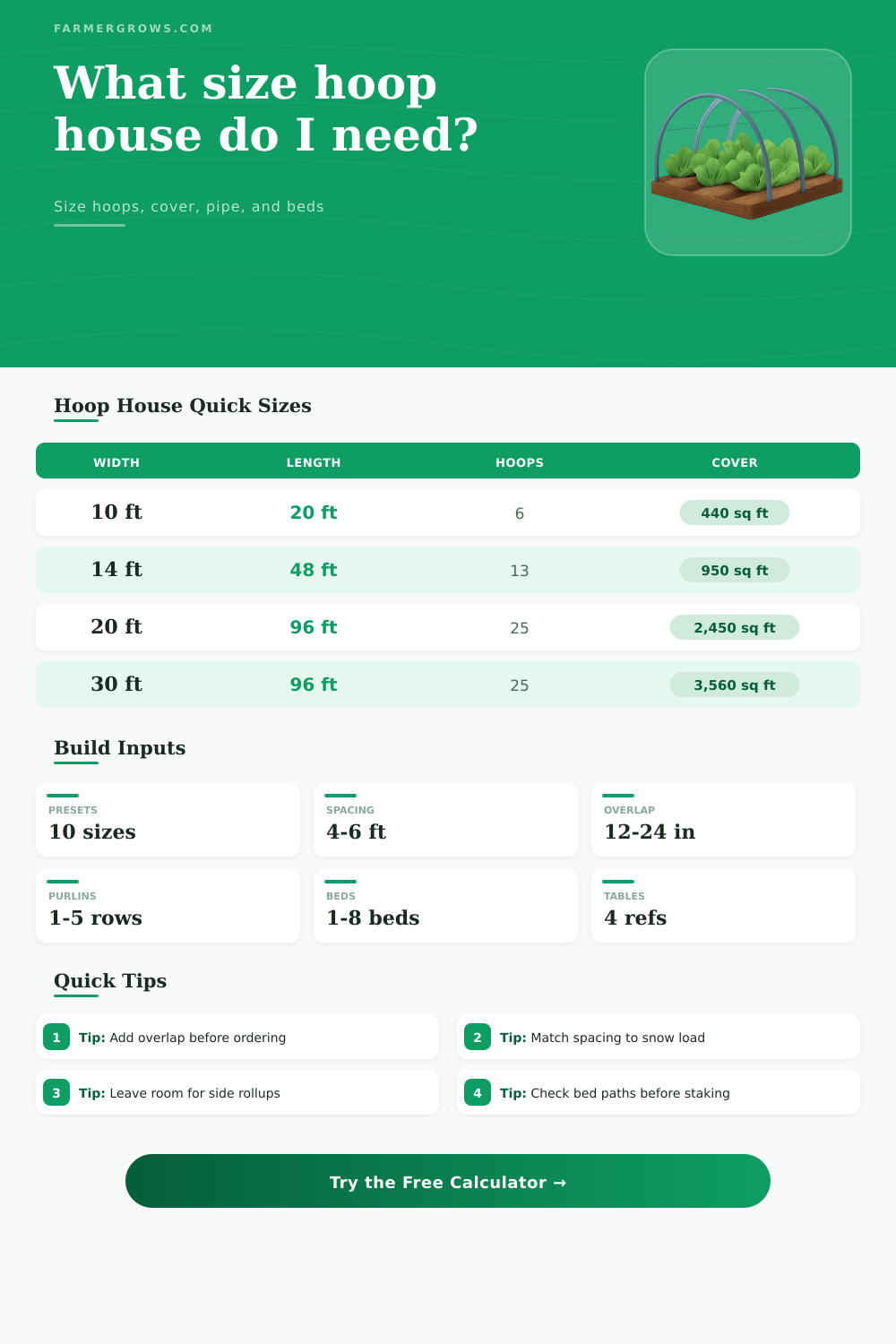
| 4 ft | Common market-garden high tunnel | 26 including end hoops | Good default for many 14 to 30 ft wide houses. |
| 5 ft | Moderate climates and shorter houses | 21 including end hoops | Often workable when purlins and anchors are strong. |
| 6 ft | Light-duty caterpillar or mild sites | 18 including end hoops | Check wind and snow exposure before using wide spacing. |
| House width | Common height | Typical film width | Overlap reminder |
|---|---|---|---|
| 10 to 12 ft | 5 to 7 ft | 20 to 24 ft roll | Allow side burial, wiggle wire, or roll-up edge. |
| 14 to 17 ft | 6 to 8 ft | 28 to 32 ft roll | Check arc length instead of using width alone. |
| 20 to 24 ft | 8 to 11 ft | 36 to 40 ft roll | Extra edge helps if end bows are not perfectly square. |
| 26 to 34 ft | 11 to 15 ft | 48 to 60 ft roll | Leave handling slack for pulling film over long houses. |
| Inside width | Common bed plan | Planted width | Path and edge note |
|---|---|---|---|
| 10 ft | Two 30 in beds | 5.0 ft | Works for low tunnels and narrow caterpillar houses. |
| 14 ft | Three 30 in beds | 7.5 ft | Keep shoulders clear for cover edges and irrigation lines. |
| 20 ft | Four 36 in beds | 12.0 ft | Balanced layout for greens, herbs, and short trellis crops. |
| 30 ft | Six 36 in beds | 18.0 ft | Central paths or utility strips may reduce planted area. |
Check plastic after layout: Order from the calculated arc plus side overlap, not just the ground width. A taller gothic bow can need much wider film than its footprint suggests.
Fit beds before driving posts: Add beds, paths, side clearance, drip lines, and roll-up hardware before finalizing width. A workable walking path is part of the growing system.
A hoop house are a structure that use curved pipes and plastic film to extend the growing seasons for plants. When you design your hoop house, you must decides on its width, length, and height. These dimensions will affects the cost of the hoop house and the growing spaces it provides for your plants.
For instance, the width of the hoop house will determine how many garden bed can fit inside the hoop house. The length will determine how many pipe you need to build your hoop house. Finally, the height will affect how much pipe you need to build the hoops and how much air will be inside the hoop house.
How to Plan Your Hoop House Size and Shape
The style of the bow that the hoops will make will affect the appearance of the hoop house. For instance, a Quonset bow is a round bow that spreads the weight of the plastic film even across the structure of the hoop house. A Quonset bow is a good choice if your climate isnt too extreme.
A gothic peak bow has a sharper ridge than a round Quonset bow and will shed snow more effective. However, you will need to buy more plastic and pipe to construct a hoop house with a gothic peak bow. A caterpillar tunnel is a hoop house that sit lower to the ground and uses fewer purlins to create the hoops.
The fewer the purlins, the more less expensive the hoop house will be. Each hoop style has an arc factor and a volume factor. The hoop house pipe and air-space calculator will use these factors to calculate the amount of pipe and the amount of air that should be inside the hoop house when you select a certain hoop style.
Another factor that will affect your hoop house is the distance between the hoops. If you place the hoops three feet apart, your hoop house will be very strongly, but you will have to buy more pipe. If you place the hoops four feet apart, you will save money on pipe.
Four feet is the most common distance between hoops for market gardens. Using five and six foot distance between hoops will use less pipe. However, the plastic film will have to span a larger distance between hoops.
The spacing input will allow you to see how many hoops you will need if you change the distance between the hoops. Another critical component for your hoop house is the plastic film. You must calculate the total area of the curved plastic film for your hoop house.
The film must cover the entire hoop house structure. You will also have to purchase extra plastic film to bury the hoops or attach hardware to the hoops. You will also have to add plastic film to the hoops to create an overlap so the film is secure to the hoops.
A ten-percent addition to the plastic film is sufficient for a good crew to construct your hoop house. However, if the plastic film will be exposed to the elements or if you will need to redo a seam in the plastic, use a fifteen or twenty-percent addition to the total amount of plastic film. The hoop house calculator will separate the roof plastic from the end walls to calculate the amount of plastic film needed for each part of the hoop house.
The layout of your garden beds and paths will determine the growing space for your plants inside the hoop house. The more narrow the paths in the hoop house, the more growing spaces you will have for your plants. However, you will need to leave room for your shoulders to move between the garden beds with your harvest tote.
You will also have to leave room for the plastic film to roll up on the sides of the hoop house in hot weather. You can use the bed-count and bed-width to determine if your garden layout will fit into your hoop house. Any layout that comes to a width greater than the width of the hoop house the hoop house calculator software will flag.
The volume of air that will be inside the hoop house will impact the stability of the temperature inside the hoop house. The taller your hoop house, the more air it will hold. A larger amount of air will cause the temperature in your hoop house to change more slow between the hours of the sun when the plants are exposed to the sun and after the sun sets.
A hoop house with a large volume of air will take longer to heat up in the morning. The volume estimate for your hoop house will use the cross-section area times the length of your hoop house to estimate the volume of air in cubic feet. This volume will let you compare the air capacity of a low caterpillar tunnel hoop house with that of a tall gothic hoop house.
The total amount of pipe that you will need to build your hoop house will depend on the number of purlin that you use to tie your hoops together. A hoop house that is twenty feet wide will use three rows of purlins. However, if you live in an area that receives alot of snow, five row of purlins may be required.
The total length of the purlins will be added to the total length of pipe for the hoops. A percentage of waste will also be added to these lengths to ensure you have enough pipe to complete your hoop house project.