Heating Degree Days Calculator
Estimate seasonal heat demand, envelope loss, infiltration load, and fuel input for barns, sheds, hoop houses, and other farm buildings.
Use a preset to seed the calculator with a familiar building type. Each option sets the climate base, average outdoor temperature, days, shell size, R-value, infiltration, system factor, and fuel form.
Heating Degree Day Results
Seasonal demand, peak load, and fuel input are shown below.
| Base | Use | Meaning | Note |
|---|---|---|---|
| 50 F | Cool rooms | Low heat need | Storage use |
| 55 F | Mixed spaces | Short season | Light shell |
| 60 F | Work zones | Balanced load | General use |
| 65 F | Living spaces | Standard base | Most common |
| Band | HDD/yr | Climate feel | Planner note |
|---|---|---|---|
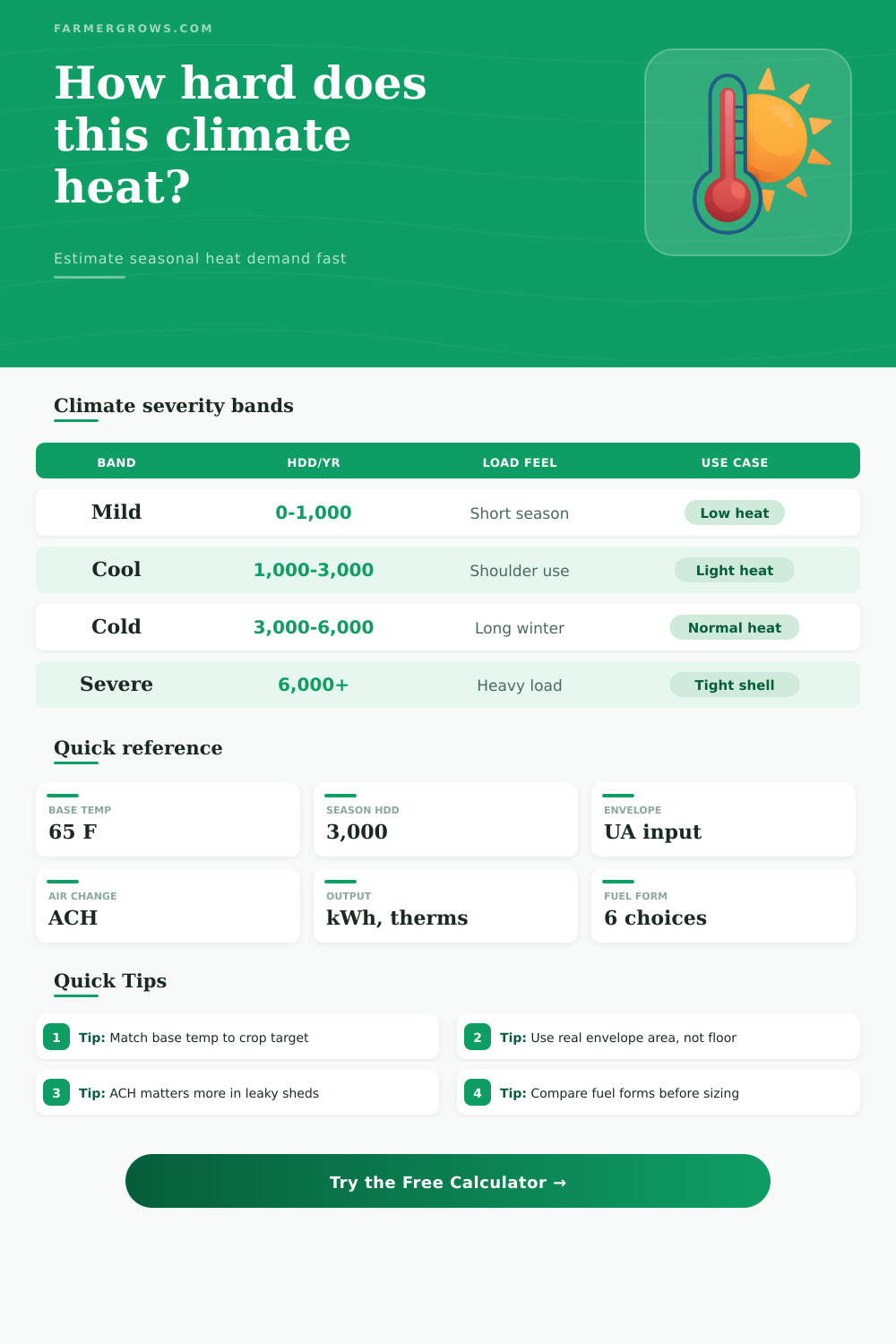
| Mild | 0-1,000 | Short winter | Small load |
| Cool | 1,000-3,000 | Shoulder use | Light heat |
| Cold | 3,000-6,000 | Long season | Normal shell |
| Severe | 6,000+ | Heavy winter | Tight envelope |
| Benchmark | Value | What it means | Load note |
|---|---|---|---|
| R-10 shell | High loss | Poor insulation | Big UA |
| R-20 shell | Mid shell | Average build | Normal UA |
| R-30 shell | Good shell | Strong wrap | Lower UA |
| 0.5 ACH | Tight shed | Low leakage | Small infilt |
| Fuel | Unit | Heat content | Use note |
|---|---|---|---|
| Electric | kWh | 3412 Btu | Direct heat |
| Natural gas | therm | 100,000 Btu | Common input |
| Propane | gal | 91,600 Btu | Rural barns |
| Wood pellets | ton | 16.5 MMBtu | Bulk biofuel |
Heating degree days are the measurement of an amount of heat that is required to maintain a specific temperature within a building. A heating degree day isnt a measurement of a 24 hour period, but instead is a measurement of the amount that the average outdoor temperatures drops below the target base temperature for the building. For instance, if the target base temperature is set at 65 degrees but the average outdoor temperature is 40 degrees, then the calculation of the heating degree days will reveal that there is 25 heating degree days for that specific date.
In order to calculate the total number of heating degree days that are required for a given season, the figure is calculated for each day within that season. The total number of heating degree days for that season will tell the individual if that season are mild or severe, and will provide information as to how much fuel is to be purchased for that season, or how large the heating equipment for that building should of been sized. The target base temperature is the main factor in calculating the degree days that is required for a building to remain at that target base temperature.
What Are Heating Degree Days and How They Help
If the target base temperature for a root cellar, for instance, was set at 55 degrees, then fewer heating degree days would be calculated for that building than if the target base temperature was 65 degrees, the target base temperature for a potting room for tropical plants. Thus, a ten-degree difference in the target base temperatures will result in a significant amount of fuel that that building will consume over time. Heat loss from a building can occur in two main ways: through conductive loss of heat, and through air infiltration into the building.
Conductive loss is heat that leave a building through the building materials through which it passes, and the R-value for those materials determines how much heat is lost through that structure. A thin plastic sheet has a lower R-value than a wall that is wrapped in fiberglass insulation batts, for instance, which means that heat will escape more quickly through the plastic sheet than through the fiberglass wrapped wall. Air infiltration is the movement of outdoor air into the building, which leads to outdoor air replacing the indoor air.
Air infiltration is measured in air changes per hour (ACH). Air changes per hour will be higher in a building that has many air leaks, leading to the need for more fuels to heat that structure. A heating calculator calculates the area of the buildings envelope, as well as the air change rate for the building.
The area of the buildings envelope and the air change rate for that building allow for the determination of the peak heat loss of that structure. Peak heat loss is the amount of heat that a building loses during the coldest portion of that buildings season. Determination of the peak heat loss for a building prevents the purchase of heating equipment that is too small or too larger for that building.
Heating equipment that is too large for the building will cycle on and off too frequently to heat the structure, leading to wear and tear on the heating equipment. Internal gain is another factor in the heating load of a building. Internal gain is the heat that the objects that is inside the structure release into the structure.
Any animals, grow lights, or individuals that is within the building create internal gain within the structure. Thus, internal gain works to offset the total heating load of the structure, and ensures that the heating load calculations for the structure is accurate. In order to use the result of a heating calculation, the heat loss in BTUs must be converted into another fuel source.
For instance, people use BTU measurements of heat loss, but fuel that will be purchased will be gallons of propane, cords of wood, or even kilowatt-hours of electricity. The efficiency of each fuel source will impact the total amount of fuel that may be required to heat the structure. For instance, heat pumps may emit more heat than the amount of electricity that it consume, but an old furnace may lose some of the heat that it generates through its flue.
If the estimate for the fuel that the building will consume is too high, there are three main methods to reduce that fuel estimate. First, the target base temperature may be lowered. Second, people may seal air leaks in the structure.
Third, the fuel source that is used may be replaced with an efficient fuel source. Sealing air leaks is the most efficient method for reducing the fuel that is required for the building. Thus, heating degree days provides a method for turning heating requirements into a budget, and managing the weather accordingly.