Corn Seed Germination Time Calculator
Estimate corn emergence date, accumulated growing degree days, expected stand, planting grid, and frost risk from seed-zone soil temperature, corn type, maturity, seeding depth, row spacing, residue, and cold forecast pressure.
Corn emergence is driven by seed-zone heat after imbibition. This calculator uses a corn base temperature of 50°F, adjusts the GDD target for corn type, seed age, depth, soil moisture, residue, and cold nights, then ties the timing to row spacing and stand-loss planning.
Corn Emergence Results
Estimates combine corn base-50 GDD, seed-zone temperature, corn type, depth drag, moisture, residue, stand allowance, and frost timing.
| Seed-zone soil temp | Likely emergence pace | GDD effect | Stand risk | Field note |
|---|---|---|---|---|
| Below 50°F | Stalled or very slow | Near 0 GDD/day | High | Cold imbibition and disease pressure can reduce stand. |
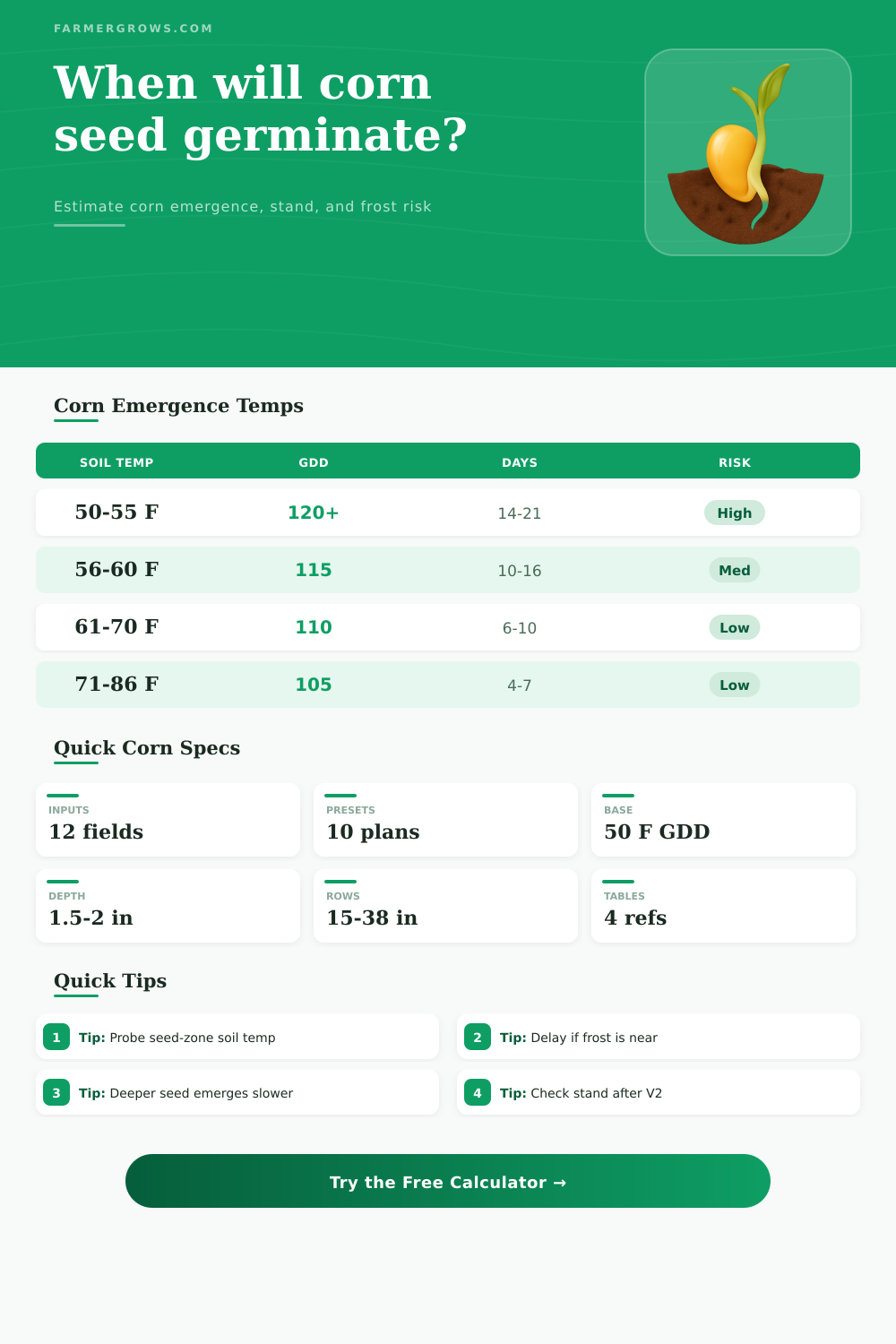
| 50 to 55°F | 14 to 21 days | Low daily GDD | Moderate to high | Works best with high-vigor seed and improving forecast. |
| 56 to 60°F | 10 to 16 days | Moderate daily GDD | Moderate | Common early planting zone for field corn. |
| 61 to 70°F | 6 to 10 days | Strong daily GDD | Low | Usually the most reliable spring emergence range. |
| 71 to 86°F | 4 to 7 days | Fast daily GDD | Low if moist | Watch shallow sweet corn beds for drying. |
| Corn type | Base emergence GDD | Best soil temp | Depth focus | Special caution |
|---|---|---|---|---|
| Field dent corn | 105 to 115 | 55 to 86°F | 1.5 to 2.25 in | Residue and cool rain can stretch the window. |
| Early field hybrid | 105 to 112 | 52 to 75°F | 1.5 to 2 in | Often planted early, so frost timing matters. |
| Sweet corn su | 115 to 125 | 60 to 86°F | 1 to 1.5 in | Seed is less rugged than field corn in cold wet soil. |
| Supersweet sh2 | 135 to 150 | 65 to 86°F | 0.75 to 1.25 in | Delay planting until the bed is warm and draining. |
| Popcorn | 125 to 135 | 58 to 82°F | 1 to 1.75 in | Small seed needs firm contact and even moisture. |
| Row spacing | Seed spacing | Seeds per acre | Garden equivalent | Use case |
|---|---|---|---|---|
| 30 in | 6.0 in | 34,848 | 0.80 seeds/sq ft | Common field grain and silage rows. |
| 30 in | 8.0 in | 26,136 | 0.60 seeds/sq ft | Wider final stand or sweet corn ears. |
| 20 in | 7.0 in | 37,335 | 0.86 seeds/sq ft | Narrow-row field corn systems. |
| 15 in | 8.5 in | 49,183 | 1.13 seeds/sq ft | High-density systems or forage use. |
| 36 in | 10.0 in | 17,424 | 0.40 seeds/sq ft | Garden sweet corn or small equipment. |
| Formula term | Formula used | Why it matters | Scout check |
|---|---|---|---|
| Daily corn GDD | ((min(maxT,86)+max(minT,50))/2)-50 | Measures heat available to corn seed. | Use local high/low data after planting. |
| Seed-zone blend | 0.7 soil + 0.3 forecast air | Warms or cools soil expectation. | Probe soil at seed depth in morning. |
| Population per acre | 43,560 sq ft / row-ft per seed | Converts row spacing and in-row spacing. | Count plants in 1/1000 acre strips. |
| Expected stand | seeds x emergence rate x loss factor | Estimates useful seedlings after stress. | Confirm at V1 to V2 before replanting. |
Before planting: Check seed-zone soil temperature for several mornings, not just afternoon surface warmth. Corn can tolerate cool starts better when the next two days are warming.
After planting: Scout by emergence stage and stand count. Uneven spikes often point to depth variation, crusting, residue shade, or cold water sitting in the furrow.
You stand in the field with your seed just planted. Now all it need is heat to do its thing. It’s thermodynamic, the seeds beneath the black soil waiting in the dark. Maybe you’re checking the weather app every other minute but that only tells half the story, the story of air temperature. What matters more are the temperature at seed depth, where roots search for moisture. To track when things will germinate, we use measurement of total heat, not guesswork.
Once you input your soil conditions, the rest of the math are done for you. The calculator saves you from finding the daily average and then adding those averages up. Because corn doesn’t grow below 50 degrees F., the calculator assume a base temperature of 50, so warmth below fifty doesn’t count towards emergence date; only warmth above that does. This is known as growing degree days, a concrete way to measure what’s otherwise an unpredictible process.
How to Track Corn Growth with Heat Units
As long as the soil remains at sixty degrees, you add heat gradualy. When it dips to fifty-two, things slow down. The tool takes these factors into account based off the corn type, since different hybrid respond differently to cool mornings. When weather’s cool, sweet corn’s less tolerant of a chilly start than field corn typically is. Why? Because those kernels are softer; they don’t like their soaking water so cold. Supersweets are even more tender. They can be especially tricky they may require even warmish soil to push up and out of the crust.
That difference is reflected in the heat unit requirement adjustment made by the calculator. If you plant a tender seed in cold ground, the predicted emergence date shift later. This alerts you that the seedling might not emerge in time to avoid being exposed to frost (or perhaps some other disease) first.
Other variables matter, and while it sounds easy, depth can be tricky. If you’ve had a dry period, trying to get plants in deep might result in moist soil. But emergence will happen later with each added half inch of depth. They have to force their way farther through compacted soil which requires more kernel energy. That means slower development. And greater risk if things turn bad during your waiting period. The tool takes all that into account, resulting in a longer estimate range for deeper-planting too.
It looks at more than just your seeds per acre; it also considers row width to calculate how many plants is likely based on your planting grid pattern. This is useful when deciding if you should of replant part of a field that has come up light or just let it grow out.
Soil temperature is also influenced by residue cover. Insulating cover tends to maintain soil coolness earlier in the day but slows down drydown later. Early in the season, no-till fields tend to be cooler than clean-tilled beds, causing an additional few days delay in sprouting. You gain moisture but lose warmth.
And those benchmarks relate to rate of emergence (stand risk) versus soil temperature. They are found on page in reference tables. They help you set realistic expectations based on the prediction if it isn’t clear.
It’s all about germination, about racing not only nature but also the calendar. Get the corn up before pests or frost do. Also, make sure there is enough heat so it grow evenly and emerges at the same time. Uniformity in growing makes for uniform maturity, and that helps at harvest time. Learning your variety’s heat requirement, and checking the temperature where those seeds are planted, shifts from guesswork toward informed management. From reading the sky to reading the dirt, the corn will follow when the ground do. Buried potential becomes a standing crop, one row at a time.