Hay Bales Per Acre Per Year Calculator
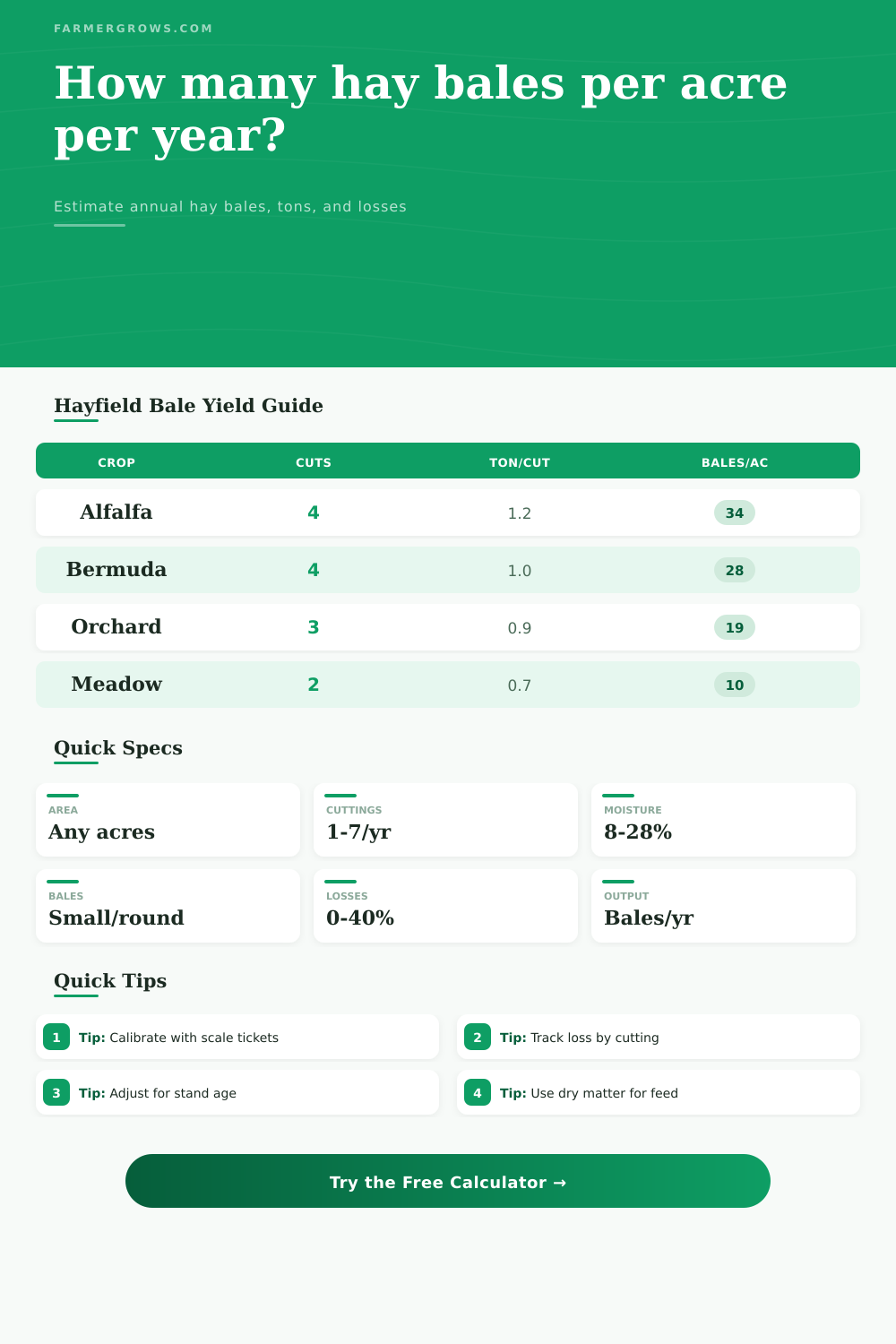
Estimate annual hay bale production from acres, crop, cuttings, per-cutting yield, moisture, bale size, field loss, storage loss, fertility, and stand age.
Choose a realistic hayfield starting point, then adjust acres, crop, cuttings, field losses, storage shrink, bale type, fertility, and stand age for your own farm records.
Annual Hay Bale Estimate
Your hayfield estimate will update as inputs change.
High-yield legume hay can produce strong dry matter where fertility, pH, drainage, and harvest timing stay on target.
Warm-season fields respond heavily to nitrogen and summer moisture, often with several smaller harvest windows.
Cool-season grass gives dependable spring tonnage, with summer regrowth depending on rain and stand vigor.
Mixed stands balance grass tonnage and legume quality, but bale count shifts as the botanical mix changes with age.
| Bale type | Typical size | Common weight at 15% moisture | Best calculator use |
|---|---|---|---|
| Small square bale | 14 x 18 x 36 inches | 45 to 65 lb | Horse hay, hand-stacked barn inventory |
| Three-string square | 16 x 23 x 44 inches | 90 to 120 lb | Western small square production |
| Mini round bale | Ranch compact round | 350 to 500 lb | Small equipment and specialty hay |
| 4 ft x 5 ft round bale | 48 inch wide x 60 diameter | 650 to 900 lb | Common beef cattle hay roll |
| 5 ft x 5 ft round bale | 60 inch wide x 60 diameter | 800 to 1100 lb | High-volume round bale systems |
| 5 ft x 6 ft round bale | 60 inch wide x 72 diameter | 1100 to 1600 lb | Large cattle hay and transport planning |
| 3 ft x 3 ft large square | 3 x 3 x 8 ft | 700 to 900 lb | Dairy, export, and mechanized stacks |
| 3 ft x 4 ft large square | 3 x 4 x 8 ft | 900 to 1400 lb | Dense large-square commercial hay |
| Field scenario | Cuttings/year | Field-cured tons/ac/year | Approx small squares/ac/year |
|---|---|---|---|
| Prime alfalfa, good fertility | 4 | 4.0 to 6.0 tons | 130 to 200 bales at 55 lb |
| Bermuda grass, fertilized | 4 | 3.0 to 5.0 tons | 98 to 164 bales at 55 lb |
| Orchardgrass hay field | 3 | 2.0 to 3.5 tons | 65 to 115 bales at 55 lb |
| Mixed grass-legume stand | 3 | 2.3 to 4.0 tons | 75 to 131 bales at 55 lb |
| Native meadow or low-input hay | 1 to 2 | 0.8 to 1.8 tons | 26 to 59 bales at 55 lb |
| Adjustment | Low value | Moderate value | High value |
|---|---|---|---|
| Field loss from harvest handling | 4% careful handling | 8% normal dry hay | 15% leafy or weather delayed |
| Storage loss after baling | 3% covered indoor | 8% covered outdoor | 20% ground contact or weathering |
| Safe dry hay moisture | 10% very dry | 14% to 16% typical | 18% plus watch zone |
| Stand age yield factor | 0.72 thin old stand | 1.00 mature stand | 1.04 prime stand |
| Annual tons after field loss | 55 lb small squares | 850 lb round bales | 800 lb 3x3 squares |
|---|---|---|---|
| 2 tons per acre | 73 bales/ac | 5 bales/ac | 5 bales/ac |
| 3 tons per acre | 109 bales/ac | 8 bales/ac | 8 bales/ac |
| 4 tons per acre | 145 bales/ac | 10 bales/ac | 10 bales/ac |
| 5 tons per acre | 182 bales/ac | 12 bales/ac | 13 bales/ac |
| 6 tons per acre | 218 bales/ac | 15 bales/ac | 15 bales/ac |
Use real weights when possible. Bale counts become much sharper when you weigh a few representative bales from each cutting and update the bale weight field.
Separate field and storage loss. Field loss reduces bales made; storage loss reduces feedable hay later, especially with round bales stored outdoors.
During hay season, your head will spin with conflicting numbers. There’s an empty barn but a full field. It is not a trick of voodoo. It is a matter of physics. From field to barn, things happen: leaf shatter, moisture loss, and weather delays all diminish yields before stacking a bale.
When cutting hay, most producers estimate what tonnage they’ll have based off how their pasture appeared at cut time. This is dangerous behavior. Dry matter isn’t green weight. Feed value isn’t visual volume. A system that bridges the gap from cutting to feeding time are needed. This page fills that gap.
How to Calculate Your True Hay Yield
Enter your farm’s raw variables: how many acres? What are you growing? The calculator show your potential, or what you could harvest using only those two factors. But the true math occurs in the adjustments.
First is field loss. This includes leaving leaves on the ground and dropping chunks from the baler. To account for that reality, there’s a percentage slider at the bottom. In good conditions and fast harvesting, you might expect only five percent loss. But if it’s been rainy and you wait around for a couple days till things are dry enough to go, and now the crop has sweated in the windrow a bit, you’ll double or triple that number. It is a little thing but it is very important.
Storage loss also matters. Round bales left on soggy ground or exposed to a lot of rain will still be perfectly baled yet lose half their bales. The field loss and storage shrink gets separated out by the calculator so you know what’s leaking. Storing indoors preserves your investment. Storing outdoors requires a bigger loss rate. Moisture and covering affect the final count, as seen in the reference table on the page.
Your loss rates may be too low. Double-check your storage assumption. Odds are good that you’re overestimating your survival over the winter.
The engine is fueled by crop choice. Timothy might be easier to handle (and hold less water), but it makes fewer tons per acre than alfalfa does. Nitrogen helps a bermuda grass pasture, but what happens when there’s no rain in summer? Fertility inputs and stand age further adjust those base yields. A second-year stand isn’t the same as a seventh; a 7-year-old pasture yield differently than a 2-year-old. Remember the age factor; forgetting it will raise your expectations. The calculator automatically figures that into the equation, delivering a more cautious, lower estimate of an older pasture.
The other thing that affects the math is Bale size. They may be small squares or round bales (which look smaller in count but weigh much more). The tool will convert them into bales by the ton no matter what their shape. You just need to enter the appropriate weight for your baler, moisture levels etc. A small dry square weighing 45 pounds on the ground will weigh less than a square that weighed 55 pounds with fifteen percent moisture when it was made. Enter the right weight. The tool won’t work without it. If you put in a generic weight, you will get a generic number back. It will be wrong. If you have a scale ticket, use it. Real data is always better than guessing.
The bottom line is that dry matter matters. You can’t buy a bunch of hay on the scale in tons; you need to feed it to your animals. That’s where the dry matter comes into play. What your animals EAT is the dry matter number of output. Gross tonnage is always higher than that number. That difference is the portion of your bales lost to mold and heat, plus all the moisture lost from evaporation. Use that dry matter number when planning how much feed you will have this winter. Do not use the number shown on the scale. That’s the one you’ll live or die by.
It’s not a question of wishing that Mother Nature cooperates when planning your hay crop; it’s all about reducing the losses that you do expect. Rain? Out of your hands. Accounting for it in advance? That’s where your hands go to work. Moisture, storage shrink, field loss… Put them together and you’re no longer guessing; you’re starting to know.
The math runs itself with the tool up top. It’s you who does the accounting, the discipline part. Plug in the real numbers. Grin and bear the reduced yields. Stack ’em high. Come winter, you’ll know just what you’ve got, every last pound of dry matter.