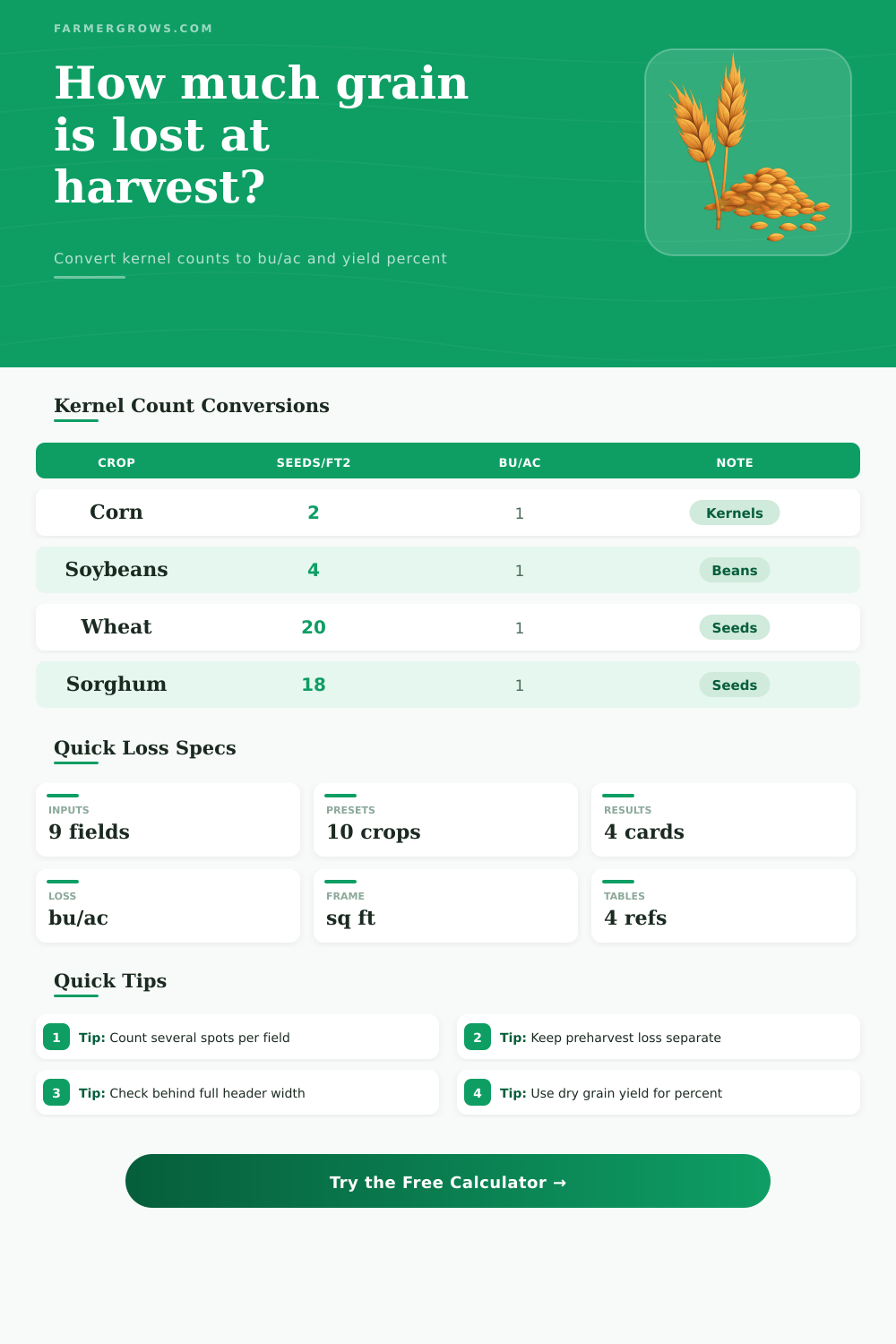
Harvest Grain Loss Calculator
Convert field kernel or seed counts into preharvest loss, header loss, separator loss, total bu/ac loss, and percent of expected yield.
Count loose kernels or seeds in a measured frame at several representative spots. Keep preharvest counts separate from combine-caused header and separator counts so adjustment decisions are based on machine loss, not field loss that happened earlier.
Harvest Loss Results
Results convert counted kernels or seeds per frame into seeds per square foot, crop-specific bu/ac loss, and percent of yield.
| Crop | Approx. seeds per bu/ac per sq ft | Standard bushel weight | Typical field count note |
|---|---|---|---|
| Corn | 2 kernels/ft² = 1 bu/ac | 56 lb/bu | Count whole kernels and loose kernels from dropped ears separately if needed. |
| Soybeans | 4 beans/ft² = 1 bu/ac | 60 lb/bu | Small changes in cutterbar or reel position can shift header loss quickly. |
| Wheat | 20 seeds/ft² = 1 bu/ac | 60 lb/bu | Windrows, chaff rows, and uneven spreaders can make more samples necessary. |
| Barley | 15 seeds/ft² = 1 bu/ac | 48 lb/bu | Check cracked grain and unthreshed heads along with the ground count. |
| Oats | 10 seeds/ft² = 1 bu/ac | 32 lb/bu | Light grain and straw volume can make separator loss uneven behind the machine. |
| Sorghum | 18 seeds/ft² = 1 bu/ac | 56 lb/bu | Use a small frame or average many counts because seed numbers rise quickly. |
| Canola | 70 seeds/ft² = 1 bu/ac | 50 lb/bu | Very small seed makes a light-colored tray or frame helpful. |
| Rice | 21 seeds/ft² = 1 bu/ac | 45 lb/bu | Soft ground and lodged areas may need separate checks. |
| Frame size | Area | Best use | Count conversion example |
|---|---|---|---|
| 1 ft x 1 ft | 1 sq ft | Small-seeded crops, fast spot checks | Counts equal seeds/ft² directly. |
| 1 ft x 2 ft | 2 sq ft | Soybeans, canola, small strips | Divide counted seeds by 2 before crop conversion. |
| 2 ft x 2.5 ft | 5 sq ft | General combine checks | Divide counted seeds by 5 before crop conversion. |
| 2 ft x 5 ft | 10 sq ft | Corn, soybean, broad checks | Divide counted seeds by 10 before crop conversion. |
| 3 ft x 5 ft | 15 sq ft | Low-loss corn or wide headers | Useful when individual kernel counts are low. |
| Loss component | Where to count | What it points to | Field reminder |
|---|---|---|---|
| Preharvest loss | Before crop enters the header | Lodging, shatter, dropped ears, wildlife, weather | Subtract this before judging combine settings. |
| Header loss | Behind the header but ahead of combine discharge pattern | Reel speed, cutterbar, deck plates, gathering chains, snouts | Use header width and row width to keep sample locations honest. |
| Separator loss | Behind the combine discharge pattern | Rotor, cylinder, concave, fan, sieve, chaffer, travel speed | Check tailings, grain tank quality, and unthreshed heads. |
| Machine loss | Header plus separator | Harvest setup and operating speed | Use this number for adjustment decisions. |
| Total field loss | Preharvest plus machine | Overall field grain left on the ground | Use this number for harvest record comparisons. |
| Symptom in the field | Likely loss source | First setting to inspect | Repeat-count target |
|---|---|---|---|
| Whole ears or missed rows | Header | Gathering speed, snout height, deck plate spacing | Header loss falls without more butt shelling. |
| Loose beans at cutterbar | Header | Reel speed, reel fore-aft, ground speed, cutterbar condition | Header count drops while feeding remains smooth. |
| Clean grain behind discharge | Separator | Fan, chaffer, sieve, rotor speed, concave clearance | Separator count drops with clean tank sample. |
| Unthreshed heads or pods | Threshing | Rotor or cylinder speed and concave clearance | Ground count and tank dockage both improve. |
| Heavy loss on slopes | Cleaning shoe | Travel speed, leveling, sieve load, spread pattern | Counts become even across the header path. |
Sample pattern: Toss or place the frame in several spots across the swath, including center and outer header areas. Average the counts before making a major setting change.
Adjustment discipline: Change one combine setting at a time, harvest enough distance to stabilize flow, then recount with the same frame size and crop conversion.
measuring the loss of grain that occurs while the combine is moving through the fields is a necessary process to calculate the financial costs of that loss. Although individual kernels of grain may seem small when viewed up close, they accumulate to form many bushel of grain. The number of bushels of grain that the combine loses can be measured by counting the number of kernels of grain that are found within a frame of known size, and converting that count into an amount of bushels per acre.
The method by which that measurement is converted from the count of kernels to bushels per acre must change according to the crop that is being harvested, due to the difference in the size of the kernels within each of the different types of crops. A calculator can be used to make this measurement, as the calculator can process not just the dimension of the frame in which the grain is counted, but also the different counts of grain from three separate sources: the grain that was already on the ground prior to the combine header entering the field with the grain, the grain that the header knocks loose, and the grain that the remainder of the combine loses. Each of these individual measurements must be calculated separately.
How to Measure Grain Loss from a Combine
The count of the grain that is lost due to factors other than the combine (such as lodging, weather, or wildlife) can help to indicate whether the combine is efficiently performing its tasks; the grain that is lost due to the header can indicate issues with settings or components of the header; and the loss of grain due to the remainder of the combine can reveal if there are mechanical issues with the remainder of the combine. If these measurements were combined into a single number, it would be impossible to determine which component of the combine require adjustment. Thus, the requirement to enter each of these measurements into the calculator helps to ensure that the combine operators can understand which components of the combine require adjustment.
Four to six different samples of the grain can be collected across the width of the combine header to calculate an average amount of grain loss. Averaging the amounts of grain loss allows for the evenness of the combines header to be smoothed out by evenness in the count of the amount of grain within samples. A frame of ten square feet is recommended for counting the amount of grain in fields containing large-seeded crops; a smaller frame is used for crops like canola.
Additionally, the combine operator must enter the row spacing of the combines header into the calculator; without the row spacing, the calculation may lead to inaccurate conclusions regarding the evenness of the combine header. The calculator will provide an output that includes the total amount of grain loss, the amount of grain loss that occurred due to the combine alone, and the percentage of the total expected yield of the field that was lost due to combine-related issues. For most crops, a machine-only grain loss of less than 1% is considered to be excellent performance; a machine-only grain loss between 1% and 2% is considered to be normal performance.
When the machine-only grain loss reaches 3% or more, the combine should be stopped to make necessary mechanical changes. Additionally, the calculation will provide information regarding the individual contributor of the total loss; this information will allow those using the calculator to determine whether they makes adjustments to the combine header or to the remainder of the combine. In addition to the calculations that are performed with the calculator, there are additional variables regarding the field that contribute to grain loss.
For instance, different slopes within the field will affect the performance of the fan located on the combine. Additionally, different moisture levels in the field will affect how much grain shatters at the cutterbar, and different changes in the speed at which the combine moves forward will cause it to throw grain out of the back of the combine. The combine operators must consider these variables when measuring the amount of grain loss of the combine.
Thus, it is recommended to make one change to the combine, run the combine for a few hundred feet, and then measure the loss of grain again with the frame. The trend in grain loss over time will be more reliable than the measurement of grain loss at one point in time. It is essential for combine operators to consider grain loss as part of the routine operation of the combine, rather than in emergency situations.
By understanding what normal performance of the combine looks like, the operators will be able to recognize any loss of that normal performance. Thus, the grain count is a routine task that the combine operators should perform; the settings to the combine will change, but the frame that is used to count the grain will remain the same. By performing this task on a routine basis throughout the farming season, the operators will protect the yield of the fields more effective than if they perform the task only once at the end of the farming season.