Vegetable Garden Fertilizer Calculator
Estimate bed area, vegetable crop demand, soil test N-P-K status, organic matter credit, compost or manure credit, fertilizer grade, and side-dress split in pounds of product.
Load a common bed or crop plan, then adjust the dimensions, soil test levels, compost or manure credit, fertilizer grade, and timing for your garden.
Vegetable Fertilizer Plan
Your garden fertilizer estimate will appear here.
These cards recalculate from the current bed area, fertilizer grade, soil test, and credit settings so you can compare crop groups before changing the selected crop.
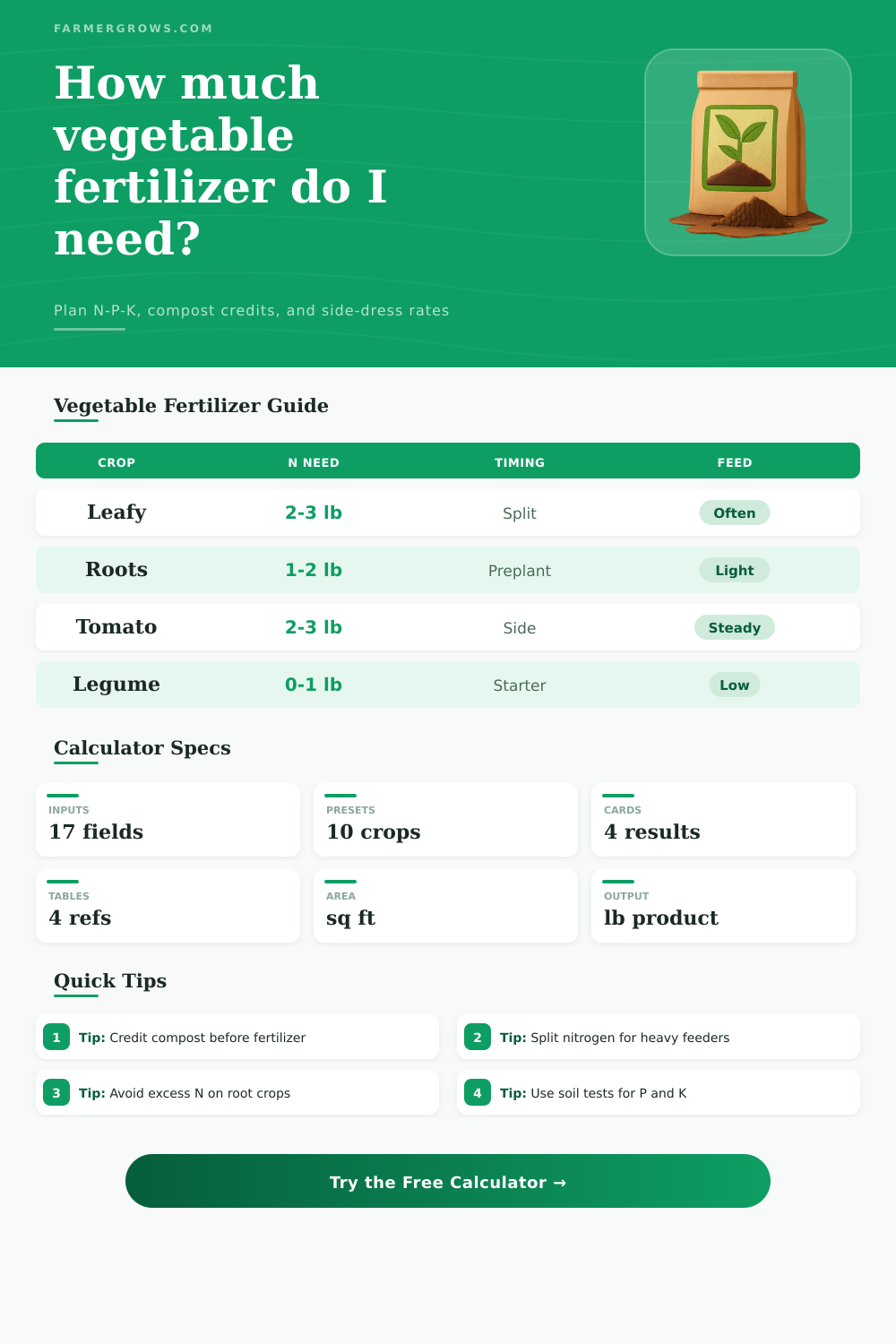
| Vegetable crop group | Season N target | P2O5 planning target | K2O planning target | Common timing pattern |
|---|---|---|---|---|
| Leafy greens | 2.6 lb/1000 sq ft | 1.0 to 2.0 lb/1000 sq ft | 1.5 to 2.5 lb/1000 sq ft | Small repeated feeds after cutting |
| Root crops | 1.2 lb/1000 sq ft | 1.2 to 2.2 lb/1000 sq ft | 1.5 to 2.8 lb/1000 sq ft | Mostly preplant, avoid excess N |
| Fruiting vegetables | 2.4 lb/1000 sq ft | 1.5 to 2.8 lb/1000 sq ft | 2.2 to 3.5 lb/1000 sq ft | Preplant plus bloom side-dress |
| Cole crops | 3.0 lb/1000 sq ft | 1.3 to 2.5 lb/1000 sq ft | 2.0 to 3.2 lb/1000 sq ft | Preplant plus midgrowth side-dress |
| Legumes | 0.6 lb/1000 sq ft | 0.8 to 1.8 lb/1000 sq ft | 1.2 to 2.4 lb/1000 sq ft | Light starter, little extra N |
| N-P-K grade | N percent | P2O5 percent | K2O percent | Best garden fit |
|---|---|---|---|---|
| 10-10-10 balanced | 10 | 10 | 10 | General beds when all nutrients are needed |
| 5-10-10 garden | 5 | 10 | 10 | Root, flower, and fruiting crops with enough N |
| 4-4-4 organic | 4 | 4 | 4 | Mild feed for mixed beds and raised beds |
| 3-4-6 tomato | 3 | 4 | 6 | Tomatoes, peppers, eggplant, and cucurbits |
| 12-0-0 blood meal | 12 | 0 | 0 | Nitrogen-only side-dress for greens or corn |
| Compost or manure | Input unit | Available N credit | P2O5 credit | K2O credit |
|---|---|---|---|---|
| Finished compost | Per 1 inch over 1000 sq ft | 2.5 lb | 1.4 lb | 2.0 lb |
| Leaf compost | Per 1 inch over 1000 sq ft | 1.2 lb | 0.8 lb | 1.0 lb |
| Mushroom compost | Per 1 inch over 1000 sq ft | 3.0 lb | 2.2 lb | 2.8 lb |
| Aged cow manure | Per lb per 100 sq ft | 0.6% of weight | 0.4% of weight | 0.6% of weight |
| Composted poultry manure | Per lb per 100 sq ft | 2.0% of weight | 2.0% of weight | 1.2% of weight |
| Timing approach | First share | Side-dress share | Best crop fit | Watch point |
|---|---|---|---|---|
| All preplant | 100% | 0% | Roots, herbs, low-feeding beds | Avoid heavy soluble N before rain |
| Preplant plus side-dress | 50% | 50% | Tomatoes, peppers, cole crops | Place side-dress away from stems |
| Light starter plus side-dress | 30% | 70% | Warm-season transplants | Use gentle starter near roots |
| Heavy side-dress program | 35% | 65% | Corn, squash, long-season crops | Do not delay the first side-dress |
| Small weekly feedings | 20% | 80% | Containers and leafy greens | Use several light applications |
Credit tip: Count compost and manure before sizing bagged fertilizer. Mature compost may feed slowly, but it can still move the N-P-K plan.
Timing tip: Side-dress nitrogen for tomatoes, corn, squash, and cole crops after plants are established rather than loading the whole season up front.
Fertilizer applications requires the person to perform calculation to ensure they provides the vegetables with a proper amount of nutrients. Each type of vegetable require a different amount of nutrients than the other vegetable crops. Furthermore, a person cannot apply fertilizer without first determining the current nutrient level in the soil, as the soil contain the nutrients necessary to fulfill the needs of the vegetables.
A person must determine the amount of nitrogen, phosphorus, and potassium that is already contain within the soil, as well as determining the amount of nitrogen, phosphorus, and potassium that adding compost or manure to that bed will provide to the vegetable bed. The calculator tool can determine the total amount of fertilizer product that must be purchased based off these factor, such as the size of the vegetable bed to be fertilized, the nutrient levels that are found in the soil, the type of vegetable crops that will be grown within that bed, and the organic credit that will be provided to that soil. Soil tests will provides the initial data to perform the calculation of the amount of fertilizer product that should be purchased.
How to calculate fertilizer for vegetable beds
Soil tests will reveal the levels of nutrients that are currently contain within the root zone of the vegetables. The nitrates that is contained within the soil will reveal the amount of nitrogen that is currently available for the plants. Similarly, the phosphorus and potassium levels within the soil will reveal whether those nutrients are currently low, medium, or higher within the soil.
If the amount of phosphorus and potassium are high within the soil prior to adding fertilizer, then adding more of those two nutrients will not aid the plants in fulfilling there nutrient requirements, and may even slow the growth of those plants due to the excess nutrient. The fertilizer calculator will account for these levels within the soil when determining how much fertilizer product the grower must add to the vegetable bed. The organic matter that will be added to the soil will also release nitrogen into the soil over time, so the amount of nitrogen that that organic matter will release is also provide for in the fertilizer calculation.
The compost and manure that will be added to the vegetable bed will provide the vegetables with nitrogen, phosphorus, and potassium. The person applying the fertilizer must measure the amount of compost and manure that will be added to the vegetable bed. The amount of nitrogen, phosphorus, and potassium that compost and manure provide is dependent upon the thickness of the layer of compost and manure that is add.
For instance, a one-inch layer of compost will provide more nutrients to the vegetables than a thin layer of compost. Thus, the person must measure the amount of compost and manure to account for the nitrogen, phosphorus, and potassium that will be release into the soil. The fertilizer calculator will provide a credit for the nutrients that the compost and manure will provide prior to calculating the amount of bagged fertilizer that the grower must purchase.
The type of vegetable that will be grown within the vegetable bed will impact the amount of fertilizer that is required for that vegetable bed. For instance, leafy vegetables require more nitrogen than root vegetable. Similarly, fruit vegetables contain more phosphorus and potassium than nitrogen during the flowering stage of the vegetable.
Thus, different types of vegetables will require adjustment to the fertilizer product calculations. The timing of when the fertilizer is added to the soil will also impact the amount of fertilizer that is calculated for each vegetable bed. Different types of vegetables will require the addition of all of the fertilizer at the time of planting, but other vegetables may require the fertilizer to be provide in parts throughout the growing season.
For instance, it is common to add a portion of the fertilizer at the time of planting, and the remainder of the fertilizer may be added in one or two applications during the season. These split applications will ensure that the nitrogen is available for the vegetables during there period of highest need of that nutrient, as well as help to avoid losing some of that nitrogen to rain during the early portion of the season. The reference tables include with the fertilizer calculator will indicate the types of nitrogen, phosphorus, and potassium target for the vegetables that are to be grown within the vegetable bed, as well as the common fertilizer grade that contain those nutrients.
Each of the reference tables will indicate the amount of nutrients that different types of compost and manure will provide, allowing the grower to decide whether purchasing additional fertilizer or compost will be beneficial to the vegetable bed. These reference tables can help to create a fertilizer plan that is based upon the growers vegetable bed condition, rather than guessing at the amount of each nutrient that is required to be added to the soil. Thus, the fertilizer calculator aims to provide the vegetables with the nutrients that they require in order to grow, but also to avoid adding excess nitrogen to the soil, as well as to avoid purchasing fertilizers that contain nutrients that are already contain within the soil.