Days to Harvest Calculator
Estimate when a crop will be ready from a planting or transplant date, adjust for variety speed and weather, check frost risk, and map a harvest window plus succession planting dates.
🌱 Crop presets
Choose a common crop to fill the form, then fine tune the dates, maturity days, variety type, and season adjustment for your garden.
📅 Harvest date inputs
🌿 Crop maturity comparison grid
📊 Reference tables
| Crop preset | Typical start | Default days | Harvest window |
|---|---|---|---|
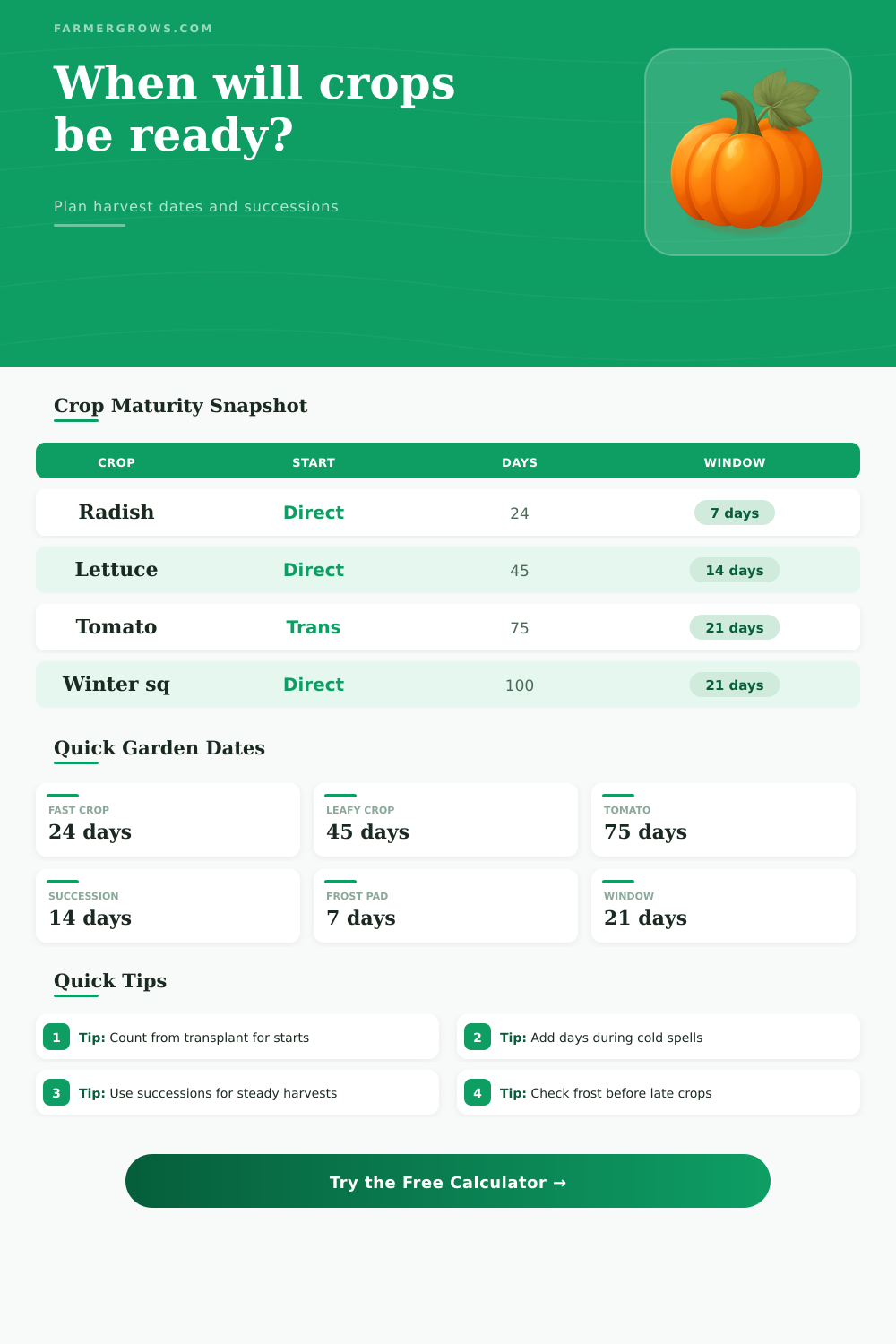
| Radish | Direct seed | 24 days | 5 to 10 days |
| Leaf lettuce | Direct seed or transplant | 45 days | 10 to 21 days |
| Bush bean | Direct seed | 58 days | 14 to 21 days |
| Cucumber | Direct seed or transplant | 62 days | 21 to 35 days |
| Tomato | Transplant | 75 days | 21 to 45 days |
| Pepper | Transplant | 78 days | 21 to 40 days |
| Broccoli | Transplant | 72 days | 10 to 20 days |
| Carrot | Direct seed | 80 days | 21 to 45 days |
| Winter squash | Direct seed or transplant | 100 days | 14 to 30 days |
| Variety type | Date adjustment | Best use | Planning note |
|---|---|---|---|
| Very early | Subtract 12 days | Short seasons and first harvests | Confirm packet days before relying on the full shortcut. |
| Early | Subtract 7 days | Quick market or home harvests | Useful when planting several varieties of one crop. |
| Standard | No change | Most seed packet estimates | Good default when variety details are unknown. |
| Late or storage | Add 8 days | Storage carrots, cabbage, onions | Often gives better size or storage quality. |
| Large-fruited | Add 12 days | Large tomato, melon, squash types | Needs warm finishing weather and frost space. |
| Season condition | Adjustment | Why it matters | Example crop response |
|---|---|---|---|
| Normal season | 0 days | Use packet days as written. | Most crops in steady weather. |
| Cool spring | Add 7 days | Growth slows when soil and nights stay cold. | Lettuce, carrot, broccoli may sit longer. |
| Cold soil setback | Add 12 days | Warm-season seed can stall before germination. | Beans, cucumber, squash are most affected. |
| Warm steady growth | Subtract 4 days | Moderate warmth speeds vegetative growth. | Tomato, bean, cucumber often move faster. |
| Heat stress delay | Add 5 days | High heat can pause flowering or quality. | Tomato fruit set and leafy greens can slow. |
| Short days late season | Add 8 days | Fall plantings mature slower as day length drops. | Carrot, lettuce, and brassicas need extra time. |
| Succession crop | Common interval | Stop rule | Harvest planning cue |
|---|---|---|---|
| Radish | 7 to 10 days | Stop before hot weather or hard frost. | Short window, so small repeat sowings work well. |
| Leaf lettuce | 10 to 14 days | Pause during peak heat unless shaded. | Cut baby leaves first, then allow regrowth. |
| Bush bean | 10 to 14 days | Stop when frost-free days run out. | Two or three blocks can smooth harvest volume. |
| Cucumber | 14 to 21 days | Stop when late mildew or frost risk is high. | Newer vines can replace tired early plants. |
| Carrot | 14 to 21 days | Plan last sowing by maturity plus fall slowdown. | Storage plantings need time to size before winter. |
| Broccoli | 21 to 28 days | Use transplants for reliable fall timing. | Harvest main heads, then side shoots if weather holds. |
Planning a garden requires the use of actual harvest dates rather than hopeful assumption about harvest dates. The use of actual harvest dates is one of the best ways to decrease instance of disappointment in the vegetable garden. Most people simply choose a seed packet based off the days to maturity that is shown on the packet.
People typically assume that there vegetable garden will fill the requirements that they set up for themselves based on the days to maturity on the packet. However, a variety of factor that will alter the harvest date of each vegetable will manipulate that number. One of the factors that will affect the harvest date of each vegetable is the starting method for the vegetable.
Plan Your Vegetable Garden Using Real Harvest Dates
Those that are started from a seed will have different harvest dates than those that are started as a transplant. The calculator will allow for the calculation of days to harvest once the user chooses the starting method for each vegetable. For instance, the calculator will count the days to harvest for radishes and carrots from the day that the seed enters the soil.
However, the days to harvest for tomatoes and pepper will be counted from the day that the young plant goes into the ground. Assuming that the vegetable that is started from a seed will have the same days to harvest as the same vegetable started as a transplant will introduce error into the harvest date estimates for those vegetables. Another of the factors that will impact the harvest date is the variety of the vegetable that will be grown in the vegetable garden.
The early variety of a vegetable will have a different number of days to maturity than the standard variety. Additionally, the large-fruited variety will have a different number of days to maturity than the storage variety of the same vegetable. These varieties are not promotional names for the vegetable seeds but instead are indicative of how long it takes for the plant to mature with each of these different category.
These different numbers can be accounted for in the calculator to determine the true days to maturity for the vegetables. Another of the variables that will alter the days to harvest for the vegetables is the weather for the region where the vegetable garden is to be started. The weather can manipulate the growth of vegetables.
For instance, starting seeds in soil that is too cool will alter the days to maturity of those vegetables. Additionally, too much heat can impact the growth of vegetables in the same way that cool soil does. Each of these variables can be accounted for in the calculator to determine the true days to maturity of vegetables that may be impacted by these environmental factor.
Once the days to maturity have been determined, the length of time that the vegetable will remain usable can be determined. Each vegetable will have a different length of time during which it will be usable. For instance, some vegetables will be usable for a shorter period of time than others.
Accounting for this length of time will help determine whether the vegetables from one planting will meet the needs of the garden, or if additional sowings will be required to provide enough vegetables to the vegetable garden. The succession interval will allow for the planning of additional sowings to account for the length of time that vegetables will be usable from the initial planting of the seeds. For any vegetables that will be started after the middle of summer, the impact of frost risk should be accounted for in the planning of the vegetable garden.
The date for the first harvest can be compared to a buffer date, and the maturity date for the vegetables can be compared to the average date of the first frost of the year. These two dates will reveal whether or not the vegetable will finish growing before the frost of the year sets in, or if there are alterations that should be made to the start of the vegetables to ensure they will finish growing before the winter season. The reference tables can be used during the planning of the vegetable garden in the case that there are any question about the dates for which the vegetables will be harvested.
These tables can indicate the days to maturity for the vegetables, as well as the impact that various factor can have on the maturity of those vegetables. The gardener does not have to memorize these tables, but can refer to them when making decision about the vegetable garden. This will prevent the selection of vegetable seed based on the assumption that the vegetables will have the same length of time to maturity as those that were grown the previous year.
Succession planting can be determined using the calendar view of the vegetable garden planner. The decision of how many days to wait between successive plantings of the same vegetable will allow for an estimation of how the vegetable will continue to grow after the initial planting date. For instance, vegetables such as radishes will require a seven-to-ten-day interval between sowings.
However, leaf lettuce will require more time to restow than bush beans, which will benefit from two or three block of planting that occur every ten to fourteen days. These dates are suggestions for how fast the vegetable will grow from sowing to size that is usable from the vegetable garden, but can easily be adjusted based on the dates that are calculated for each planting. The last date that a vegetable can be planted is a step that many people skip when planning their vegetable garden.
However, it is important to find the last safe date to plant seeds in order to prevent frost from damaging the growth of the vegetable. This date can be found by working backwards from the average date of the first frost of the year, and accounting for the number of days that it takes for the vegetable to mature. This date is not something that can be negotiated for tender vegetable.
Hardy vegetables can be planted closer to the first frost of the year, but even for these vegetables a buffer will be established to protect the vegetable from the detrimental effect of cold soil in the winter season. When planning a vegetable garden, the days to maturity for the vegetables should be treated as an estimate of the time that the vegetables will take to mature. The impact that various variables will have on those days to maturity will allow for the estimation to be adjusted accordingly.
Once these variables have been accounted for, the vegetable garden will function as an actual schedule for the vegetables to be harvested from the vegetable garden. The change in the way that many vegetable gardeners plan their vegetable gardens will lead to harvests that occur at the times that they wish for those vegetables to be available from the vegetable garden.