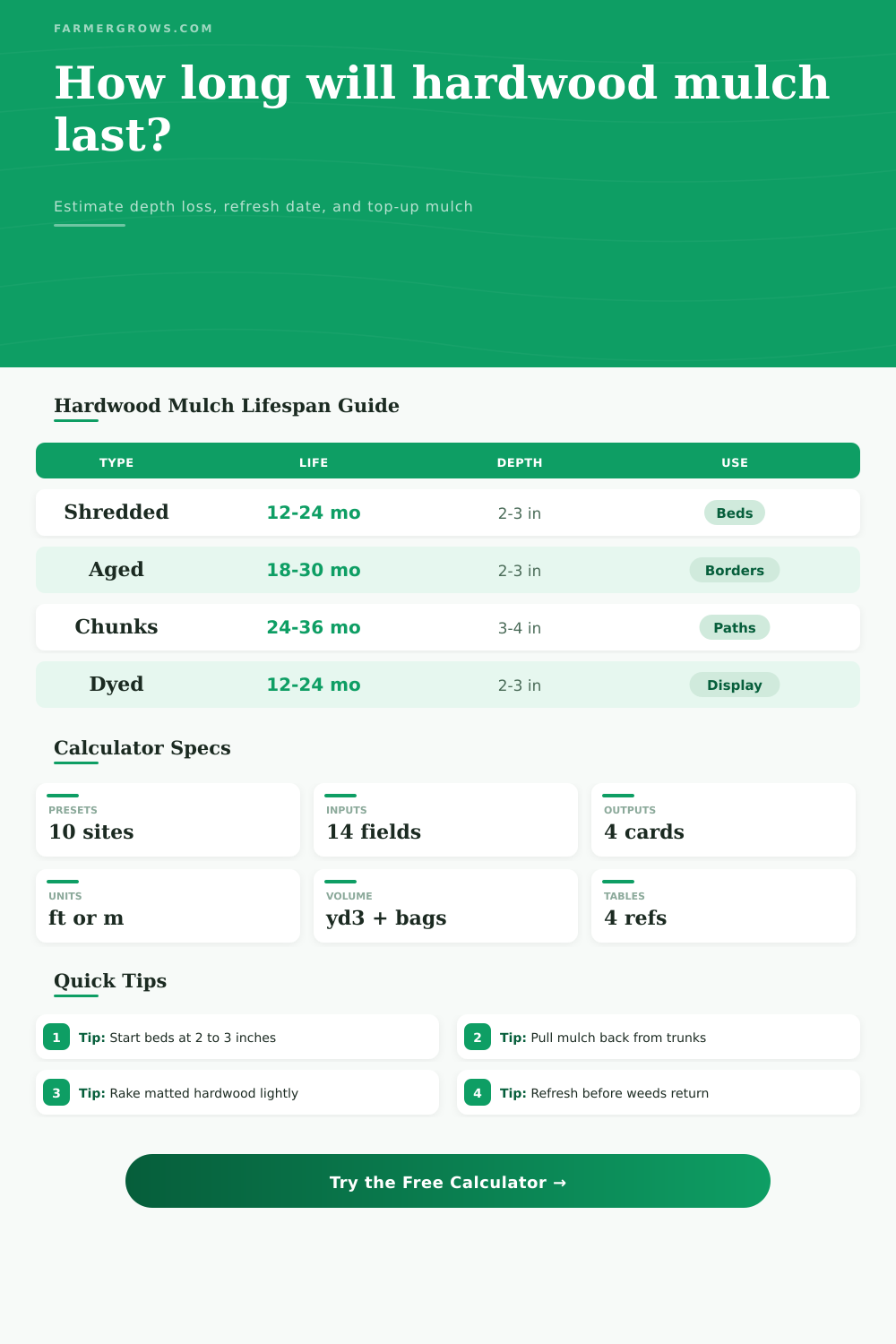
Hardwood Mulch Lifespan Calculator
Estimate how long hardwood mulch will keep useful depth, when to refresh it, and how much top-up material is needed for beds, borders, tree rings, paths, and play edges.
Load a realistic hardwood mulch situation, then tune the area, depth, site exposure, traffic, slope, and maintenance to match the bed you are judging.
Hardwood Mulch Lifespan Estimate
Adjust the fields above to calculate remaining life and top-up volume.
Hardwood decomposes faster in wet beds, splash zones, irrigated borders, and areas where leaves mix into the layer.
Triple-shredded hardwood looks neat but loses loose depth sooner than chips or bark chunks.
Foot traffic, pets, blowers, and bed cleanup reduce usable depth even when the wood has not fully decomposed.
Most beds perform well at 2 to 3 inches; deeper layers fit paths better than crowns or trunks.
| Top-up depth | Sq ft per yd³ | Sq m per m³ | 2 cu ft bag covers | 3 cu ft bag covers |
|---|---|---|---|---|
| 0.5 in | 648 sq ft | 79.8 m² | 48 sq ft | 72 sq ft |
| 0.75 in | 432 sq ft | 53.2 m² | 32 sq ft | 48 sq ft |
| 1 in | 324 sq ft | 39.9 m² | 24 sq ft | 36 sq ft |
| 1.5 in | 216 sq ft | 26.6 m² | 16 sq ft | 24 sq ft |
| 2 in | 162 sq ft | 20.0 m² | 12 sq ft | 18 sq ft |
| 3 in | 108 sq ft | 13.3 m² | 8 sq ft | 12 sq ft |
| Container | Volume | Bags per yd³ | Coverage at 2 in | Coverage at 3 in |
|---|---|---|---|---|
| Small bag | 1.5 cu ft | 18 bags | 9 sq ft | 6 sq ft |
| Standard bag | 2 cu ft | 13.5 bags | 12 sq ft | 8 sq ft |
| Large bag | 3 cu ft | 9 bags | 18 sq ft | 12 sq ft |
| Half yard bulk | 13.5 cu ft | 0.5 yd³ | 81 sq ft | 54 sq ft |
| One yard bulk | 27 cu ft | 1 yd³ | 162 sq ft | 108 sq ft |
| Project | Typical area | Fresh depth | Refresh interval | Top-up at 1 in |
|---|---|---|---|---|
| Small front bed | 80 sq ft | 2-3 in | 12-20 mo | 0.25 yd³ |
| Foundation border | 160 sq ft | 2-3 in | 14-24 mo | 0.49 yd³ |
| Tree ring, 8 ft diameter | 50 sq ft | 2-3 in | 18-30 mo | 0.15 yd³ |
| Garden path | 180 sq ft | 3-4 in | 18-30 mo | 0.56 yd³ |
| Large landscape bed | 500 sq ft | 2-3 in | 12-24 mo | 1.54 yd³ |
Measure the loose layer before ordering. Push aside leaves and crusted flakes, then measure several spots. Hardwood often looks thin at the surface while still holding depth underneath.
Top up to the target depth, not above it. Restoring a 2 to 3 inch layer usually improves weed control without burying crowns, stems, or trunk flares.
MULCH: In spring, you buy it, pay to have it delivered on truck, and then marvel as they pour that rich, dark layer over your flower bed. Then in late summer, it’s all gray and thin again. What a waste of money, you think.
No, no, hardwood mulch is like a slow-burning log; it breaks down and compacts at a pace determined by both you (with your leaf blower) and the sun. A few quick calculation can show you the results, but knowing how the numbers shift will save your garden.
Why Mulch Changes and How to Fix It
One: What kind of wood? The standard in landscapes is double-shredded hardwood, which retain its shape and doesn’t mat down. Less surface area equals slower decomposition, so chunky bark (rather than small pieces) endure longer. It’s not just good-looking; there’s less surface area for microbes to munch. And yes, finer does break down faster, at least initially. A fine-triple-shredded variety may be nice looking then, but people who think finer is better usually don’t realize fine means faster, too. Refresh a fine mulch frequently if used around a high-maintenance border. Rougher chips on practical path may last awhile. Texture affects rate of decay… And that determines how long it lasts, the tool says. Surprised?
The second component of the equation is depth. Two or three inches deep is ideal for most ornamental bed. It should be thick enough to stop weeds, but not so thick that root growth get choked. Three inches would of be your starting point, and if you begin there, you’ve got wiggle room in case heavy rain settles things down. The calculator assumes how fast your soil might settle over time (you enter your starting depth, then it subtracts an estimate of how much will be lost annually). It calculate when you’ll reach your refresh point.
And what’s your refresh point? You decide. When the soil is barely a half-inch deep, some people freak out. Other people let it go right up to the moment that weeds push their way through. A shallow refresh needs less frequent topping up, but also lets you live with weed awhile longer. There’s no getting around the fact that it’s a balance of work vs. Appearance.
Conditions at the site also silently accelerate or decelerate this process. Mulch in a southwest-facing house bed that gets baked by the sun will cook faster than mulch in your front yard, which gets frequently irrigated. More moisture mean more microbes and faster action. The tool considers such things as slope, moisture level and even sun exposure. Your bed might be on a hill; gravity and runoff will wash it away. Whether the wood breaks down slowly doesn’t matter. Physics is physics; you can’t negotiate. You’ll need more (over)age of it to compensate for mechanical loss, not just biological breakdown.
Traffic is the silent mulch-killer. Whether it’s the path you walk, the pet runway or your own insistent weeding rake, stuff gets displaced. What appears nicely covered from the sidewalk may be bare inches from the door where you walk every day. Use the calculator to factor this in. It makes all the difference when predicting actualy amounts. Are kids playing in garden or are dogs digging? Your mulch dissapears at a faster rate compared to a no-touching zone. That equates to cubic yards, or bags of top-up. Use the tool to order with confidence. A little extra (overage) buffer is included since nobody likes to be caught with half their bed bare.
To calculate how many bags you need for your project, refer to the coverage tables. In general: bigger projects are better bought in bulk. You want to add enough back to equal the protective depth but not so much as to smother plant crown.
Hardwood mulch will look great and help your soil. It’s alive! It protects the roots below while breaking down to become nourishment for them. Right on. That’s what it’s supposed to do. That’s not a bad thing; it doesn’t mean you’re trying to make it last forever. You’re managing its life cycle.
First, measure it before the weeds win. Then calculate how much you’ll need and top up as carefullyly as you did back in spring. Again and again…but each time the soil underneath get richer.