Grow Light Layout Calculator
Estimate fixture count, row and column spacing, wall clearance, hanging height fit, overlap, and expected average PPFD for grow tents, benches, and indoor crop canopies.
Choose a starting layout, then adjust canopy size, footprint, target PPFD, overlap, hanging height, and fixture count mode.
Layout Results
Use these values as a planning estimate, then confirm final uniformity with fixture maps or a PAR meter.
Compare the current count against one fewer and two larger options. The best choice is usually the smallest count that clears target PPFD and keeps spacing near the fixture footprint.
Footprint count: ceiling(canopy length / effective length) x ceiling(canopy width / effective width).
PPFD count: ceiling(target PPFD x canopy m² / (fixture PPF x utilization factor)).
Average PPFD estimate: fixture count x fixture PPF x utilization factor / canopy m².
DLI: PPFD x photoperiod x 0.0036.
| Crop stage | Typical PPFD range | Common photoperiod | Layout note |
|---|---|---|---|
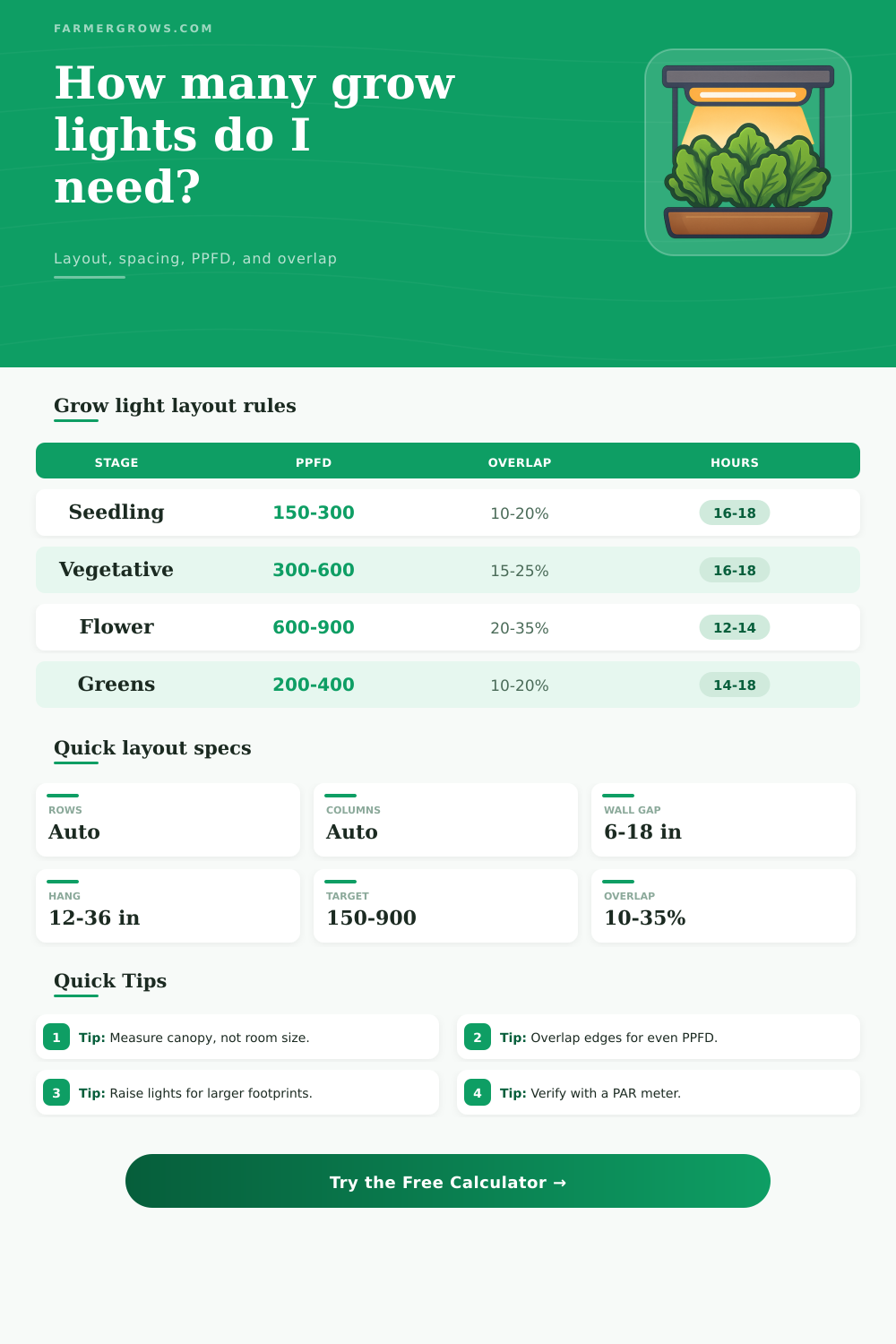
| Seedling / clone | 150-300 umol/m2/s | 16-18 hours | Use higher hang height and low overlap |
| Leafy greens | 200-400 umol/m2/s | 14-18 hours | Even rows matter more than peak intensity |
| Vegetative growth | 300-600 umol/m2/s | 16-18 hours | Moderate overlap fills canopy edges |
| Flowering / fruiting | 600-900 umol/m2/s | 12-14 hours | Higher count may be cleaner than low hanging |
| High-wire vegetables | 350-700 umol/m2/s | 14-18 hours | Run rows parallel with crop rows |
| Fixture style | Typical footprint | Common PPF | Best layout use |
|---|---|---|---|
| Seedling bar | 1 x 4 ft | 80-250 umol/s | Shelves and propagation racks |
| Small LED board | 2 x 2 ft | 350-650 umol/s | Small tents and veg benches |
| Mid LED panel | 3 x 3 ft | 700-1100 umol/s | 4 x 4 tents with overlap |
| Bar LED array | 4 x 4 ft | 1200-1900 umol/s | Flower rooms and larger tents |
| Linear greenhouse light | 2 x 6 ft | 900-1800 umol/s | Bench rows and supplemental light |
| Layout item | Starting range | When to increase | When to decrease |
|---|---|---|---|
| Wall clearance | 6-18 in | Hot edge or wall reflection is strong | Canopy reaches tent walls |
| Footprint overlap | 10-35% | Edges are weak or maps show valleys | PPFD is already above target |
| Hanging height | 12-36 in | Center hotspot or poor blending | Low PPFD and fixture is dimmable |
| Row spacing | 60-90% of footprint | Too many lights or excess PPFD | Dark strips between rows |
| Canopy | Stage | Typical layout | Planning target |
|---|---|---|---|
| 2 x 4 ft tent | Greens or veg | 1-2 fixtures in one row | 250-550 PPFD |
| 4 x 4 ft tent | Vegetative | 1 large or 4 small fixtures | 350-600 PPFD |
| 4 x 4 ft tent | Flowering | 4 panels or one bar array | 600-900 PPFD |
| 4 x 8 ft bench | Leafy greens | 2-4 fixtures in rows | 200-400 PPFD |
| 10 x 20 ft room | Fruiting crops | Grid by fixture footprint | 500-800 PPFD |
Achieving even light distribution within your grow room can be a challenge due to the fact that even with carefully planned light fixture arrangements, light distribution is often not even. When you hang light fixtures within your grow room, you may find that the middle of the canopy is receiving alot of light, but the edges of the plant canopy are much less lit. Alternatively, you may find that one specific area of the plant canopy is receiving too much light, while other areas of that same plant isnt receiving enough light to encourage even growth.
In order to avoid these even lighting distribution problems, you must determine the correct number of light fixture that should be employed within the grow room, the correct placement of the light fixtures within the grow room, and the correct hanging height for the light fixtures. The first of these steps involves planning the layout of the light fixtures within the grow room. You should start with measuring the canopy area of the grow room.
How to Make Light Even in Your Grow Room
In measuring the canopy area, you should only take into account the area that will be covered by light fixtures, you should not include the walking space within your grow room or the walls of the grow room in your measurement. Furthermore, you must take measurements of the area that will be covered by plants, you should not include any area outside of the plants in your measurement of the canopy area. Each hanging light fixture has a certain effective coverage area for the plants within your grow room.
The effective area of that light fixture changes based off the hanging height of that light fixture. If you increase the hanging height of the light fixture, the footprint of that light will widen to cover more of the grow room. However, if the hanging height of that light fixture is decreased, the footprint of that light will become more focused on the plants in the middle of the grow room.
These light fixtures may overlap in the grow room. Using a small amount of overlap between each light fixture can even out the distribution of light to each plant. Using too little overlap will result in the plants growing in stripes of light; using too much overlap will result in the use of too much electricity and too many light fixtures.
The amount of overlap that is needed within the grow room will depend upon the stage of growth of the plants being grown. For example, plants in the seedling and leafy green stage require less light intensity than flowering plants. The hanging height of the light fixtures will have an impact upon the amount of light that is distributed to each plant within the grow room.
The higher that you place the hanging lights into the grow room, the more light fixtures will be needed to provide even light to the canopy of the plants. However, if you lower the hanging height of the lights within the grow room, each plant will experience increased light intensity towards the middle of the grow room, but the light will fade more rapidy towards the outer edges of the grow room. Furthermore, if the grow room contains white paint or a white tent, the reflected light will return to the plants.
However, you must ensure that you do not overcount the amount of reflected light that reaches the plants (as the plants or the lights may block that reflected light from the reflected surface). You must also account for the clearance of the walls within the grow room. By leaving a gap between the outer edges of the grow room lights and the walls of the grow room, you can ensure that the plants does not sit in a shadow.
Furthermore, by leaving this gap, you also prevent the heat created by the lights from heating the grow room walls. Efficiency is another consideration within the growing room. While two lights has the same wattage, the light fixture with the higher PPF will distribute more light to the plants.
Furthermore, the efficiency of each light will impact how you calculate the amount of light that is distributed to the plants over time (known as the Daily Light Integral). For instance, a higher light intensity that is provided for fewer hours will provide the same light as a lower light intensity provided over a longer period of time. The light fixture and grow room layout calculator can assist in performing these calculations.
The calculator will help you determine the number of light fixtures that should be placed within the grow room, as well as the distance that each row of light fixtures should be spaced from the next row of lights. Furthermore, you can use the calculator to determine how adding or removing light fixtures will impact the evenness of light distribution within the grow room. The reference tables will help you determine the light and plant growing stage information and the different types of light fixtures that may be available.
While you can use the light fixture calculation to determine the number of lights that you should use within your grow room, it is possible that the calculations are not accurate for your grow room. For example, grow rooms often contain corners and supports for the lights that the calculations did not account for. Therefore, a PAR meter can be used to determine the light levels distributed to each plant in your grow room.
Should the light levels not even out for each plant, you may adjust the position of the lights by a few inches. In addition, there is a common error in planning the layout of the light fixtures within the grow room. People often determine the even distribution of lights based upon the size of the grow room (rather than the canopy size of the grow room).
The size of the tent that contains the grow room does not have to be even with the size of the plants within it. Therefore, planning the grow room based upon the size of the tent will result in the purchase of too many light fixtures for the grow room, and the grow room will use too much electricity. It is important to only measure the area covered by the plants.
Another consideration for the grow room is the type of light fixtures that you purchase for your grow room. For instance, a long linear light bar will distribute the light differently than a square panel light fixture. The light fixture calculator allows you to test the impact of different types of light fixtures by changing the footprint values within the calculator.
Thus, you can determine if using a long linear bar light will reduce the number of lights that are needed within the grow room, or if using multiple smaller light fixtures will provide more even lighting. One last consideration within the grow room is the temperature of the light fixtures. Higher intensity lights will emit more heat into the grow room.
If the light fixtures are too close to the plants, the leaves of the plants will reach too high of a temperature. Therefore, increasing the hanging height of the lights may prevent the leaves from becoming too hot. Your goal as a grower is to provide each plant with the same amount of even light for the number of hours that the plants require light in order to perform adequate photosynthesis.
By planning each of these factors for your grow room, you will be able to ensure that your grow room will provide even light distribution to each plant, without having to make any adjustments after initially setting up the lights.