🌡 Greenhouse Heat Load Calculator
Estimate greenhouse heating demand from envelope loss, ground loss, and infiltration, then round the delivered load up to a practical heater size that matches the structure and winter design temperature.
Choose a real greenhouse layout to seed the calculator. Each preset sets the structure style, dimensions, cover type, floor condition, leakage pattern, and heater allowance so the load starts close to an actual farm decision.
Heating Load Results
Live output updates as you change the greenhouse style, cover, temperatures, leakage, and heater settings.
| Cover | U-value | R-value | Use note |
|---|---|---|---|
| Single 6 mil poly | 1.15 | 0.87 | Low cost film |
| Double inflated poly | 0.75 | 1.33 | Better winter hold |
| Twin-wall polycarb | 0.85 | 1.18 | Rigid panel shell |
| Glass glazing | 1.10 | 0.91 | Bright but leaky |
| Thermal curtain | 0.35 | 2.86 | Night-time boost |
| Insulated wall | 0.20 | 5.00 | Best tight panel |
| Tightness | Base ACH | Door factor | Use note |
|---|---|---|---|
| Tight sealed house | 0.35 | 0.05 | Fresh build |
| Average farm house | 0.70 | 0.15 | Common default |
| Leaky film house | 1.20 | 0.30 | Older shell |
| Windy open bay | 1.80 | 0.65 | Big door spikes |
| Load band | Round up | Efficiency | Note |
|---|---|---|---|
| Under 50k | 5k step | 80-90% | Small unit heater |
| 50-150k | 10k step | 82-92% | Standard size |
| 150-300k | 25k step | 85-95% | Bigger winter bay |
| 300k+ | 50k step | 88-95% | Multiple heaters |
| Fuel | Raw heat | Metric note | Best fit |
|---|---|---|---|
| Propane | 91,500 BTU/gal | 26.8 kWh/gal | Remote farms |
| Natural gas | 100,000 BTU/therm | 29.3 kWh/therm | Piped service |
| Kerosene | 135,000 BTU/gal | 39.6 kWh/gal | Compact storage |
| Electric | 3,412 BTU/kWh | 1.0 kWh | Small clean installs |
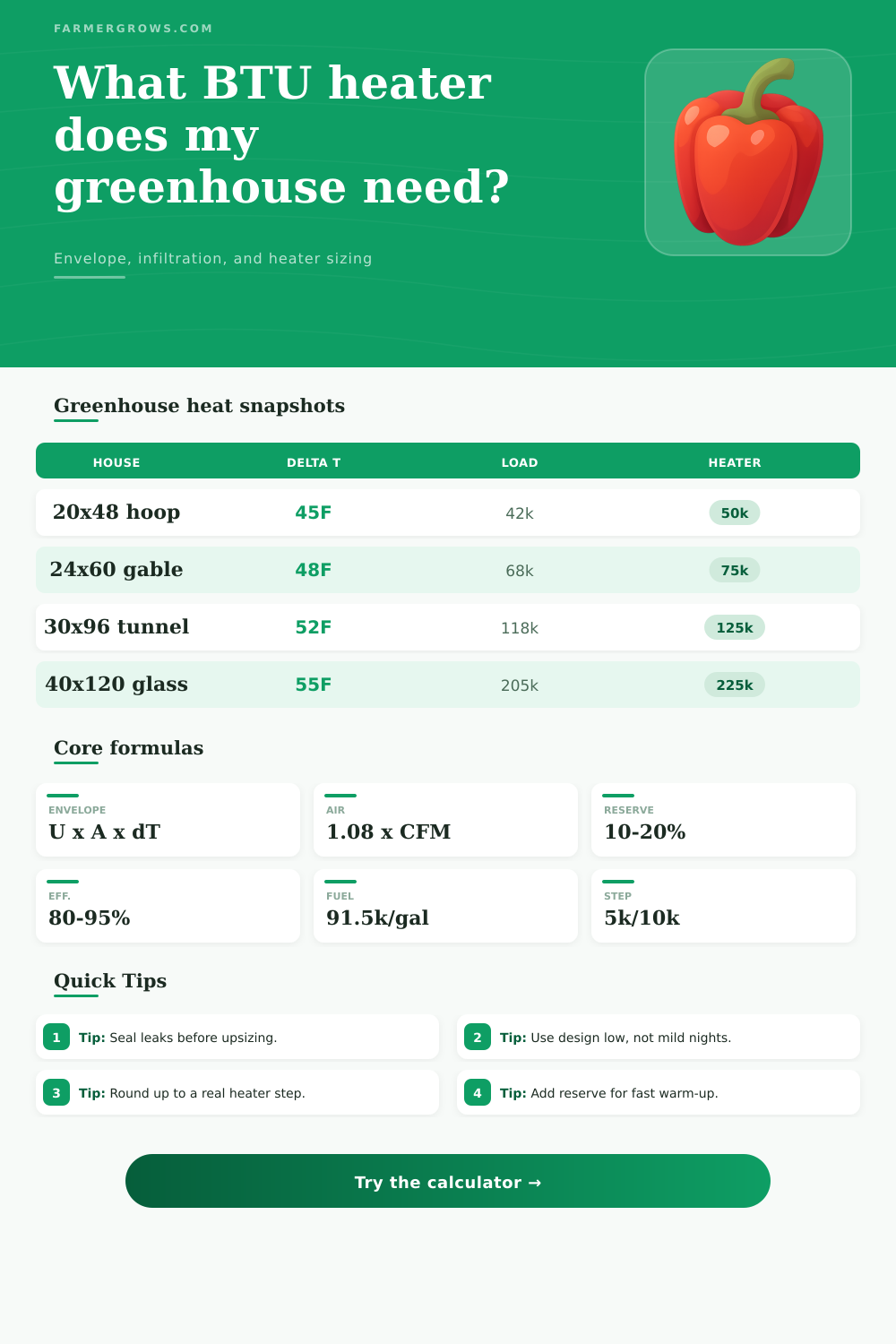
This calculator uses U x A x delta-T for envelope loss, 1.08 x CFM x delta-T for infiltration, then applies heater efficiency and reserve before rounding to a practical nameplate size.
In order to determine the proper heater sizes for the greenhouse, it is necessary to calculate the amount of heat that will be lost by the greenhouse under cold weather conditions. If the greenhouse heater that is selecting for the greenhouse is too small, the greenhouse will not be able to compensate for the heat loss that occurs by the greenhouse under cold weather conditions, and the low temperatures will damage the plants within the greenhouse. Additionally, if the size of the heater that is selected for the greenhouse is too large, the greenhouse will waste fuel due to the fact that the heater will consume more fuel than is required to heat the greenhouse to a standby temperature.
In order to calculate the total heat loss of the greenhouse, the heat loss that occurs through the greenhouse envelope, the floors of the greenhouse, and through the greenhouse air infiltration must be calculated. Heat loss through the greenhouse envelope is based off the area of the greenhouse envelope, the U-value of the covering of the greenhouse, and the difference in temperature between the inside and outside of the greenhouse. The U-value is a measurement of how easily heat pass through a particular material.
How to Size a Greenhouse Heater
For instance, single-layer polyethylene has a higher U-value than double-inflated film, which means that heat passes more easily through single-layer polyethylene than it do through double-inflated film. Additionally, the shape of the greenhouse will also impact the amount of heat that is lost through the greenhouse envelope. For instance, a hoop house has a high surface area that will allow for more heat loss than a greenhouse with a lower surface area.
Heat loss through the floor of the greenhouse is cause by the movement of heat from the warm greenhouse to the cold ground outside of the greenhouse. Heat loss occurs through bare soil floors more than it does through frost protected floors. Therefore, incorporating frost-protected floors into the greenhouse will reduce the amount of heat that is lost through the floor of the greenhouse.
While the amount of heat loss through the floor of the greenhouse is typically less than the heat loss through the greenhouse envelope, it is important to still calculate the amount of heat loss that occurs through the floor of the greenhouse as well. One of the methods of heat loss in the greenhouse is through air infiltration into the greenhouse structure. Air infiltration occurs through the zippers of greenhouse covers, greenhouse vents, the gaps between the greenhouse frames, and the greenhouse doors.
Air changes per hour (ACH) is a measurement of the rate of air infiltration into greenhouses. Infiltration can cause the amount of heat loss that can be calculated by multiplying the number of cubic feet per minute of air infiltration from the greenhouse by 1.08 (the number of BTUs of heat in one cubic foot of air) and the difference in the temperature inside and outside of the greenhouse. By sealing all gaps in the greenhouse structure, you’ll reduce the amount of infiltration of outside air into the greenhouse.
By reducing the infiltration of outside air into the greenhouse, the amount of heat that the heater must provide will be reduced as well. Thus, this is one of the cost-effective methods of reducing the amount of heat loss by the greenhouse. In addition to the gross heat load that is determined for the greenhouse, that gross heat loss must be divided by the efficiency of the heater that will be used to determine the amount of heat that must be provided by the greenhouse heater to compensate for the heat loss.
The efficiency of gas heaters is typically between 80 and 95% efficiency. No greenhouse heater will have an efficiency rating of 100% for various reasons related to the physical structure of the heaters. A reserve margin of 10 to 20% must be added to the total heat load of the greenhouse to provide for temperature drops that can result from opening the greenhouse doors to allow for the entrance and exit of laborer.
Finally, the total heat load can be rounded up to the nearest available size of greenhouse heater. For example, if the calculations indicates that a greenhouse heater with 45,000 BTU output is required, it may be necessary to purchase a greenhouse heater with a BTU output of 50,000 BTU. The U-value of the greenhouse covering that is selected for the greenhouse impacts the amount of heat loss of the greenhouse.
For instance, if single 6-mil polyethylene is used to cover the greenhouse, the U-value will be approximately 1.15. If double-inflated film is used for greenhouse covering, the U-value will be approximately 0.75. If twin-wall polycarbonate is used to cover the greenhouse, the U-value will be approximately 0.85.
If the greenhouse is covered in glass, the U-value will be approximately 1.10 for the greenhouse covering. However, the glass may leak heat at the edges of the greenhouse frame. If thermal curtains are incorporated into the greenhouse, the U-value will be approximately 0.35.
If the greenhouse walls are insulated, the U-value will be approximately 0.20. Each of these types of greenhouse coverings will have a specific U-value, and these U-values will impact the heat loss of the greenhouse. Each covering has advantage to others in relation to heat loss.
For instance, tomatoes can lose more heat through the greenhouse covering than orchids. Therefore, it is important to consider the need of the crops to be grown in the greenhouse when selecting the greenhouse covering for the greenhouse. In determining the size of the greenhouse heater, it is important to use the lowest (coldest) temperatures within the greenhouse area rather than the average temperatures.
The local temperature for 1% winter lows is the lowest temperature that should be used to calculate the size of the heater for the greenhouse. Using the average temperatures of the greenhouse area will result in the greenhouse heater failing to compensate for the heat loss during the cold winter temperatures, which will result in the death of the plants within the greenhouse. Finally, another consideration in selecting the size of the greenhouse heater is the wind that exists in the area.
High rates of infiltration of outside air into the greenhouse (which is caused by strong winds) will result in the greenhouse losing heat at a faster rate, thus requiring a larger greenhouse heater. Finally, the type of fuel that is to be used (propane, natural gas, kerosene, electricity) may also factor into the decision of the greenhouse heater that is to be purchased.