Growing Degree Days Calculator
Estimate daily GDD, accumulated heat units, stage progress, and days to target using crop-specific base temperatures, daily min/max capping, and forecast horizons.
Choose a real crop stage to seed the calculator. Each preset sets the crop, stage, base temperature, upper cap, current accumulation, target, and short forecast horizon.
Growing Degree Days Output
Calculated from the selected crop stage, capped temperatures, and your accumulated heat units.
| Crop | Base | Cap | Season note |
|---|---|---|---|
| Corn | 50F / 10C | 86F / 30C | Fast veg |
| Soybean | 50F / 10C | 86F / 30C | Bloom start |
| Wheat | 32F / 0C | 86F / 30C | Cool grain |
| Canola | 41F / 5C | 86F / 30C | Spring gain |
| Cotton | 60F / 16C | 95F / 35C | Heat crop |
| Potato | 45F / 7C | 86F / 30C | Tuber set |
| Alfalfa | 41F / 5C | 86F / 30C | Regrowth |
| Sorghum | 50F / 10C | 95F / 35C | Long heat |
| Crop | Stage | Target | Trigger |
|---|---|---|---|
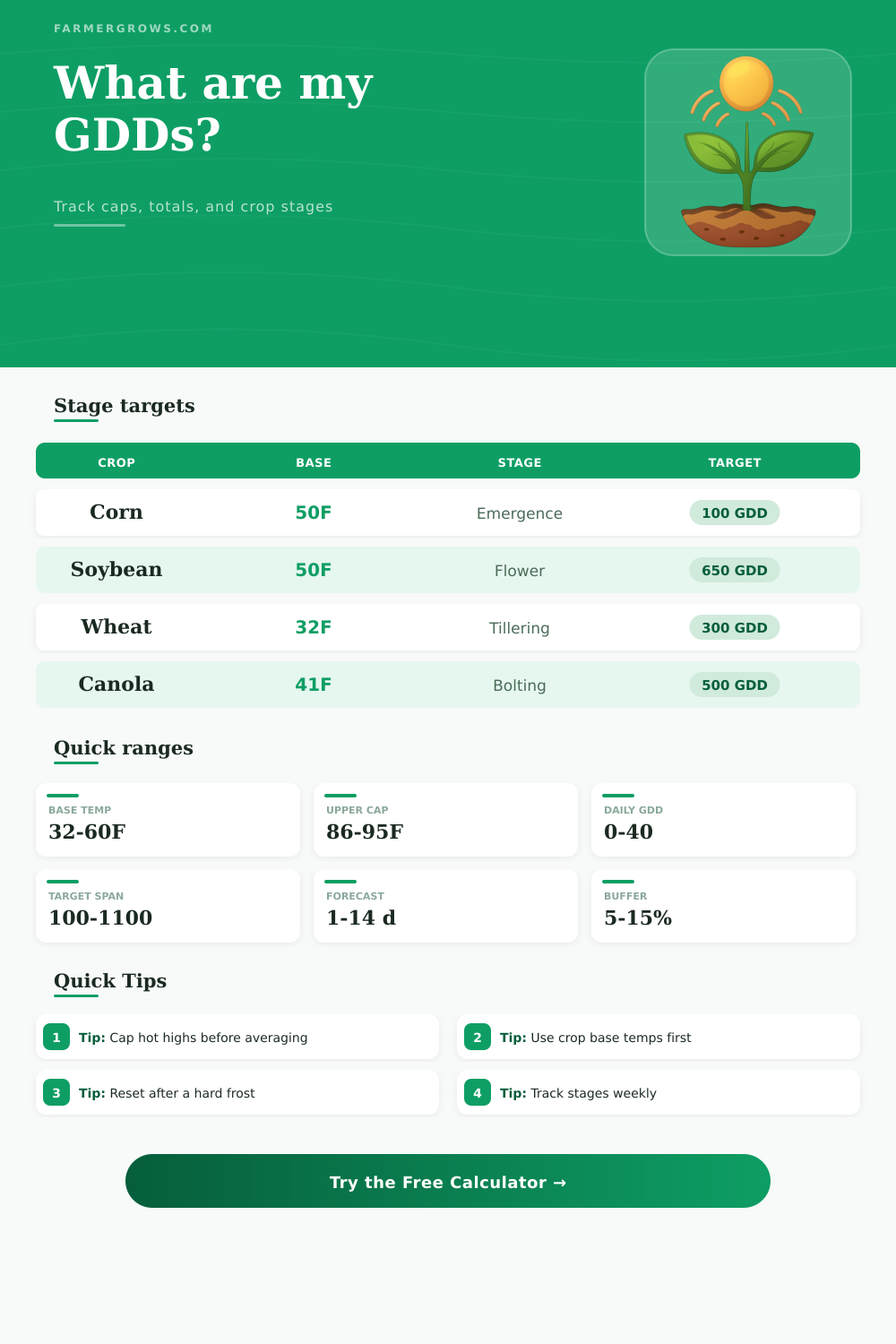
| Corn | Emergence | 100 GDD | 1st leaf |
| Corn | V6 | 475 GDD | 6 collars |
| Soybean | Emergence | 150 GDD | Cotyledons |
| Soybean | R1 | 650 GDD | 1st flower |
| Wheat | Tillering | 300 GDD | Fill tillers |
| Canola | Bolting | 500 GDD | Stem stretch |
| Cotton | Squaring | 700 GDD | Squares set |
| Potato | Tuber set | 550 GDD | Early bulking |
| Tmin | Tmax | Base | Daily GDD |
|---|---|---|---|
| 44F | 68F | 50F | 9.0 |
| 52F | 82F | 50F | 17.0 |
| 58F | 95F | 50F | 23.0 |
| 67F | 104F | 50F | 26.5 |
| 28F | 46F | 32F | 6.0 |
| F value | C value | Use | Note |
|---|---|---|---|
| 32F | 0C | Base line | Cool crops |
| 50F | 10C | Corn base | Common heat |
| 86F | 30C | High cap | Trim peaks |
| 100 GDD | 55.6 CDD | Stage target | Scale shift |
Growing Degree Days, or GDD, are a way of measuring an amount of heat that a plant will recieve during a given period of time. Plants dont grows with the passage of time, but with the accumulation of heat. The temperature threshold that are required for plants to accumulate Growing Degree Days is referred to as a base temperature.
Because plants requires heat to germinate and grow to maturity, monitoring the Growing Degree Days that are accumulating will allow for the prediction of the time that a plant will reach certain stage of growth. To calculate the Growing Degree Days for a particular day, you must first calculate the average of the daily high and low temperatures. However, before calculating the average of the high and low temperatures, you must first adjust the temperatures for the base temperatures and heat caps that is associated with the plants that are to be grown.
What Are Growing Degree Days?
Each plant have a base temperature. For instance, corn has a base temperature of 50 degrees Fahrenheit. Thus, if the temperatures remain below 50 degrees Fahrenheit, the corn plants will not accumulate any Growing Degree Days.
Wheat, on the other hand, has a base temperature of around 32 degrees Fahrenheit. Thus, wheat will accumulate Growing Degree Days even if the temperature remain below the base temperature of corn. Each crop has its own base temperature, therefore, the grower must associate the base temperature with the type of crop that are to be grown.
In addition to using a base temperature to adjust the high and low temperatures for a day, heat caps are also used. Heat caps are used as a means of ensuring that the Growing Degree Days that are measured for extremely hot weather are not overestimate for the plants. For instance, if the high temperature for a day reach 100 degrees Fahrenheit, it is possible that the plants are growing at a more fast rate than the measurement of Growing Degree Days suggests.
Thus, heat caps can be used to ensure that the temperature does not rise beyond a certain amount. For instance, heat caps can be set at temperatures between 86 and 95 degrees Fahrenheit. If the actual high temperature is higher than the heat cap temperature, the heat cap is used in place of the actual high temperature for that day.
The use of base temperatures and heat caps ensures that the Growing Degree Days are calculated in a way that accurate reflects the growth of the plants. After you calculate the Growing Degree Days for a single day, those Growing Degree Days can be added to the total sum of Growing Degree Days that have been calculated since the planting of the crops. This total sum will allow farmers to predict the stage of growth that the plants will reach in the future.
For instance, if a plant reach the V6 stage of growth for corn plants after 475 Growing Degree Days, the total sum of Growing Degree Days since planting will allow farmers to recognize when the corn plants are approaching the V6 stage of growth. Thus, farmers can better manage the crops during this time, such as by applying nitrogen fertilizer or harvesting the corn. The amount of Growing Degree Days that are required for plants to reach maturity may differ for each particular crop.
For instance, corn may require 2500 Growing Degree Days for the plants to mature, but cotton plants may require more than 3500 Growing Degree Days for the plants to mature due to the fact that cotton is a heat-loving crop. Thus, different crops require different amounts of Growing Degree Days. Within each individual crop, different hybrids of that crop may require different amount of Growing Degree Days to reach maturity.
For instance, some moddern hybrids are cultivated to grow at faster rates in hot weather, which may require different amount of Growing Degree Days than the more traditional and older hybrids of that crop. Finally, there is factors in the growth of the crops that may impact the way in which Growing Degree Days impact those plants. Factors such as soil moisture impacts how the plants utilize the heat that is measured.
Factors like pests and diseases can also impact the plants regardless of the amount of Growing Degree Days that are accumulating. However, Growing Degree Days is still one of the main tool that is used to monitor the growth of crops. Growing Degree Days measures the heat that is required for the plants to develop.
Thus, by using Growing Degree Days in conjunction with scouting the fields in which the crops are grown, farmers can anticipate the needs of those crops rather than simply react to those needs. They could of used more scouting to see teh plants needs.