Sod Pallet Calculator
Estimate sod pallets, rolls, and handling weight from lawn shape, area, and overage. The prep depth setting also estimates base soil volume for a cleaner install plan.
Pick a real yard shape to seed the calculator. Each preset sets dimensions, turf type, depth, and buffer so the result is ready for a fast estimate.
Sod Pallet Output
Calculated from shape, turf type, buffer, and prep depth.
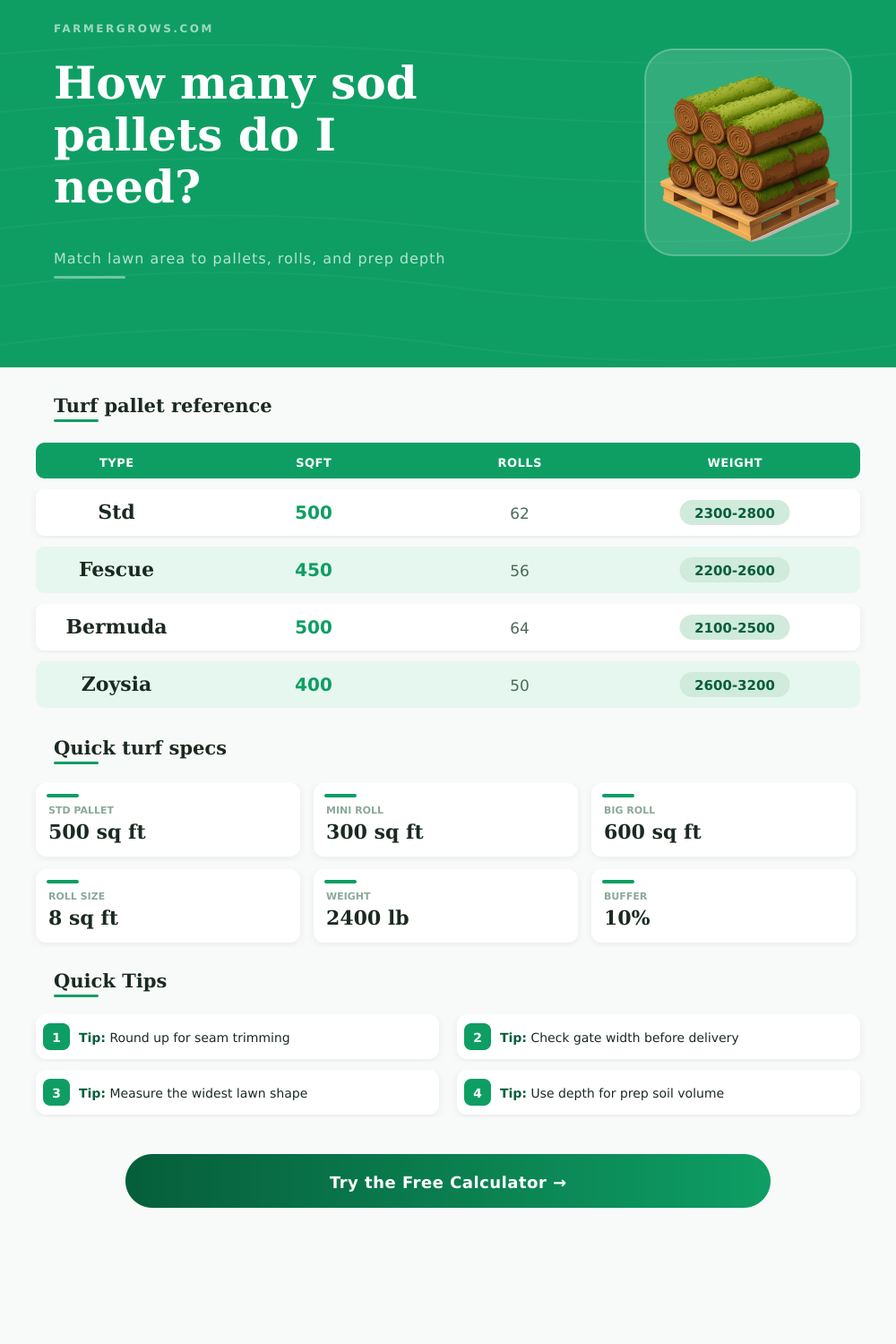
| Type | Sq ft/pallet | Rolls/pallet | Weight range | Notes |
|---|---|---|---|---|
| Standard bluegrass | 500 sq ft | 62 | 2300-2800 lb | Balanced lawn load |
| Tall fescue | 450 sq ft | 56 | 2200-2600 lb | Common cool season |
| Bermuda | 500 sq ft | 64 | 2100-2500 lb | Warm season turf |
| Zoysia | 400 sq ft | 50 | 2600-3200 lb | Dense and heavier cut |
| St. Augustine | 400 sq ft | 40 | 2700-3300 lb | Broad blade, heavy |
| Perennial rye | 500 sq ft | 62 | 2200-2700 lb | Fast renovation turf |
| Mini roll pallet | 300 sq ft | 60 | 1400-1800 lb | Small access jobs |
| Big roll pallet | 600 sq ft | 30 | 3000-3600 lb | Fewer seams on site |
| Project | Area | Std pallets | Rolls | Note |
|---|---|---|---|---|
| Front patch | 500 sq ft | 1 | 62 | One pallet job |
| Townhome strip | 900 sq ft | 2 | 112 | Easy curb drop |
| Backyard block | 1,500 sq ft | 3 | 186 | Common refresh |
| Corner lot | 2,100 sq ft | 5 | 261 | Order with buffer |
| Family yard | 3,000 sq ft | 7 | 372 | Stage by section |
| Large block | 4,500 sq ft | 10 | 558 | Check truck access |
| Depth | Per 100 sq ft | Per 1,000 sq ft | Equivalent | Use note |
|---|---|---|---|---|
| 1 in | 0.31 yd3 | 3.09 yd3 | 8.33 ft3 | Light leveling |
| 2 in | 0.62 yd3 | 6.17 yd3 | 16.67 ft3 | Thin top-up |
| 3 in | 0.93 yd3 | 9.26 yd3 | 25.00 ft3 | Common sod prep |
| 4 in | 1.23 yd3 | 12.35 yd3 | 33.33 ft3 | Regrade layer |
| 6 in | 1.85 yd3 | 18.52 yd3 | 50.00 ft3 | Deep rebuild |
| 8 in | 2.47 yd3 | 24.69 yd3 | 66.67 ft3 | Heavy repair |
| Staging method | Best for | Clearance | Handling | Note |
|---|---|---|---|---|
| Curbside drop | Small lawns | 8 ft gate | Manual carry | Fastest unload |
| Driveway stack | Medium yards | 10 ft pad | Wheelbarrow | Keep pallets level |
| Forklift unload | Large blocks | 12 ft route | Lift and place | Needs firm ground |
| Trailer drop | Side access | 9 ft path | Hand shuffle | Works on tight lots |
| Backyard split | Long runs | Two-way path | Batch staging | Reduces turf drag |
| Street staging | Busy sites | Permit space | Short carry | Plan traffic early |
To calculate how much sod are needed for a lawn, determine the total area of the ground to be covered by the sod. To find the area of a rectangular yard, multiply the length of the yard by its width. For a triangular area, multiply the base of a triangle by its height and divide the result by two.
For a circular area, square the diameter of the circle, divide the result by four, and multiply the result by pi (3.14). Find the area of the ground to be covered accurate, as the amount of sod that you will order is based off this total area of the lawn in square footage. To account for sod that will be trimmed or need for fitting into irregularly shaped plots, add ten percent to the total area in square footage.
How to Measure and Order Sod for Your Lawn
This percentage will account for sod rolls not stretching when lay out on the ground. Without the buffer of ten percent, there may not be enough sod to complete the job. The type of sod that you will order will impact the amount of sod that will be moved and the coverage area for each pallet of sod.
For instance, pallets of standard bluegrass sod covers five hundred square feet and come with sixty-two rolls of sod. Pallets of zoysia sod cover four hundred square feet. Zoysia sod is also heavier then bluegrass sod.
The weight of the sod will determine what type of vehicle you will use to move the sod and whether the ground can support the weight of the sod. Before sod is laid on the ground, the soil must be prepared. Soil preparation require adding a layer of topsoil or sand to the ground.
The depth of the soil layer must be determined before it can be calculated how many cubic foot of soil will be needed for the sod to be laid on top of the prepared soil. The volume of the soil to be added to the lawn is the area of the lawn multiply by the depth of the soil layer in feet. If the depth of the soil is not enough for sod to be laid on, the roots of the sod will not develop proper and the sod will brown during summer month.
The depth of the soil to be prepared must match that of the existing soil in the lawn. Clay soil require more drainage mix to be added than sandy soil. The weight of pallets of sod is another important factor to consider when sod will be delivered.
A single pallet of wet sod weigh approximately two thousand four hundred pounds. The sod weighs more when wet. The paths and gates in the area must be wide enough to allow for the delivery of the sod.
The paths in which the sod will be delivered should be at least eight feet wide to accommodate the most common types of delivery vehicles for curbside drops of sod. Should many pallets of sod be ordered, it will be necessary to use tools like wheelbarrows or forklifts to move the sod. It is very difficult to move many pallet of sod by hand.
Another factor to consider is where you will stage the sod when deliver. The staging area is where the pallets will be stored after the sod is delivered. For small loads, the sod can be staged at the curb.
For medium loads, the sod should be staged in the driveway. The widest obstacle, like a gate, should be measured before the sod arrive at the location to ensure the sod can navigate the obstacle and enter the yard. By planning the area that will be covered by sod, the buffer for trimming and fitting, the type of sod, the depth of the soil, the weight of the sod, and where the sod will be staged, you will ensure that you order the correct amount of sod for your sod-laying project.