🐔 Broiler Chicken Feed Calculator
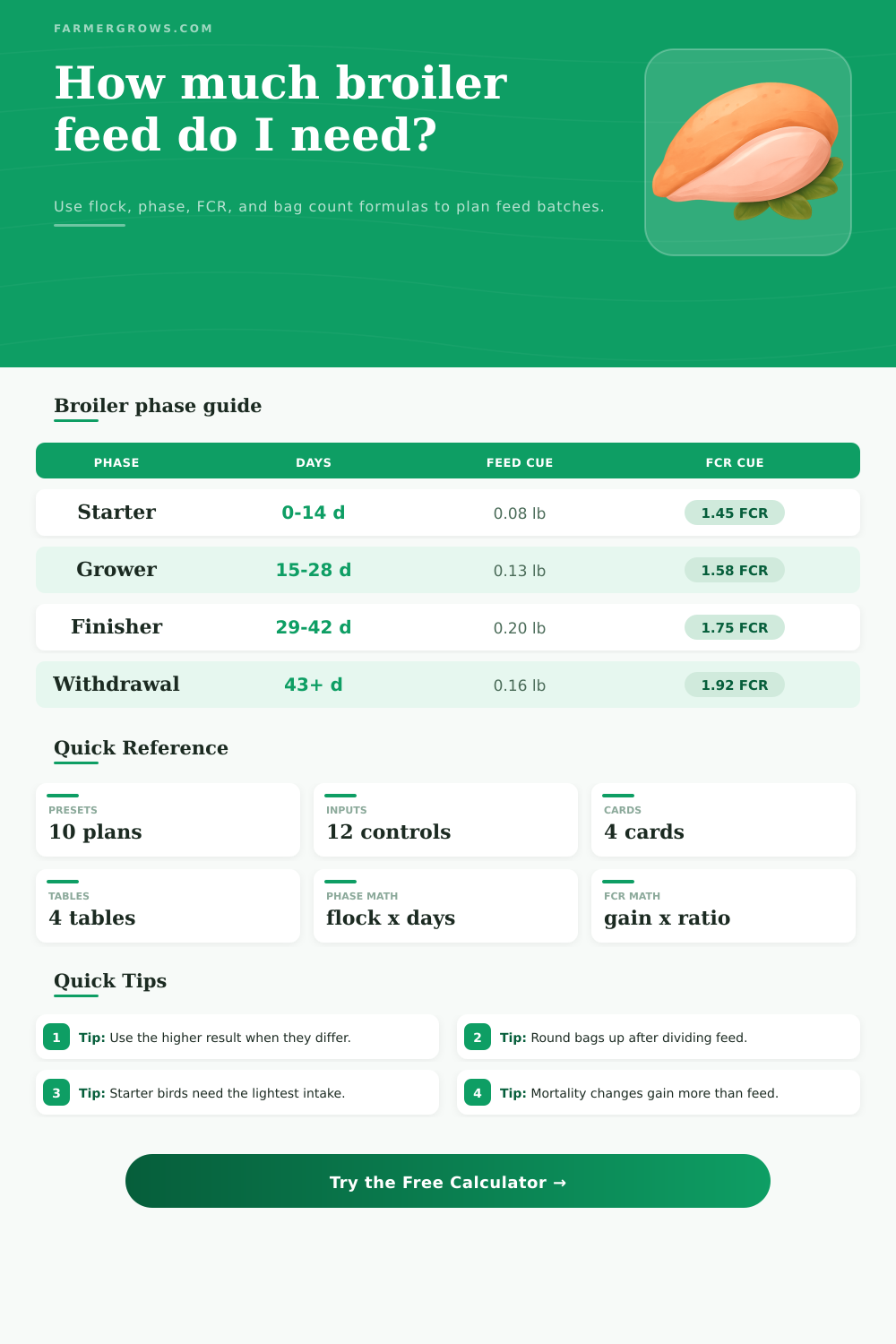
Estimate phase feed, FCR feed, planned feed, and bag count from flock size, feed phase, daily intake, growth gain, and bag size. The calculator keeps starter, grower, finisher, and withdrawal planning in one practical batch view.
Choose a common broiler scenario to seed the calculator. Each preset blends phase, flock size, days, intake, weights, FCR, waste, mortality, phase factor, and bag size.
This broiler calculator is tuned for starter, grower, finisher, and withdrawal feed planning, so it keeps the math focused on bird count, phase intake, conversion, and bag rounding.
Broiler Feed Output
Phase feed, FCR feed, planned feed, and bag count from the settings above.
| Phase | Days | Feed cue | FCR cue |
|---|---|---|---|
| Starter | 0-14 | 0.08-0.10 | 1.4-1.5 |
| Grower | 15-28 | 0.12-0.16 | 1.5-1.7 |
| Finisher | 29-42 | 0.18-0.24 | 1.7-1.9 |
| Withdrawal | 43+ | 0.14-0.18 | 1.9-2.0 |
| FCR band | Status | Feed cue | Meaning |
|---|---|---|---|
| 1.35-1.50 | Very tight | Excellent intake | Strong feed efficiency |
| 1.51-1.70 | Good | Normal growth | Healthy broiler band |
| 1.71-1.90 | Watch | Higher feed use | Check phase fit |
| 1.91+ | Loose | Feed climbs fast | Review waste and health |
| Bag | Bag wt | Use | Note |
|---|---|---|---|
| Small sack | 25 lb | Top-ups | Good for tiny batches |
| Feed bag | 50 lb | Standard | Most common broiler bag |
| Metric sack | 25 kg | Metric runs | Easy unit conversion |
| Bulk sack | 100 lb | Large lots | Fewer bags to move |
| Example | Phase | Feed | Bags |
|---|---|---|---|
| Starter 500 | Starter | 42 lb | 1 bag |
| Grower 1,000 | Grower | 154 lb | 4 bags |
| Finisher 2,000 | Finisher | 414 lb | 9 bags |
| Commercial 4,000 | Withdrawal | 798 lb | 16 bags |
Broiler feeding require careful planning because broiler feeding involve balancing the amount of feed that the birds will consume with the amount of weight that the birds will gain from the feed. If a person dont plan the broiler feeding properly, the person may order too little feed so that an emergency delivery of feed is required, or the person may order too much feed, which will result in teh feed becoming stale and the company will lose money as a result. In order to properly plan broiler feeding, it is important to understand the different phases that the broilers will be experiencing and the feed conversion ratio of the birds.
Broiler feeding can be divided into different phases in order to provide the right amount of feed to each groups of birds at a time. During the starter phase for broilers, which occurs between day zero and two weeks of the chickens lives, the birds will consume a relatively small amount of feed. At this stage in their lives, the young broiler birds are focused on gaining early growth.
How to Plan Feed for Broiler Chickens
During the grower phase, which lasts for weeks three and four, the birds will consume more feed than during the starter phase, as the grower phase requires more energy to perform the physical development of the young broiler birds. During the finisher phase, when broiler birds are nearing their market weight, they will consume the highest amount of feed during this last phase of their lives. Finally, during the withdrawal phase, which occurs before the broiler birds are slaughtered for human consumption, the farmer will reduce the feed to the broilers to ensure that the birds do not become too fat with too much fat, and to ensure that the chemicals in the feed has had time to break down prior to slaughter.
The feed conversion ratio (FCR) is a measurement of the efficiency with which broiler birds consume feed and gain weight. To calculate the feed conversion ratio, the total amount of feed that the broilers consume is divided by the total weight gained by those broiler chickens. The feed conversion ratio will increase as the birds increase in size and the amount of feed that is required to maintain those increased weights.
A low feed conversion ratio during the starter phase is beneficial to the broiler farms in that it indicates that the broiler chickens are growing at an efficient rate. A high feed conversion ratio during the finisher phase, however, is detrimental to broiler farms in that the broilers are consuming more feed to perform maintenance of their bodies rather than to perform growth, and thus the broiler farm is losing money. Additionally, the feed conversion ratio may change as a result of changes in the environment in which the broilers are raised; cold temperatures will increase the birds appetites for feed, but heat will decrease their appetites for feed.
There are two main methods for calculating the feed requirements for the broiler farm. The first method calculates the feed requirements by multiplying the amount of feed that each bird consumes each day by the number of birds that are to be raised and the number of days that the feed is to be provided to those birds. The second method calculates the feed requirements by multiplying the target weight of the broiler chickens by the target feed conversion ratio.
Each farm should order the amount of feed indicated by the higher of these two methods to ensure that the feed will not be exhausted for the flock of broiler chickens. In addition to accounting for the number of birds that will be raised, the feed requirements should also be adjusted for the mortality rate of the broiler birds and for feed waste within the broiler farm. Broiler birds will die; accounting for this mortality rate will ensure that there is enough feed to provide for all of the birds that will live.
Additionally, broiler farms often lose feed to spilled feed and dust; accounting for feed waste will ensure that there is enough feed to provide for the broiler birds that will be raised. The feed that the broiler birds consume may not always meet the projections that were made for each phase of their lives. For instance, if broiler birds die within a phase, feed may have to be provided to make up for the number of birds that died.
Additionally, if feed is wasted in the broiler farm, feed may have to be provided to make up for the feed that is wasted. Broiler birds will eat less feed if the environment in which they are raised is hot, but the birds will eat more if the environment in which they are raised is cold. Finally, if the flock of broiler birds isnt uniform in their weight, size, and age, the feed conversion ratio of the flock will be poor.
If there are a number of birds that is significantly smaller than the average weight of the flock, the average feed conversion ratio will be higher than if each bird within the flock was of similar weights. Broiler farms should monitor the broiler birds in order to ensure that the feed that is provided is accurate to the feed that should be consumed by the birds. To monitor the broiler birds, the farmers can observe their behavior, the condition of their litter, and the weight of the birds.
Additionally, the amount of feed that is used within each broiler farm each week should be tracked in comparison to the feed that was planned to be used. If the amount of feed that the broiler birds consume is higher than that which was planned for each flock of broilers, the orders for feed for the future will have to be adjusted to provide enough feed for the broiler birds. Thus, by accounting for mortality, feed waste, and other environmental adjustments, broiler farms will order the amount of feed that is required to supply feed to each phase of broiler consumption.
They should of monitored the birds more closely.