⚡ Greenhouse Energy Calculator
Estimate greenhouse heating load, daily energy, and heater size from real cover values, daylight references, and benchmark house data.
Choose a real greenhouse layout to seed the calculator. Each preset sets structure, cover, dimensions, temperatures, leakage, curtain use, and seasonal run time.
Greenhouse energy snapshot
Enter dimensions, cover data, and temperature targets to see the peak load, daily energy, seasonal load, and heater size.
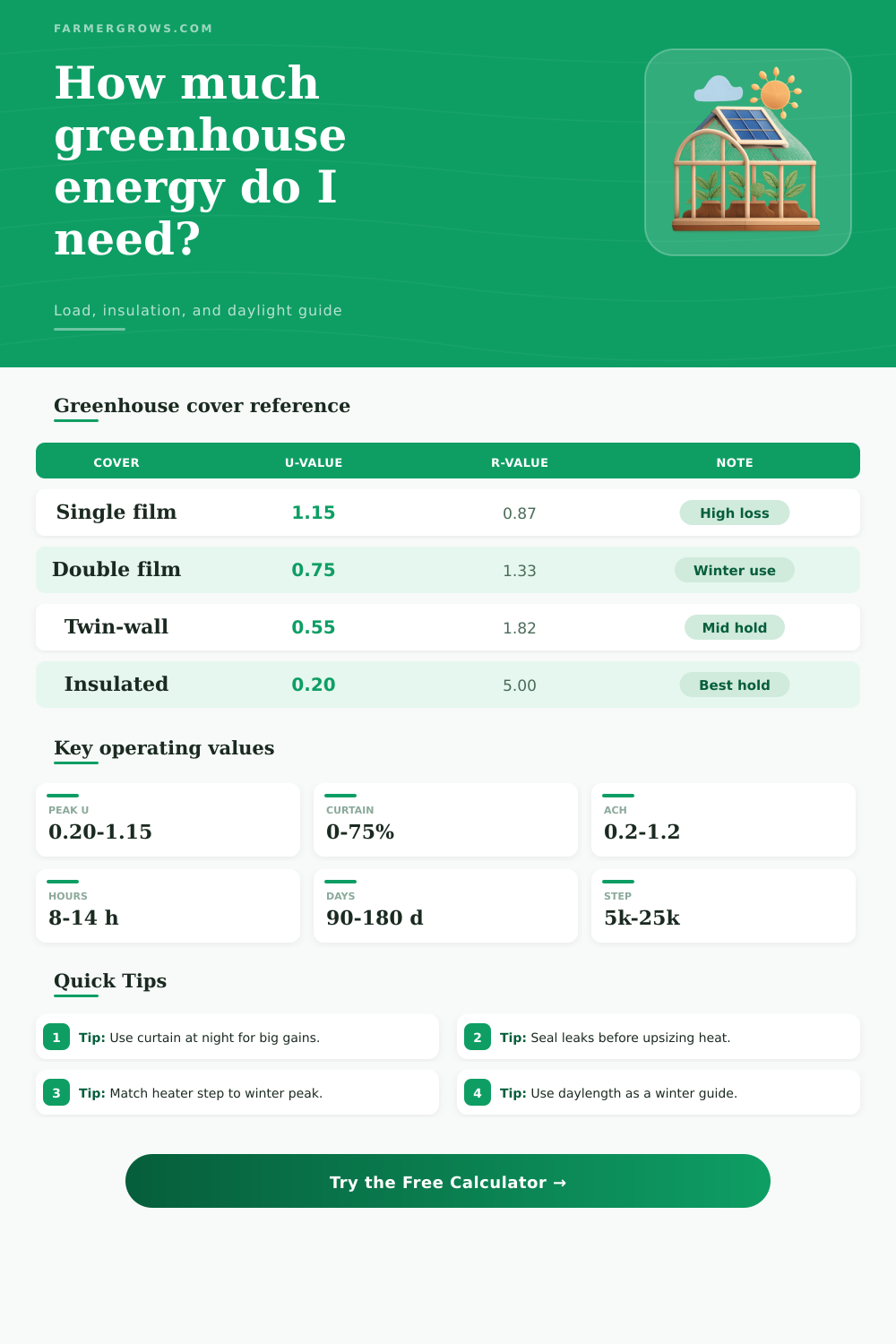
| Cover | U-value | R-value | Typical use | Night curtain |
|---|---|---|---|---|
| Single film | 1.15 | 0.87 | Low-cost shell | 0% |
| Double film | 0.75 | 1.33 | Winter tunnel | 12-28% |
| Twin-wall poly | 0.55 | 1.82 | Rigid house | 15-30% |
| Glass | 1.10 | 0.91 | Bright glazing | 0-15% |
| Insulated panel | 0.20 | 5.00 | Service wall | 50-75% |
| House | Cover | Peak load | 12 h energy | Note |
|---|---|---|---|---|
| 20 x 48 hoop | Double film | 107 kBTU/hr | 1.29 MMBtu | Tight winter shell |
| 24 x 60 gable | Single film | 154 kBTU/hr | 1.85 MMBtu | Common load case |
| 30 x 96 tunnel | Double film | 183 kBTU/hr | 2.19 MMBtu | Long tunnel run |
| 40 x 120 glass | Glass | 520 kBTU/hr | 6.24 MMBtu | Large bright house |
| Latitude | June daylength | December daylength | Swing | Winter note |
|---|---|---|---|---|
| 25 N | 13.56 h | 10.44 h | 3.12 h | Short winter pull |
| 35 N | 14.36 h | 9.64 h | 4.72 h | Moderate drop |
| 45 N | 15.43 h | 8.57 h | 6.86 h | Strong winter loss |
| 55 N | 17.10 h | 6.90 h | 10.20 h | Very short winter days |
| Curtain | Effective U | Peak load | 12 h energy | Use case |
|---|---|---|---|---|
| 0% | 1.15 | 154 kBTU/hr | 1.85 MMBtu | No curtain |
| 25% | 1.01 | 136 kBTU/hr | 1.63 MMBtu | Light curtain |
| 50% | 0.83 | 112 kBTU/hr | 1.34 MMBtu | Standard curtain |
| 75% | 0.67 | 91 kBTU/hr | 1.09 MMBtu | Heavy curtain |
This calculator uses U x A x dT for shell loss, adds ground and infiltration loads, then applies runtime and reserve to estimate daily and seasonal energy.
Heating a greenhouse require an understanding of how heat moves through the structure of the greenhouse. While the BTU rating of the greenhouse heater are critical, it isnt the only critical factor in heating a greenhouse. Beyond understanding how heat moves through the greenhouse and how much heat need to be provided by the heater, a critical factor to consider is how fast the heat escape the greenhouse.
The greenhouse envelope is all of the areas where the warm air in the greenhouse meet the cold air outside of the greenhouse. The material used to construct the greenhouse determines how many heat is lost through the greenhouse envelope. Using a single layer of plastic film for the greenhouse roof is low cost for the greenhouse owner.
How to Keep Heat in a Greenhouse
However, the single layer of plastic film allow for heat to escape quick due to the high U-value of the plastic. Constructing a greenhouse roof with double film or twin wall polycarbonate allow for layers of trapped air that create a thermal break that will reduce the amount of heat that escapes the greenhouse roof. Therefore, using double film or twin wall polycarbonate will reduce the amount of fuel that the owner requires to heat the greenhouse each month.
The floor of the greenhouse is another area in which heat can escape from the greenhouse. If the greenhouse feature a bare soil floor, the soil will allow heat to move into the earth. Using an insulated slab for the floor of the greenhouse or installing frost protection will stop heat from move into the ground.
To calculate the total heat loss from a greenhouse, you must calculate and add together the heat loss from the greenhouse shell and the heat loss from the greenhouse floor. The total heat loss of a greenhouse is the peak load for that greenhouse. The peak load is the maximum amount of heat that is required to heat the greenhouse during the coldest hour of the coldest night in the greenhouse’s growing season.
Air leakage is another problem that occurs within greenhouses that allow warm air to escape the greenhouse. If the ridge cap or greenhouse doors has air gaps, warm air will escape from the greenhouse. Air leakage is measured in air changes per hour within the greenhouse.
Air changes per hour indicate the number of times the air is replaced in the greenhouse in an hour. A high rate of air changes per hour mean that there is significant air leakage in the greenhouse. If the air changes per hour in the greenhouse is high, the warm air will not be able to remain within the greenhouse.
Adding insulation to the greenhouse will reduce the air changes per hour, and sealing all gaps in the greenhouse will fix the air leakage problem. Another control strategy is the use of a night curtain. Using a night curtain will create a second envelope of air for the greenhouse.
This second layer of air will trap still air near the greenhouse plants. The still air will reduce the amount of heat that is lost from the greenhouse roof. Using a night curtain will reduce the peak load of heat that the greenhouse requires.
Using a night curtain will allow the greenhouse greenhouse to either use a smaller heater or to maintain the same cost in heating the greenhouse with the same size heater but to keep the plants warmer. When selecting a greenhouse heater, dont purchase a heater that barely meet the peak load of the greenhouse. If the owner selects a heater for the greenhouse that barely meets the peak load, there will be no margin of error in measuring the greenhouse temperature.
Add a percentage of reserve heating capacity to the size of the heater for the greenhouse. This will provide heat to the greenhouse in the event that the temperature drop due to the greenhouse door being opened. The total energy demand of the greenhouse depends on the peak load of the greenhouse, the number of hours that the greenhouse is heated each day, and the total number of days in the growing season.
The number of hours that the greenhouse is heated each day depends on the latitude of the greenhouse. Greenhouses located in the north will be exposed to daylight for longer periods then greenhouses located in the south. As a result, the number of heating hours will be greater for greenhouses located in the north than for those in the south.
Multiply the peak load by the number of heating hours per day. Then multiply the result of this calculation by the total number of days in the growing season for the greenhouse. The total energy that is calculated for the greenhouse is the total energy that the greenhouse will require to sustain it’s growing plants each year.