Grazing Capacity Calculator
Calculate how many animals your pasture can support and for how long
Quick Presets
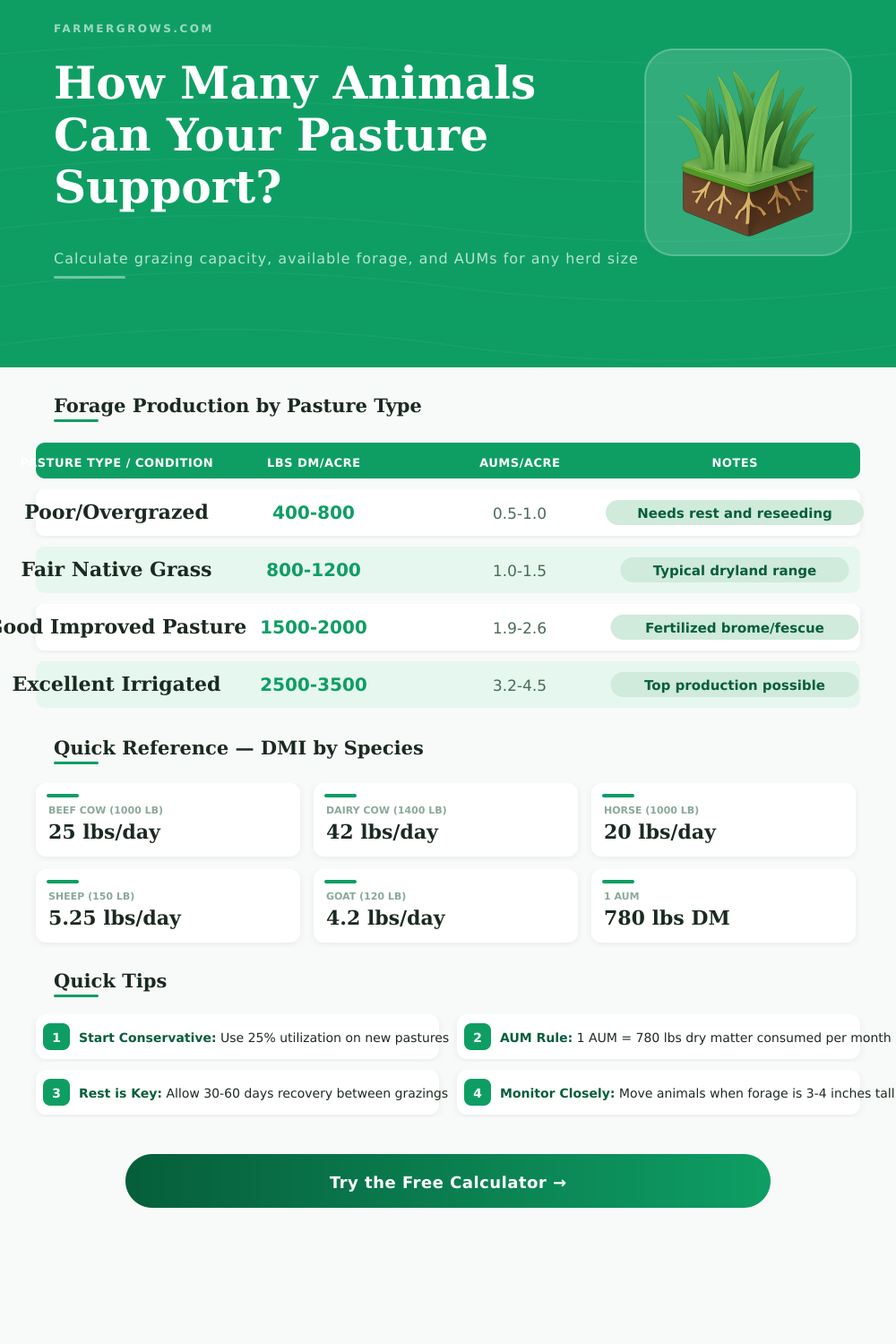
Forage Production Reference
| Pasture Type / Condition | lbs DM/acre | AUMs/acre | Notes |
|---|---|---|---|
| Poor / Overgrazed Range | 400–800 | 0.5–1.0 | Needs rest; consider reseeding |
| Fair Native Grassland | 800–1200 | 1.0–1.5 | Typical dryland range |
| Good Native / Improved | 1200–1800 | 1.5–2.3 | Well-managed native pasture |
| Excellent Improved Grass | 1800–2500 | 2.3–3.2 | Fertilized brome/fescue/orchardgrass |
| High Irrigated Pasture | 2500–3500 | 3.2–4.5 | Alfalfa mix, irrigated, peak season |
| Cool-Season Annual | 2000–3000 | 2.6–3.8 | Cereal rye, oats, ryegrass |
Daily Dry Matter Intake by Species
| Animal | Typical Weight | DMI % BW | lbs DM/day | AUE* |
|---|---|---|---|---|
| Beef cow (mature) | 1000 lb | 2.5% | 25 lbs | 1.0 |
| Beef cow-calf pair | 1000 lb cow | 2.5% | 25 lbs | 1.0 |
| Beef yearling | 600 lb | 2.5% | 15 lbs | 0.6 |
| Dairy cow | 1400 lb | 3.0% | 42 lbs | 1.4 |
| Horse | 1000 lb | 2.0% | 20 lbs | 0.8 |
| Sheep (ewe) | 150 lb | 3.5% | 5.25 lbs | 0.2 |
| Goat (doe) | 120 lb | 3.5% | 4.2 lbs | 0.17 |
*AUE = Animal Unit Equivalent relative to a 1000 lb cow
Stocking Density Guide
| Animals/acre (beef cows) | Intensity | Pasture Recovery (days) | Notes |
|---|---|---|---|
| 0.5–1.0 | Low / Continuous | N/A | Common for native range |
| 1.0–2.0 | Moderate rotational | 21–30 days | 2–4 paddock system |
| 2.0–5.0 | Intensive rotational | 30–45 days | 6–12 paddock system |
| 5.0–20.0 | High intensity | 45–60 days | Strip grazing, daily moves |
| 20.0–100.0+ | Ultra-high / Mob | 60–120 days | Mob grazing, hours per paddock |
Carrying capacity are the measure of the number of animals that a piece of pasture can support without do damage to that pasture. You must understand carrying capacity in order to determine both the number of animals that can be grazed on a pasture, as well as for how long those animal can be on that pasture. If there are too many animals on a pasture, the pasture will eat all of the grass on that pasture to an undesirable level, and the grass wont be able to regrow.
If there are too few animal on a pasture, the animals will not be utilizing all of the grass area, and hay will have to be purchased for the animals. The first step in calculating carrying capacity is to determine the total amount of forage that can be found on the pasture. You must measure the area of the pasture in acres, but it is also necessary to account for how usable that area is.
How Many Animals a Pasture Can Support
For instance, a pasture might have 50 acre, but if there are many slope or brush areas in that pasture, the animals may not be able to eat the grass in those areas. Therefore, the area is not completely usable. In addition to area, you must estimate the forage production that the pasture can create.
The amount of forage that the pasture produces will vary based off the quality of the soil, the amount of rainfall that falls on the pasture, and the type of grass that grows in the pasture. Each type of grass will produce a different amount of forage. Utilization rate is the percentage of the total forage that the grazing animals eat.
It is important that the animals are not able to eat all of the forage that is produced by the pasture. The animals must leave some grass to protect the soil and the roots of the grass from being eaten. For instance, if the utilization rate is set to 25 percent, the animals will eat 25 percent of the total forage that the pasture produces, leaving 75 percent of that forage for the protection of the pasture.
This is a safe rate for new pastures or pastures in dry areas of the land. If the utilization rate is set to 35 percent, the animals will eat 35 percent of the forage produced by the pasture. This is a common rate for rotational grazing.
If the utilization rate is set to 50 percent of the forage produced by the pasture, the animals will eat the majority of the grass on that pasture. This rate is only used if the animals are moved very frequent. Any utilization rate that is too high will cause the pasture to eat all of the forage that the pasture would of grown during the upcoming year.
One final factor that must be considered is the demand of the animals. Different type of animals will eat different amounts of forage. A 1,000-pound beef cow will eat approximately 25 pounds of dry matter every day.
Since 25 pounds is 2.5% of the body weight of a 1,000-pound beef cow, a beef cow will eat 2.5% of its body weight every day. A horse will eat approximately 20 pounds of forage per day, but they are often more pickier about the forage they eat. Sheep and goats will eat a higher percentage of their body weight in forage compared to cows.
Therefore, sheep and goats will eat at a higher rate. To compare the number of different species of animals that a pasture can support, you can use the concept of Animal Unit Equivalents (AUMs). One AUM is the amount of forage that one standard cow eats in one month.
Thus, with AUMs it is possible to calculate the number of animals of various species that can be stocked onto a pasture. The weather and the soil in that pasture affect the carrying capacity of a pasture. The impact of the weather on the pasture is reflected in the amount of forage that can grow.
Forage production will increase with alot of rain, but will decrease in drought condition. Testing the soil in the pasture will reveal how much nutrient are contained within the soil. Soil that does not contain nutrients like phosphorus will produce less grass than soil that does contain phosphorus.
Additionally, monitoring grass height ensures that the pasture is not overgrazed. If the grass in a pasture becomes too short, the grass roots will starve and the grass will not be able to germinate the following growing season. Rotational grazing is one method of managing the carrying capacity of pastures.
You can divide pastures into smaller section called paddocks. The animals can be moved from one paddock to another, allowing the paddocks that the animals previously grazed on to rest and regrow their grass. This practice helps to ensure that the pasture remains healthy and allows the land to be rested.
Another method is called high-density grazing, or mob grazing. High-density grazing requires that many animals are kept in one paddock for a short amount of time. Mob grazing can help to improve the soil in the paddock in which many animals are grazed, because the hooves and manure of the animals adds nutrients to the soil.
However, mob grazing requires much work to move the animals and the water source in these paddocks. In order to manage a pasture well, you should regularly check the pasture to ensure that the number of animals on the pasture is in accordance with the amount of grass that grows in that pasture. You should walk the pasture once a week to check the amount of grass that is left in the pasture.
If too much grass is eaten, the animals should be moved to another portion of the pasture that has different type of feed to provide for their eating needs. Therefore, regular monitoring of the grass and weather patterns in which the animals live will allow for the management of their pastures in a sustainable way.