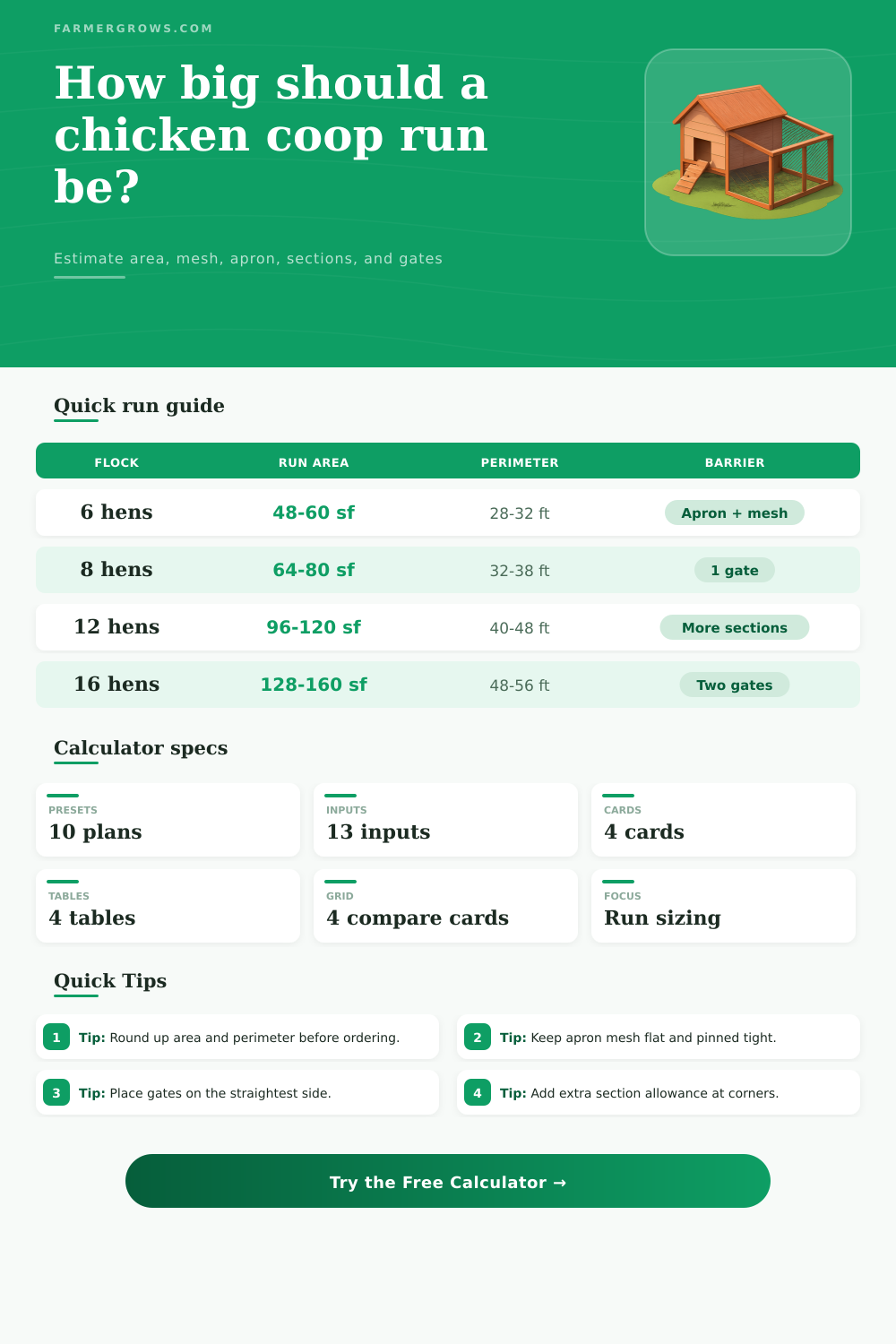
Chicken Coop Run Size Calculator
Estimate run area, dimensions, perimeter, sections, gates, and predator protection materials for a backyard chicken enclosure using simple farm-friendly formulas.
Choose a common setup to seed the calculator. Each preset blends flock size, bird size, access style, climate, geometry, buffer room, fence height, apron width, mesh depth, section length, and gate details.
Chicken Coop Run Output
Calculated from flock size, bird size, access style, climate, geometry, buffer room, and predator protection settings.
| Bird size | Base run area | Multiplier | Best use |
|---|---|---|---|
| Bantam | 6 sq ft / bird | 0.85x | Smaller footprint and lighter traffic |
| Standard | 8 sq ft / bird | 1.00x | General backyard flock planning |
| Heavy | 10 sq ft / bird | 1.12x | More shoulder room and calm spacing |
| Giant | 12 sq ft / bird | 1.25x | Large birds and wider turning room |
| Setting | Factor | Effect | Build note |
|---|---|---|---|
| Free range | 0.60x | Lowest run demand | Birds spend more time outside |
| Day run | 1.00x | Baseline sizing | Good all-purpose planning target |
| Covered run | 1.10x | More protected space | Helps in wind and rain |
| Winter yard | 1.20x | More confinement room | Useful for cold-season use |
| Enclosed run | 1.30x | Most generous sizing | Better for long-term confinement |
| Shape | Perimeter factor | Dimension rule | Build note |
|---|---|---|---|
| Square | 1.00x | Equal sides | Fast framing and easy layout |
| Rectangle | 1.00x | Use target width | Best all-around form |
| Long run | 1.05x | Narrower short side | Fits along fences and buildings |
| L-shape | 1.12x | Corner turn layout | Good around trees and yards |
| Covered run | 1.08x | Roofed rectangle | Plan extra framing at the top edge |
| Item | Formula | Typical use | Round-up rule |
|---|---|---|---|
| Fence line | Perimeter - gate openings | Fence wire, panels, or mesh | Always round up to the next full section |
| Sections | Fence line / max section length | Panel planning | Add one extra section at corners if needed |
| Wall mesh | Perimeter x fence height | Vertical chicken wire or hardware cloth | Buy extra for overlaps and seams |
| Apron mesh | Perimeter x apron width | Flat skirt around the base | Overlap corners and gate ends |
| Buried mesh | Perimeter x bury depth | Downward anti-dig line | Use more depth in soft soil |
When planning a chicken run for your backyard, you must consider the size of the chicken run. The size of the chicken run will have a direct effect on the health of your chickens. You must build the chicken run to be large enough to allow your chickens of the specific breed that you own to have enough space to move around in the run.
People often makes the mistake of building their chicken run too small, which can result in stress for the chickens. To calculate the size of the chicken run, you must calculate the square footage that is required for the different sizes of chickens that you plan to raise. For instance, bantam chickens require less square footage then heavy breed chickens like Jersey Giants because the heavy breed chickens require more space for the chickens to turn around without bumping into other chickens in the run.
How Big Should a Chicken Run Be
In addition to the size of