
In order to feed goats correctly, you first must understand that goats are opportunistic eaters. Because goats are opportunistic eaters, they will eat large amounts of food if the food is available to them. If you monitor the amount of food that goats eat, you may end up providing too much food to the goat, which can make the goat become overweight.
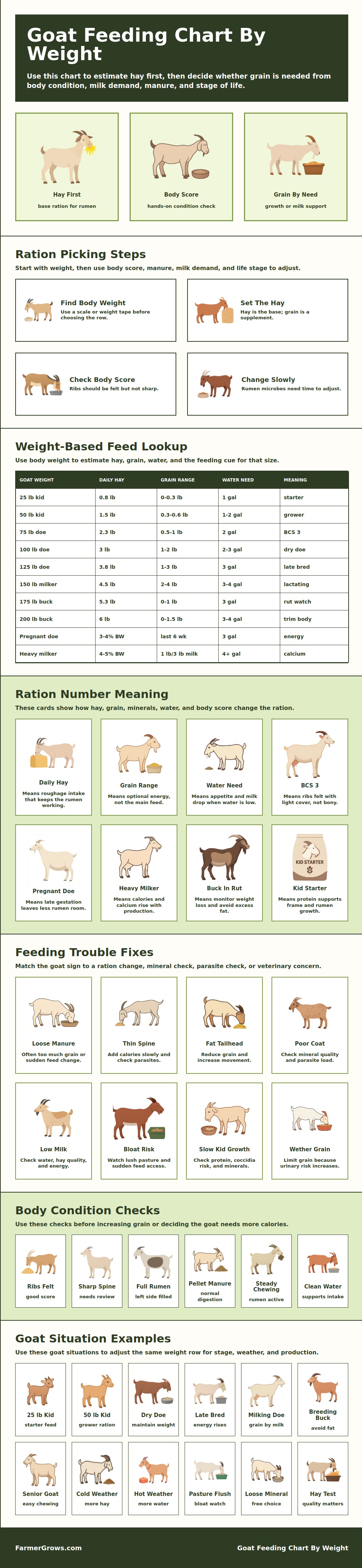
Therefore, there are specific methods that can be used to determine the amount of food that each goat should be provided. Determine the weight of the goat, as the weight of the goat will determine the amount of forage that the goat require to eat. Many goat farms utilize a weight chart to determine the amount of hay that each goat requires to eat, as providing too little hay to the goat can lead to the goat developing health issues.
How to Feed Your Goats
Due to the fact that different goats have different nutritional needs, it is impossible to provide the same amount of hay to, for instance, a small kid goat as compared to a heavy milker goat. If you provide the same amount of hay to each of these goats, the kid may not have enough food to support its growth, while the milker may develop metabolic issues due to the lack of food supporting its rumen. After establishing the amount of hay that the goat requires based off its weight, you must also evaluate the body condition score of the goat.
Many people make mistakes when evaluating the body condition score of the goat. For instance, many people mistakenly provide too much grain to goats whose body condition score indicates that they are thin. If you provide too much grain to thin goats, the goats can develop digestive issues.
Instead of using grain as the primary source of calories for the goat, feel the goat to evaluate its body condition score. If the goat has easily felt ribs but a spine that is not sharp to the touch, the goat is likely experiencing a healthy weight. However, if the tailhead of the goat is becoming fat, the goat is being provided with too much food.
Goats of different ages and life stages have different nutritional requirements. For instance, does in the final six weeks of pregnancy require more energy because they are supporting the growing kids in their body. Additionally, heavy milker goats require more energy because they are performing physical activity to produce their milk.
If you dont increase the supply of food for the heavy milker goat, the goat will begin to take the nutrients from its own body to produce its milk. Consequently, the heavy milker goat will lose body mass while it is producing its milk. Therefore, the farmer should adjust the supply of food according to the life stage of the goat.
In addition to the requirements of hay and grain, the goats also require a source of water. Just like hay and grain, water is equally important as the other two food sources. Does that are producing milk (lactating does) or bucks that are in rut require a large amount of water.
These two type of goats may require several gallons of water per day. If the water is dirty or not available to the goat at all, the goat will not eat its food. Therefore, you must ensure water is available to the goat at all times.
An indication of the health of the goat can be determined by its manure and its coat. If the manure of the goat is loose, this indicates that the goat is likely eating too much grain. Too much grain can lead to the goats rumen becoming unbalanced in relation to the amount of hay that it is eating.
However, if the spine of the goat is thin or the coat is poor in quality, the goat may not be provided enough minerals or calories. If any changes to the food supply are to be made, those changes should be made slowly. If you suddenly provide food to the goat that it did not previously have, the goats gut bacteria will become accustomed to that change.
However, if you make changes slowly over a period of several days, the bacteria will be able to adapt to the change in diet. In order to maintain a healthy herd of goats, it is necessary to use the weight of the goat as a starting point, use body condition scoring to monitor the health of the goat, and ensure that the goats have an adequate supply of hay and water.