Chinese Cabbage Growth Time Calculator
Estimate harvest timing for broad Chinese cabbage crops, including pak choi, bok choy, tatsoi, choy sum, and heading Chinese cabbage options, with cool-season timing and bolting risk.
This calculator is for broad Chinese cabbage planning rather than a napa-only schedule. Choose a non-heading pak choi/bok choy type, a flowering-stem crop such as choy sum, a rosette type such as tatsoi, or a general heading Chinese cabbage option, then adjust for transplanting, direct sowing, season, harvest stage, spacing, and temperature pressure.
Chinese Cabbage Harvest Estimate
Results adjust days-to-harvest for type, start method, harvest stage, spacing, season, heat, cold exposure, and establishment buffer.
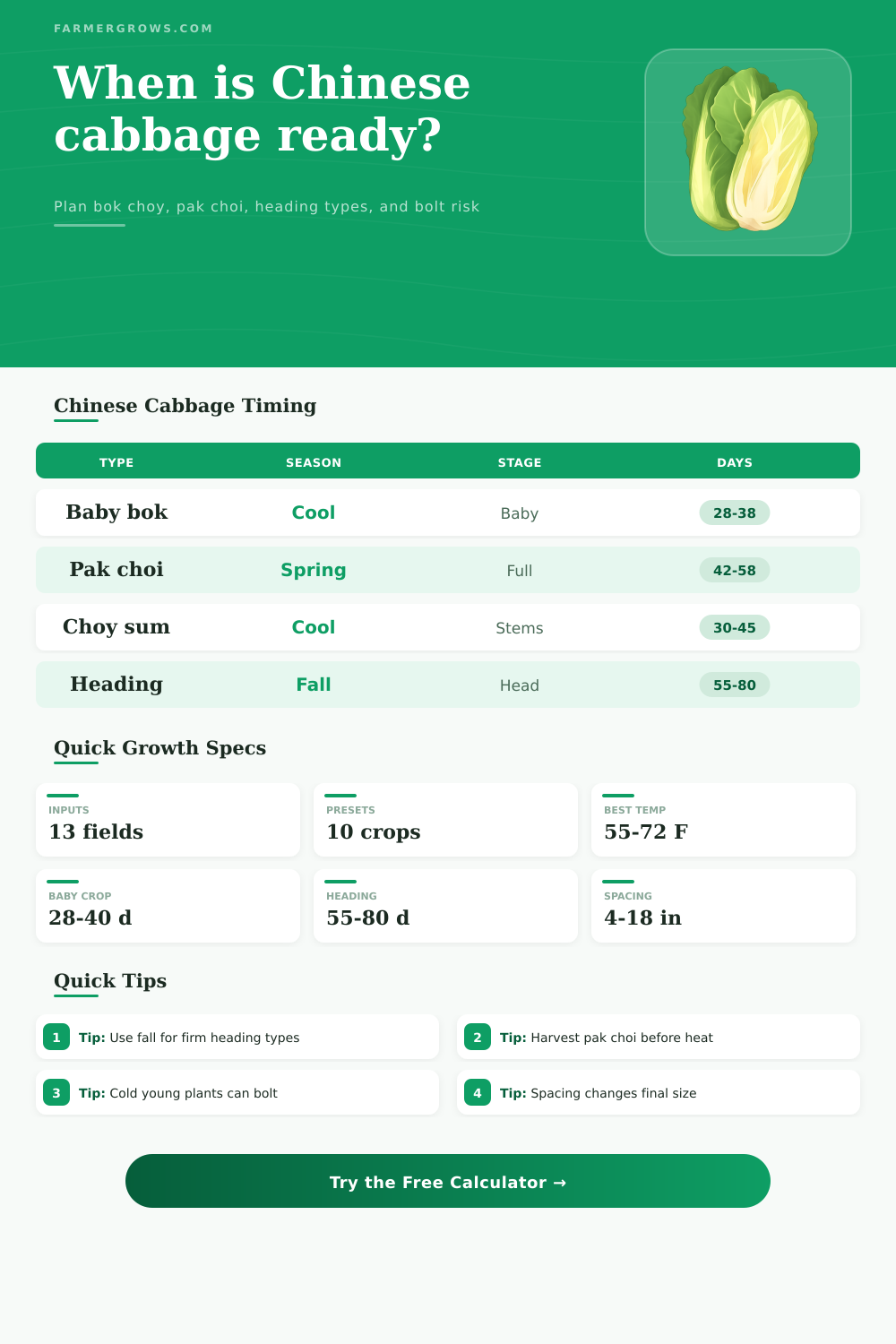
| Chinese cabbage type | Best season | Common harvest stage | Typical growth time |
|---|---|---|---|
| Baby bok choy | Spring or fall, mild days | Baby bunch, tender petioles | 28 to 40 days from sowing, shorter from plugs |
| Shanghai pak choi | Cool fall or protected spring | Mini to full green-stem bunch | 35 to 55 days depending on final size |
| Full-size bok choy | Fall open bed or cool tunnel | Thick petioles before heat | 45 to 65 days, often slower if crowded |
| Tatsoi rosette | Cool fall, winter in mild areas | Flat rosette or spoon leaves | 35 to 55 days, with good cold tolerance |
| Choy sum or yu choy | Cool shoulder season | Flowering stems just before bloom | 30 to 50 days, harvest promptly at bud stage |
| Heading Chinese cabbage option | Fall is safest for head fill | Firm compact or tall head | 55 to 80 days, wider spacing and cool finish needed |
| Spacing | Best use | Timing effect | Yield note |
|---|---|---|---|
| 2 to 4 in | Baby leaf cuts and dense greens | Fast, but not for full petioles | High plant count, low weight per plant |
| 4 to 6 in | Baby bok choy, choy sum, yu choy | Quick bunches and stem harvest | Best for repeat market bunches |
| 6 to 10 in | Shanghai pak choi and tatsoi | Balanced speed and size | Good airflow reduces leaf disease |
| 10 to 14 in | Full-size bok choy or large rosettes | More days for heavier plants | Better petiole width and clean bases |
| 12 to 18 in | Heading Chinese cabbage options | Slowest, needed for firm heads | Less crowding during head fill |
| Condition | What it does | Risk level | Planning response |
|---|---|---|---|
| 55 to 72 F days | Fast leaf and petiole growth | Low | Ideal for both baby and full harvests |
| Young plants below 45 F | Can prime bolting in sensitive types | Medium | Use row cover or delay transplanting |
| Above 80 F days | Speeds stress, bitterness, and flowering | High | Harvest smaller or use shade cloth |
| Fall cooling trend | Supports steady sizing and head fill | Low | Best window for heading Chinese cabbage |
| Spring warm-up after cold | Common bolt trigger for older plants | High | Plant young plugs and pick earlier |
| Start method | Use it for | Timing adjustment | Watch point |
|---|---|---|---|
| Direct sow | Baby greens, choy sum, fall pak choi | Add establishment days in cold soil | Thin early so spacing matches harvest stage |
| Young transplant | Pak choi, bok choy, heading starts | Shortens field time without heavy stress | Best spring choice when plugs are not rootbound |
| Standard transplant | Cool-season blocks and market rows | Moderate field-time reduction | Keep moisture steady after setting |
| Older transplant | Only when weather is mild and stable | Can lose time to shock and bolting | Avoid cold nights followed by warm days |
| Indoor sowing date | Planning from seed tray start | Counts seedling period and hardening buffer | Schedule transplant before plugs stall |
For heading Chinese cabbage options, aim for the final three to four weeks in cooling weather. Warm head-fill periods raise tip burn, loose heads, and bolting risk.
Use close spacing only for baby greens and small bunches. Full bok choy, pak choi, tatsoi rosettes, and heading types need room for airflow and base thickness.
Why do most home gardeners plant chinese cabbage? They seek the firm, sweet heads of late autumn. Or, perhaps, the crisp, clean bite of a fresh crop in springtime. Here’s the catch: With such crops as these, timing is all. Too soon and you’re chasing warming weather that sends the plants right into bolting (before any decent head forms). Too late and you’re running down frost that halts their growth cold. It’s a very slim window when both the plant and the weather wants to cooperate.
And that’s why you need to estimate when you’ll be harvesting, not guess based off average dates from seed packet. That’s where the calculator comes in (above), helping you pin down those dates by taking into account factors that are not included in generic charts. You begin with the variety, and its baseline rate of growth: Baby bok choy goes fast, usually ready in less than forty days if there’s sufficient warmth in the soil. Heading types is slower; they’re building a dense structure, rather than loose leaves.
How to Use the Calculator for Planting Chinese Cabbage
For transplants, the tool modifies those baseline dates based on what you’re doing at the get-go. Growing from seed in ground is kinder to roots but delays things by however long it takes to get seeds going in cool soil. Young plug transplant really accelerate the timeline in the field; assuming the plants aren’t rootbound or otherwise stressed. That one change shifts your planting day by a week or more. This is huge when you are trying to target a particular harvest weekend.
Temperature is key. Cool-loving Chinese cabbage prefers daytime temperatures of around fifty-five to seventy-two degrees. It suffers stress penalties if there is several days over eighty degrees. Heat tends to push bitterness toward the stem and slows leaf growth. And it takes into account how much cold you’ve exposed the young plants to before. Below-forty-five-degree temps can primes young plants to bolt when sun shines again. The combination adds up to a realistic risk score. It’s not so much a matter of days-from-sow as it is one of predicting whether those days are going to yield flower stalks or edible greens.
This leads into a place that even experienced gardeners rely on intuition: How far apart do I put things? For instance, you may assume that sowing seedlings more closely would save space, but Chinese cabbage likes air space; it spreads out its petioles as it grows. When crowded, plants also grows slower and have thinner bases. They also compete for nutrients and light. The reference tables in the tool indicates which types require wider gaps (for heading varieties) and which are fine at tighter spacing (baby harvests). If you plant heading varieties at four-inch intervals, you’re asking for trouble. They’ll never reach the critical mass of tightly packed leaves needed for a firm head. Enter the spacing into the calculator, and what you get should of be true to life, not wishful thinking.
The whole approach hinges on season selection. Because the heads develop during a slow decline in temperature, it’s typically safest to plant fall Chinese cabbage, which keeps the crispness and sweetness of the head. The danger of bolts is greater in spring, where rapid warming and lengthening days push the plant toward reproduction long before the growing phase has been completed. The tool will show just how far ahead you’d have to start your young transplants in spring to outsmart that heat window, if that’s your only option. And it will show when protective cover might help extend the season without causing too much humidity.
At bottom: Growing Chinese cabbage isn’t so much a matter of making it do what you want as it’s learning how to make it happy; and that means matching your garden with its preferences. It likes steady coolness, doesn’t like hot spells (or really any kind of moddern-weather fluctuations), and will fail you if pushed beyond its limits. Plug in the type you’re growing, along with your local temperature expectations, and go from guessing to getting down to a doable plan. From then on out, instead of thinking “Is this thing ready yet?” you’ll know just when to grab the knife. You will have fewer bolting failures and more bowls of tender, precisely timed harvest.