Silage Tonnage Calculator
Estimate bunker or pile tonnage from real dimensions, packed density, dry matter, and shrink so you can plan storage before harvest starts.
Start with a real silage setup, then fine tune the numbers. Each preset sets the shape, crop type, dimensions, density, dry matter, and shrink loss.
The density field should reflect how tightly the silage is packed. Dry matter and shrink are kept separate so you can see the difference between harvest weight and usable feed.
Silage Tonnage Output
These results combine the selected shape, density, dry matter, and shrink loss into usable storage tonnage.
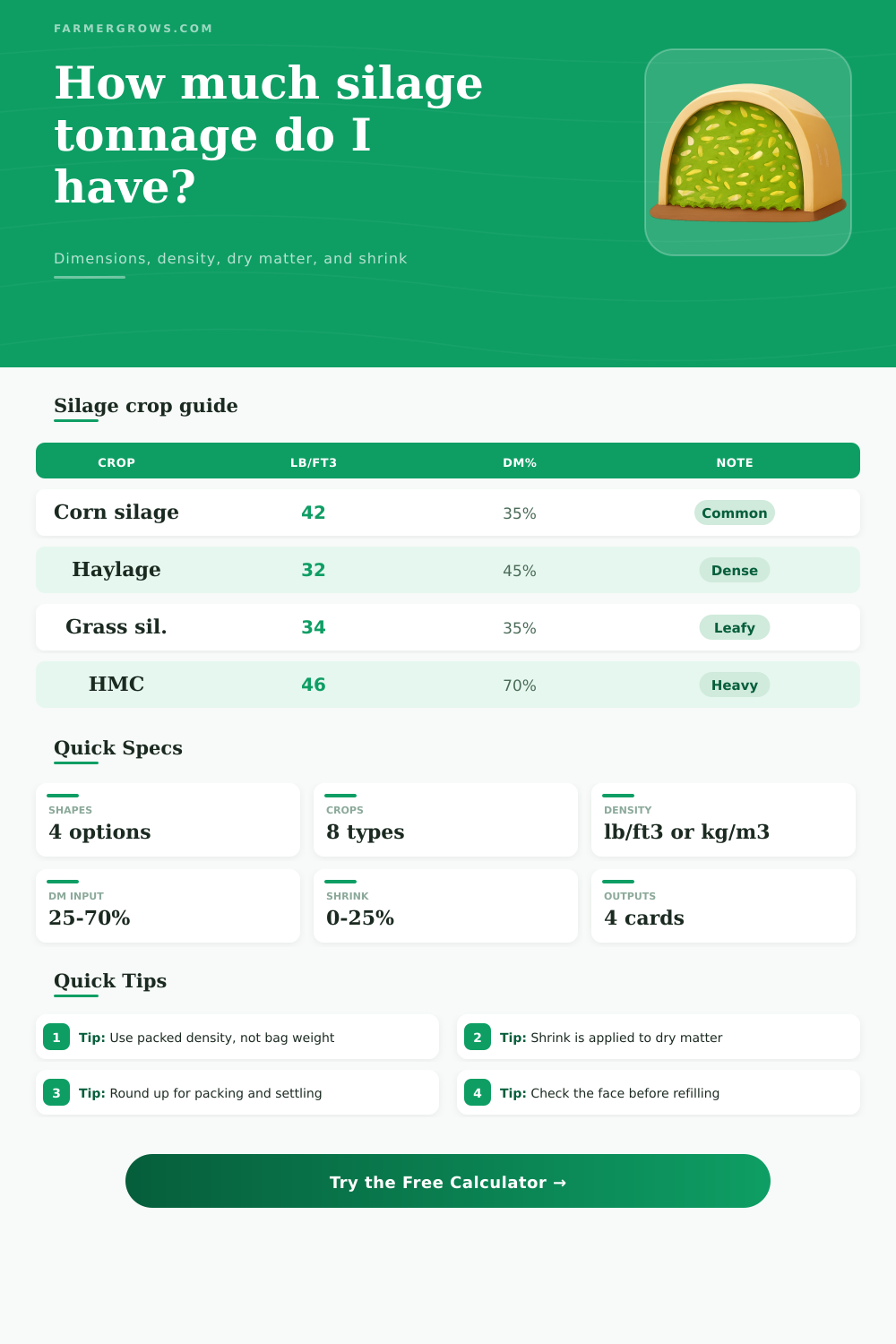
Silage density guide
| Crop | Density | DM | Note |
|---|---|---|---|
| Corn silage | 42 lb/ft3 | 35% | Very common |
| Haylage | 32 lb/ft3 | 45% | Denser forage |
| Grass silage | 34 lb/ft3 | 35% | Leafy crop |
| High-moisture corn | 46 lb/ft3 | 70% | Heavy grain |
Shape volume guide
| Shape | Formula | Inputs | Use |
|---|---|---|---|
| Rect bunker | L x W x H | 3 dims | Flat sided pad |
| Wedge pile | L x W x H / 2 | 3 dims | Sloped face |
| Round pile | pi x r2 x H | D and H | Round stack |
| Custom volume | Enter volume | 1 value | Survey data |
Dry matter guide
| Crop | Target DM | Risk | Note |
|---|---|---|---|
| Corn silage | 32-38% | Too wet | Sumps faster |
| Haylage | 40-50% | Too dry | Heats quicker |
| Grass silage | 30-40% | Too wet | Sour feed risk |
| High-moisture corn | 68-72% | Too dry | Harder packing |
Example bunker loads
| Scenario | Size | Wet tons | Usable |
|---|---|---|---|
| Small bunker | 80x30x10 | 50 tons | 45 tons |
| Mid bunker | 120x40x12 | 120 tons | 108 tons |
| Large clamp | 160x50x14 | 220 tons | 198 tons |
| Round pile | 70x18 | 95 tons | 86 tons |
Measure the inside storage footprint, then use the same unit system for every field so the tonnage math stays consistent.
Use a realistic density value from a packed face or a trusted crop guide, because packing tightness changes the final tonnage a lot.
If the pile has uneven shoulders, trim the shape or use custom volume so you do not overstate the storage you can actually feed.
Keep shrink separate from dry matter. Dry matter tells you what is in the silage, while shrink tells you how much survives storage.
When evaluating a silage pile, calculating the total tonnages of the silage is necessary to ensure that there is enough silage to feed the livestocks. The tonnage of the silage can be estimated from the physical size of the silage pile. However, estimating the tonnage from the physical size of the silage pile can lead to inaccuracy in the measurement of silage tonnage.
Using the incorrect measurement for silage tonnage can lead to the situation where the feed lasts too short than a period during the feeding season. The volume of the silage pile are the measurement of the physical space that the silage take up. However, the volume of the silage isnt the same as the density of the silage.
How to Measure Silage Tonnage
The density of the silage is the amount of weight that the silage has within a certin volume of spaces. The density change with the amount of pressure that is placed on the silage when it is being packed into the silage storage area. Using a heavy tractor to pack the silage will increase the density of the silage.
Using an accurate figure for the silage density will result in an accuracy calculation of the silage tonnage. The dry matter in the silage is the component of silage that provide nutrition to the livestock. Silage contains a high amount of water that add to the tonnage of the silage but does not add to the nutritional value of the silage.
Silage with a low percentage of dry matter will have a high tonnage of silage that is mostly water but will have a low tonnage of nutritional value to the livestocks. Silage tonnage must be manage according to dry matter, not wet tonnage, because dry matter is the feed that livestocks consume. The shrink of silage is the reduction of silage that is available due to the silage fermentation process.
Some silage tonnages will shrink due to silage spoiling or runoff from the silage storage area. Due to the silage fermentation process, it is inevitable that silage will shrink and some silage tonnages will have more shrink than other silage tonnages. Silage tonnages made from high moisture corn will shrink less than silage tonnages made from grass silage because high moisture corn will pack good when silage is stored in a silage storage area.
The type of crops that are silaged will change the calculation of silage tonnages. Silage tonnages made from different types of crops will have different density measurement. For example, corn silage will have a different density than haylage or alfalfa.
Silage storage area of different shapes will impact the calculation of silage tonnages. For example, silage piles in the shape of wedges will contain a different amount of silage than silage stored in rectangular storage areas. The calculation of silage tonnages will allow silage management to shift from a reactive to a proactive management strategy.
By calculating the total tonnage of silage in the silage pile, it is possible to calculate the number of day of feed that the silage will produce. Knowing how many days of feed the silage will produce will allow the silage manager to determine whether silage need to be purchase to last the feeding season or if the ration of silage to livestocks needs to be adjusted. Additionally, it is also possible to calculate the tonnages of silage by adjusting for the physical shape of the silage pile.
Silage piles may have even shoulders or dips in the clamp or round silage pile that may require adjustment to the dimensions of the silage pile to accurately reflect the total tonnage of silage that is available for the livestock. Through calculations that adjust for the density, dry matter, shrink, and physical dimensions of the silage, it is possible to move away from guesswork in the estimation of silage tonnages and accurately know the amount of silage available for livestocks.