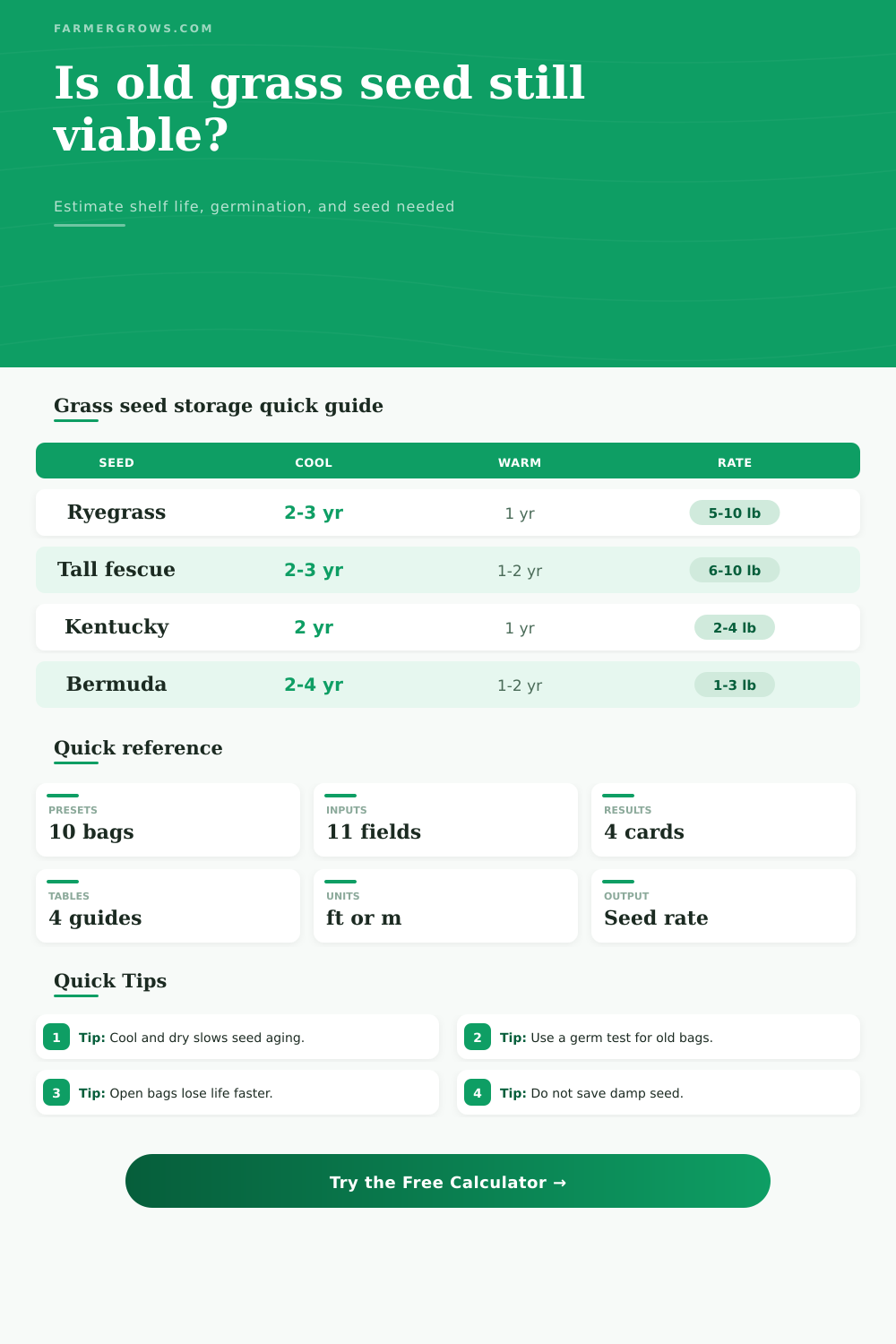
Grass Seed Shelf Life Calculator
Estimate the remaining germination of stored grass seed, compare cool and warm storage risk, and calculate how many pounds or kilograms to sow when an older bag has lost vigor.
📋Stored grass seed presets
Start with a realistic seed bag scenario, then adjust age, storage conditions, germination label, and lawn area for your own lot.
🌱Seed lot and storage inputs
Use the germination percentage printed on the label as the starting point. If you ran a paper towel germination test, enter that result to override the age estimate.
Grass seed viability estimate
Calculated from seed type, storage age, temperature, humidity, package condition, and target seeding rate.
Detailed seed lot breakdown
📊Current lot quality indicators
These field metrics translate the storage math into practical decisions: whether the bag is still sowable, how hard storage has been on it, and how much viable seed remains.
🧪Storage scenario comparison
The same seed lot can last very differently in a basement, garage, attic, or airtight bin. These cards show expected germination if every other input stayed the same.
📘Grass seed shelf life reference tables
| Seed type | Cool dry | Garage | New lawn rate |
|---|---|---|---|
| Tall fescue | 2-3 years | 1-2 years | 6-10 lb/1k sq ft |
| Perennial ryegrass | 2-3 years | About 1 year | 5-10 lb/1k sq ft |
| Kentucky bluegrass | 1-2 years | About 1 year | 2-4 lb/1k sq ft |
| Fine fescue | 2-3 years | 1-2 years | 4-6 lb/1k sq ft |
| Bermudagrass | 2-4 years | 1-2 years | 1-3 lb/1k sq ft |
| Zoysiagrass | 1-2 years | Under 1 year | 1-2 lb/1k sq ft |
| Temp + RH | Condition | Expected aging | Action |
|---|---|---|---|
| Under 90 | Excellent | Slow decline | Keep sealed |
| 90-100 | Good | Normal decline | Use within season |
| 101-120 | Fair | Faster decline | Run germ test |
| 121-140 | Stressful | High decline | Increase rate |
| Over 140 | Poor | Rapid decline | Replace if weak |
| Germination | Use status | Rate change | Best use |
|---|---|---|---|
| 85%+ | Strong | Normal label rate | New lawns |
| 70-84% | Usable | Add modest seed | Overseeding |
| 55-69% | Marginal | Add 25-55% | Patch repair |
| 40-54% | Weak | Add 60-110% | Small areas only |
| Under 40% | Poor | Replace seed | Compost test batch |
| Project | Fresh rate | 70% germ | 55% germ |
|---|---|---|---|
| 5,000 sq ft tall fescue | 40 lb | 49 lb | 62 lb |
| 3,000 sq ft ryegrass | 24 lb | 29 lb | 37 lb |
| 2,000 sq ft bluegrass | 6 lb | 7 lb | 9 lb |
| 1,000 sq ft Bermuda | 2 lb | 2.4 lb | 3.1 lb |
| 500 sq ft patch mix | 4 lb | 4.9 lb | 6.2 lb |
Grass seed lasts longest when the combined temperature in degrees Fahrenheit and relative humidity stays near or below 100. Airtight containers help only when the seed is already dry.
For older seed, place 50 or 100 seeds on a damp paper towel, keep it warm, and count normal sprouts after the expected germination period for that species.
This calculator estimates turf seed viability for planning. Actual emergence also depends on seedbed preparation, soil temperature, irrigation, seed depth, and seed lot handling before you bought it.
A bag of tall fescue sits in the back corner of your garage, behind pile of emptied planters, leftover from that little project you did last summer. “High Germination!” says the label, and yes, time does diminish seed quality no matter what. Whether you like it or not, seed viability isn’t an on-off switch: Good one minute, gone the next, on a certain date. It’s a gradual decline, a biological-chemistry equation. Living things breathes even when stored, and that breathing degrades them.
Knowing how this works is important. Wasting a season and money by sowing weakened seed results in patchy lawn. These lawns invite weed invasion or need re-doing all over again.
How to Store Seed for Longer Life
After entering your storage conditions, the calculator will do the math for you. No more guesswork on if the old bag is still worth keeping.
Contrary to popular belief, heat isn’t the only enemy. Humidity is just as destructive. Moisture seeps into the seed coat and causes metabolism to kick in, even though the seed is dormant. Instead of patiently awaiting contact with the soil, the embryo begins to burn through its own reserves of stored energy, staying alive. Add warmth and now the rate of respiration really picks up steam.
You want a sealed bag? Sure that helps, but doesn’t stop time altogether. All a sealed bag does is slow the leak. That’s why the tool wants to know relative humidity and temperature. Those two numbers spell out how hard your storage environment is working against seed’s natural way of staying preserved. If that means you’ll need to adjust your application rate or buy new seed, the calculator will tell you.
Knowing the inputs prevents bad decisions. For example: The biggest error home gardeners commit with seeds is assuming all kinds of lawn grasses have the same longevity on the shelf. Not true. Because of differences in their oil content and seed coat structure, ryegrasses tend to be more stable when stored, compared to Kentucky bluegrasses. Fine fescues? Somewhere in between. If you’re storing Bermuda grass in a warm attic without climate control, chances are it’s losing viability far quicker than some cool-basement-stored tall fescue. The tool includes these species-related vulnerabilities, so you don’t over-estimate the power of your old stuff.
How seed is stored affects how well (or poorly) it will germinate, too. We all know that storing seed means storing it in a cool, dry place, but what about storage packaging? A paper bag, once opened, isn’t as good as an airtight container with a desiccant packet. A paper bag is porous: moisture can pass into the bag, and also out of the bag. That means the seed’s embryos is exposed to changes in relative humidity from day to day, stressful. From the moment a paper bag is ripped open, the clock ticks faster. Folding the top over doesn’t help much, either.
To store seed longterm, the gold standard is to transfer seed to an airtight container along with a desiccant packet. If you’ve got some seed sitting around in a windowed bin because it “looks fine,” don’t expect high germination even if it’s not “old” by label date. It does not matter how old the lot is. The calculator adjusts the estimate because seed stored in this manner has lower germination, due to the conditions.
Germination is lower, but the seeds are still alive. This is reality, not ideal lab conditions.
A quick viability test: Want to try one yourself? Run a sample through some home testing first, this is how much you should count on getting good results when sowing; if fewer than thirty out of fifty sprout, then your germination rate is below sixty percent, so adjust accordingly.
How do you do this? Put 50 seeds between two moistened sheets of paper towel in a plastic bag, then wait a few days in a warm spot. How many sprout? If fewer than thirty germinate, your germination rate is below sixty percent. If fewer than thirty germinate, your effective germination rate is below sixty percent. If only 10 sprouted, for instance, you’re getting 20 percent germination, which is really low.
If you see weak sprouting in the test, it might not mean the seed is dead, but it might just mean you need to use a heavier hand during planting. I think the message is: Maybe you just need to use a heavier hand when you plant it. And the tool does that math for you. It adjusts to what it figures is the right seeding rate. You’ll have to use more of the dodo seed to get the same number of living plants in the ground as you would with the fresher stuff. It is simple arithmetic, masked as gardening science.
Yes, the seed is older than it was. What can’t be changed. But you can control how much goes out there. It’s laid out nicely in the reference tables on the page, for various situations. For example: if you store your seeds poorly, they’re more likely to go bad. If you store them well (cool and dry), they’ll be there waiting for you…patiently. If you leave them in the heat and damp, they will quietly die when you aren’t looking.
No shame in composting a bad bag. Go ahead and start fresh. You want that lawn, right? Make sure you don’t have to fight biology every step of the way.
Whether you’re starting from scratch or doing some overseeding, storing seed well. Treating it like a perishable good instead of something lasting forever, matters a lot. The old bag up in the garage? Don’t trust it until it proves itself.