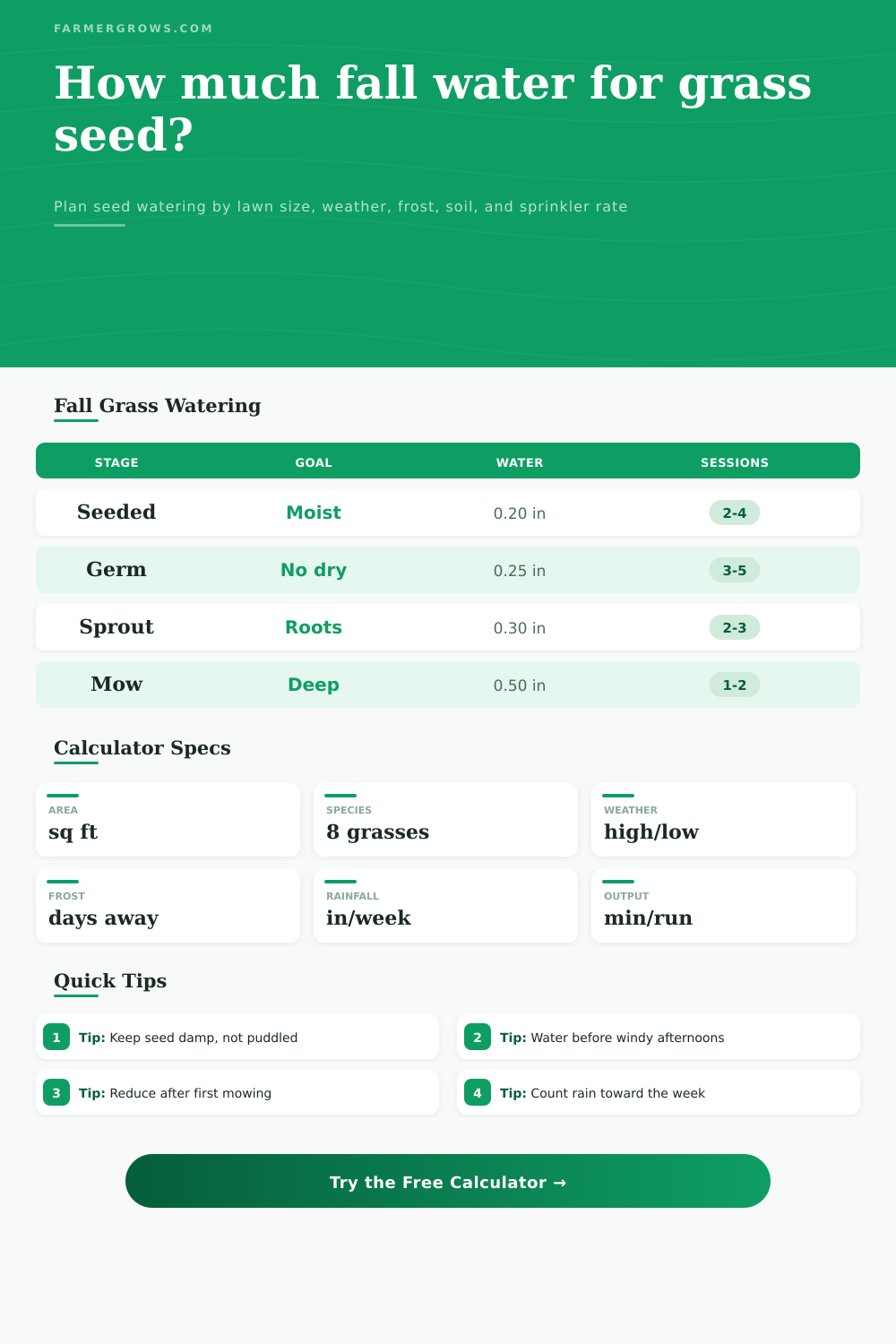
Grass Seed Fall Watering Calculator
Plan a fall grass seed watering schedule from lawn size, species, high and low temperatures, first frost timing, soil texture, rainfall, sprinkler precipitation rate, seed mode, germination stage, and available watering window.
Choose a realistic fall watering plan, then adjust the lawn size, soil, weather, rainfall, sprinkler rate, or growth stage for your yard.
Your Fall Grass Seed Watering Plan
Use the plan below as a starting point, then confirm soil moisture by touching the top half inch of the seedbed.
Fast germination makes it useful for patching and quick fall cover, but it still needs a consistently damp seed surface.
A common fall choice with good heat tolerance after establishment. Water lightly until sprouted, then deepen gradually.
Slow to germinate, so it needs more frost-free runway and careful surface moisture through a longer seedling period.
Works well in lower-input and shaded lawns, but dries out quickly when seed is placed in thin, exposed soil.
| Germination Stage | Surface Goal | Typical Daily Water | Session Pattern | When To Change |
|---|---|---|---|---|
| Freshly seeded, days 0 to 3 | Keep seed and top 0.25 inch damp | 0.15 to 0.25 inch | 2 to 4 short cycles | Increase only if the surface dries between checks. |
| Germinating, before full sprout | Prevent drying through the full seed coat | 0.20 to 0.30 inch | 3 to 5 light cycles | Shift after most seedlings are visibly up. |
| Sprouted, tiny grass visible | Moist top inch without puddling | 0.25 to 0.35 inch | 2 to 3 moderate cycles | Reduce frequency as blades reach 1 to 2 inches. |
| Rooting, 1 to 2 inches tall | Train roots deeper into the soil | 0.30 to 0.45 inch | 1 to 2 longer cycles | Move toward normal lawn irrigation after first mow. |
| After first mowing | Moisten the active root zone | 0.40 to 0.60 inch per watering day | 1 deep cycle, split if runoff starts | Begin watering by wilt, weather, and soil moisture. |
These are planning ranges for fall seedbeds. Actual watering should be adjusted for sun, wind, slope, mulch cover, sprinkler uniformity, and local watering rules.
| Fall Condition | Average Temp Cue | Watering Adjustment | Frost Note | Planning Signal |
|---|---|---|---|---|
| Warm early fall | High 70s, lows above 55°F | Add 10% to 20% for faster drying | Usually enough time for rooting | Watch afternoon wind and sunny slopes. |
| Ideal cool-season window | Highs 60 to 75°F, lows 45 to 55°F | Use stage target directly | Best with 30 or more days to first frost | Strong window for tall fescue and ryegrass. |
| Cool late fall | Highs 50 to 60°F, lows 35 to 45°F | Reduce slightly but avoid surface drying | Slow species may not mature before frost | Favor faster seed or accept spring fill-in. |
| Frost-risk seeding | Lows near freezing | Water only enough to settle seed | Young sprouts are vulnerable to hard cold | Late work may act like dormant seeding. |
| Soil Texture | Seedbed Behavior | Frequency Bias | Runoff Risk | Field Check |
|---|---|---|---|---|
| Sandy soil | Drains and dries quickly | More frequent, shorter cycles | Low, unless compacted | Top half inch turns pale and loose quickly. |
| Sandy loam | Good drainage with moderate holding | Slightly frequent cycles | Low to moderate | Surface crust is uncommon when watered gently. |
| Loam | Balanced water holding | Use the stage schedule | Moderate on slopes | Soil feels cool and slightly damp, not slick. |
| Silt loam | Holds water but may seal at the surface | Moderate cycles, gentle rate | Moderate crusting risk | Avoid hard sprinkler impact on bare seed. |
| Clay loam or clay | Holds moisture and accepts water slowly | Fewer cycles with soak pauses | High if applied too fast | Stop when shine or puddling appears. |
| Precipitation Rate | 0.10 Inch Runtime | 0.25 Inch Runtime | Best Use | Watch For |
|---|---|---|---|---|
| 0.20 in/hr | 30 minutes | 75 minutes | Slow rotor zones and clay soil | Long schedules may need fewer zones per day. |
| 0.40 in/hr | 15 minutes | 38 minutes | Many mixed residential sprinklers | Check dry edges near sidewalks and corners. |
| 0.60 in/hr | 10 minutes | 25 minutes | Spray heads and compact seeded areas | Split cycles if water starts moving downhill. |
| 1.00 in/hr | 6 minutes | 15 minutes | High output nozzles and small repairs | Very short cycles can miss coverage problems. |
| Grass Type | Germination Range | Ideal Fall Soil Cue | Frost-Free Preference | Watering Note |
|---|---|---|---|---|
| Perennial ryegrass | 5 to 10 days | 50 to 65°F soil | 20 or more days | Fast cover, but shallow roots still need careful moisture. |
| Tall fescue | 7 to 14 days | 55 to 70°F soil | 30 or more days | Strong fall choice when watered lightly until sprouted. |
| Kentucky bluegrass | 14 to 30 days | 55 to 70°F soil | 45 or more days | Needs the longest moist surface period before full cover. |
| Fine fescue | 10 to 20 days | 50 to 65°F soil | 35 or more days | Shade-friendly, but bare shaded soil can stay cool and slow. |
| Cool-season blend | 7 to 21 days | 50 to 70°F soil | 35 or more days | Water for the slowest important species in the mix. |
Check the seedbed, not the clock. The top half inch should stay evenly damp until germination. If seed moves, puddles form, or soil shines, shorten each run and add soak breaks.
Change the schedule as roots appear. Short, frequent cycles help bare seed. Once seedlings are upright, reduce frequency and water a little deeper so roots follow moisture downward before winter.
Local restrictions, slopes, sprinkler uniformity, seed mulch, and unusual weather can change the best watering plan. Use this calculator as a planning baseline and adjust with field checks.
Fall is the seed-spreading time of year, which brings a certain level of angst. You turn the dirt; you toss down the grain; then you stand there pondering: Are you baking the grass? Or are you drowning it? The latter seems likely since air seems dry to your skin and it’s the instinct: Water really well. That’s why most new lawn come to grief. They fail not from neglect, but from too much effort that either washes away all seeds into street or forms a soaked barrier so thick no air can get through.
To take the guess work out of the daily cycle, I use this calculator to help me determine middle ground. It will calculate how many minutes to run the water. This depend on your zone size and how fast your sprinklers put water down, such as using a hose with a static nozzle versus a pop-up sprinkler. That is important because they don’t deliver water as quickly. One spot would get muddy and another dry. Depending on your hardware it adjusts the run time to fit. It takes into account expected rain fall as well. So if the heavens give you a tenth of an inch, no need to go turn on the sprinklers for 30 minutes. Subtract that from the total.
How to Use the Watering Calculator
The other half of the equation is timing, and here’s where fall really throws us all into chaos. You’re up against the race to beat the first frost. How many more days are there before the freeze? That’s the question the calculator pose. And no, this isn’t some academic exercise: the days on your calendar translate into whether the seed has sufficient time to grow roots. Slow starters such as Kentucky bluegrass can be picky, requiring three weeks or so to get going. So if you’re down to 10 days before a hard freeze? Sorry, seed probably won’t make it. Quicker ones such as ryegrass afford you a little more room. The calculator weigh those biological realities against your calendar and gives you a viability score. It’s a sobering number but it also spares you the expense of purchasing seed that will never establish.
The physics are different depending on soil type. On sandy soil, water drains rapidly; an hour in direct sunlight can burn right through that soil. Clay will hold water like a sponge, but if you get up there with a hose on high and go at it, it’ll crust. The calculator takes all of that into consideration, adjusting how often you water and how long each cycle lasts. With sandier soil, it recommend briefer but more frequent bursts, keeping just the surface moist while never washing seed off. With clay, it’s going to slow you down so as to avoid runoff.
Check your soil type before blindly believing the numbers. Is the top layer slick and shiny? Then you’re watering too quickly. Does it feel dry to the touch by midday? Then you’re not watering enough. Water the top half inch or so of soil when needed (as in damp, not sopping wet) until seeds germinate and emerge above ground, at which point you’ll switch tactics and begin infrequent deep watering instead of regular spritzing. That’ll teach them to grow roots, not just up.
Moving the germination stage slider from fresh-seeded to rooting alerts you that watering will have to change: less frequent but deeper. A little less is more, but it can mean whether your lawn lives or dies in a heatwave.
And then there’s the part where you look with your eyeballs. An algorithm isn’t going to factor in whether the north-facing slope in your back yard got all baked by wind. Or a freakish cold snap caused the temperature to plummet twenty degrees overnight. Those calculated minutes are just a baseline. Now get up off your tush and go walk around the yard and feel the soil with your fingers. Cool and not quite dry? Good. Dry? Tack on a couple more minutes. Puddling? Time to pull over right now.
The calculator draws the map. You drive the car. Watch the weather. Keep the seed well-moistened. Fight the desire to drown it while trying to grow it. That’s how you get from a patch of dirt to a lasting lawn.