Grass Clipping Composting Time Calculator
Estimate how many days fresh grass clippings need to turn into usable compost based on pile size, browns, moisture, turning, temperature, and layer thickness.
Choose a mowing or yard-waste situation, then adjust the pile method, brown material, moisture, turning frequency, and temperature to match your compost bin.
Grass Clipping Compost Estimate
Adjust the pile settings and calculate to see timing.
Best when total mixed volume is at least about 27 ft³, the C:N ratio is near 25-30:1, and the pile is turned weekly or better.
Useful for smaller grass batches, but it needs dry browns and frequent rotation because wet grass can ball up.
Works for yard cleanup piles, especially with shredded leaves, but edges cool faster and finishing time stretches.
Low-effort composting works, but grass needs thin layers and browns to avoid sour, anaerobic clumps.
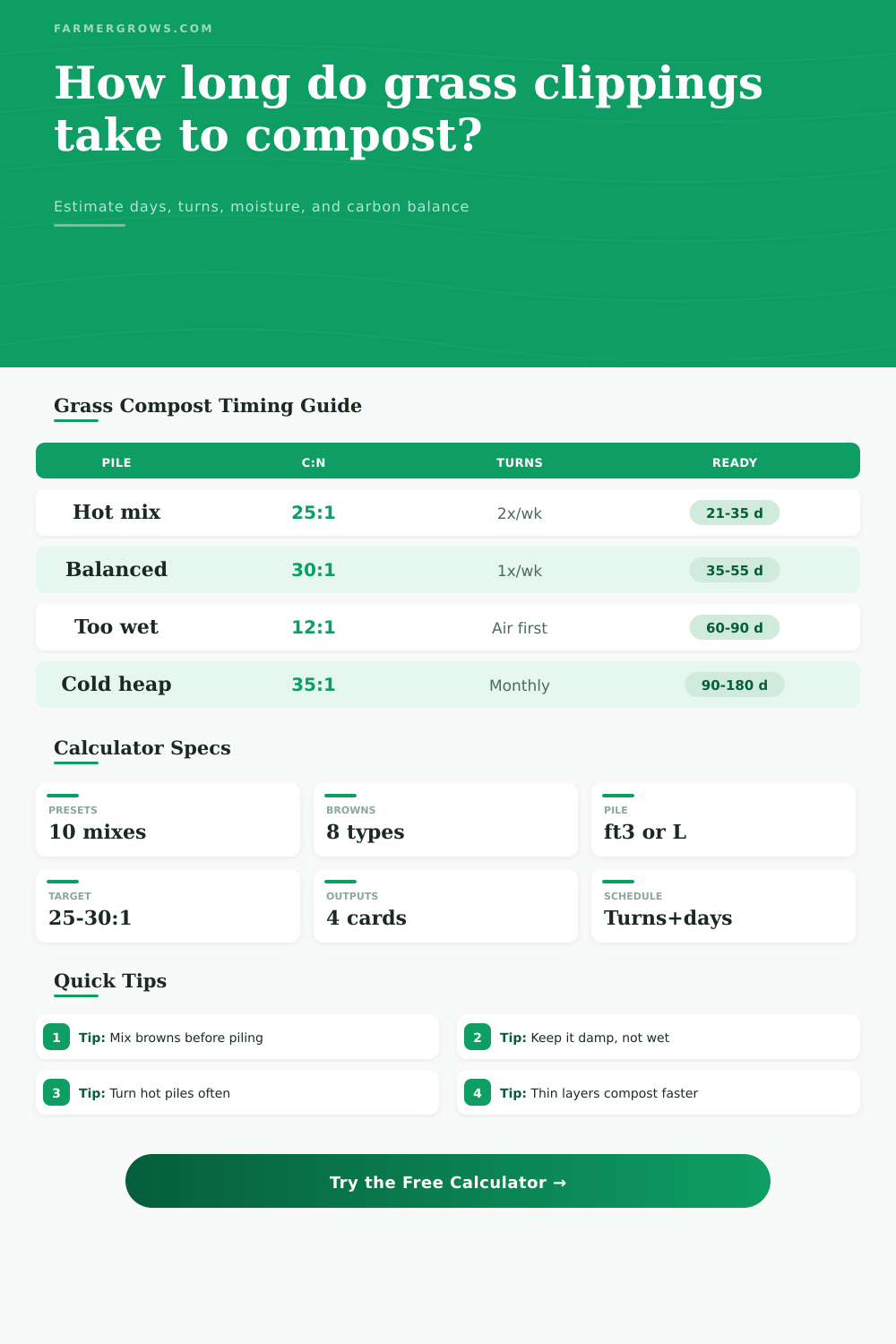
| Mix condition | Typical C:N | Moisture feel | Likely ready time |
|---|---|---|---|
| Fresh grass alone, thick layer | 12-18:1 | Wet, packs tightly | 60-120 days unless remixed |
| Grass with equal dry leaves by volume | 24-32:1 | Damp sponge | 30-55 days in an active pile |
| Grass with straw or shredded cardboard | 28-40:1 | Needs water checked | 35-70 days depending particle size |
| Grass with wood chips | 35-70:1 | Airy but slow | 70-180 days unless chips are screened out |
| Turning plan | Best use | Oxygen effect | Time impact |
|---|---|---|---|
| Daily first week | Tumblers and wet rescue piles | Breaks mats quickly | Can shorten active time 20-30% |
| Twice weekly | Hot bins with fresh grass | High oxygen, even heat | Fast reliable finish |
| Weekly | Balanced home compost piles | Enough air for most bins | Moderate finish |
| Monthly | Cold heaps and storage piles | Limited oxygen refresh | Often doubles the compost window |
| Pile size | Starting volume | Heat potential | Grass clipping note |
|---|---|---|---|
| Small batch | Under 12 ft³ | Low to moderate | Use a tumbler or mix into an existing pile |
| Half-bin | 12-26 ft³ | Moderate | Insulate with leaves and turn weekly |
| Full hot bin | 27-64 ft³ | High | Best size for fast grass composting |
| Large windrow | Over 64 ft³ | High core, cool edges | Turn thoroughly to prevent wet pockets |
| Problem sign | Likely cause | Calculator clue | Corrective action |
|---|---|---|---|
| Ammonia smell | Too much nitrogen | C:N below 20:1 | Add shredded leaves, straw, or cardboard |
| Sour odor | Too wet, low oxygen | Moisture above 65% | Turn and add dry bulky browns |
| No heat | Too small, dry, or carbon-heavy | Cold score or C:N above 40:1 | Add grass, water, or build a larger pile |
| Visible grass mats | Layers too thick | Layer above 4 inches | Break clumps and remix in thin layers |
Build the mix before it mats. Grass clippings compost fastest when they are fluffed with dry browns the same day. A thin green layer between leaf or straw layers keeps oxygen moving through the pile.
Judge moisture by squeeze, not shine. A good grass compost pile feels like a wrung sponge. If water drips out, add dry browns; if it feels dusty, sprinkle water while turning.
Grass clippings: They will decompose rapidy, so fast that most folks think they’re ideal compost ingredients. Don’t overdo it with the clippings, however; a heap of nothing but clipping gets so tight against itself that there’s no airspace through the middle. Oxygen is essential for the microbe to do their job, heating up the heap and converting nitrogen properly. When you smother them, the heap will stink of rotten eggs, and be a slimy mess.
To avoid such an issue, know what amount of the heap each ingredient occupy (as in: how much room does the grass leave for airflow?). After entering your volume and amount of brown materials, the page’s calculator takes care of the math. It will prevent you from having to guess what right carbon-to-nitrogen ratio should be. Fresh grass typically is pretty high in nitrogen (about 15 to 1 C:N ratio). To offset it, you want some brown material such as shredded cardboard, straw or dry leaves. Ideally, the final ratio should be roughly 25 to 30 parts carbon to 1 part nitrogen. Miss the mark and the microbes will either drown in nitrogen or starve for carbon. Either way: it really slows down the composting action.
How to Make Good Compost
The other big variable is moisture. Wet grass holds even more water, and will be wetter than ever if you mowed during a recent rain. Use the tool to adjust for both brown dryness as well as moist green clippings; the former is where you begin. Wrung-out-sponge feel is good advice. Too-wet means you could still squeeze some water from it by hand. Too-dry? It’s dusty. To compensate for wetness, the calculator estimates how much water you might need to add or how much dry material are required; either way, get it right and avoid the smell that sends your neighbors running for cover.
Size does matter (though few newbies understand that). Piles smaller than 12 cubic feet is too small to retain heat well. They have a lot of surface exposed to air so the surface cools before the bacteria inside can produce enough warmth. This is also why the table of references says to add small amounts to an existing bin, but not to start your own little pile. Once you get to around 27 cubic feet and beyond, you’ve got a big enough heap to insulate itself to reach those higher temps. These temperatures kills pathogens and weed seeds, which is the purpose of actively composting at all.
How much time you spend depends on how often you turn it. Turning a pile daily is required only in a rescue operation where the pile was wet. For active piles that are warm or hot, twice weekly can be the sweet spot: sufficient oxygen refresh but not so much as to lose all heat captured. A cold, passive heap can go months between turns. But don’t expect miracles. Choose your turning schedule and the calculator’s estimate of days adjust accordingly. It knows that the act of turning aerates the pile, distributing moisture and maintaining the biological activity.
The type of brown materials will alter results as well. High-carbon sawdust (it’s about 400 to 1 carbon ratio) means you only need a small amount to balance a large grass load. Slow-to-decompose wood chips are great aerators, while fast-to-break-down shredded leaves or cardboard will accelerate the process, shortening the total time. You’ll find those options among the preset combinations on the tool. For instance, it can show you the estimated finish date when you compare combinations like straw versus leaves.
Despite the inputs, patience remains key. A “perfectly” balanced hot pile will require time to cure once it cools down. That’s when the compost stabilizes… And becomes safe for use on plants. Burn-sensitive roots (or harm to seedlings) can result from rushing this process. With a little input, you can also customize your output. You can decide when the compost is mature enough to work into the soil as a coarse mulch. Alternatively, you can wait longer for a finer, seed-safe version, though that takes more time before it is ready to use in the garden. The calculator lets you set the maturity standard accordingly.
The trick to composting: It’s all about creating the right conditions for nature to do its thing. So don’t expect to hurry it along. Biology is not about speed, but balance. There are many things you can do to make it happy. Turn the pile when needed. Keep it moist but not soggy. Have just enough browns to match the greens.
Turn it into a resource; compost transforms what you call “waste” into something else entirely. A little goes a long way. Making good compost is one of those small things that makes a big difference. It helps make your garden better, too. Get the initial balance right and then let things happen.