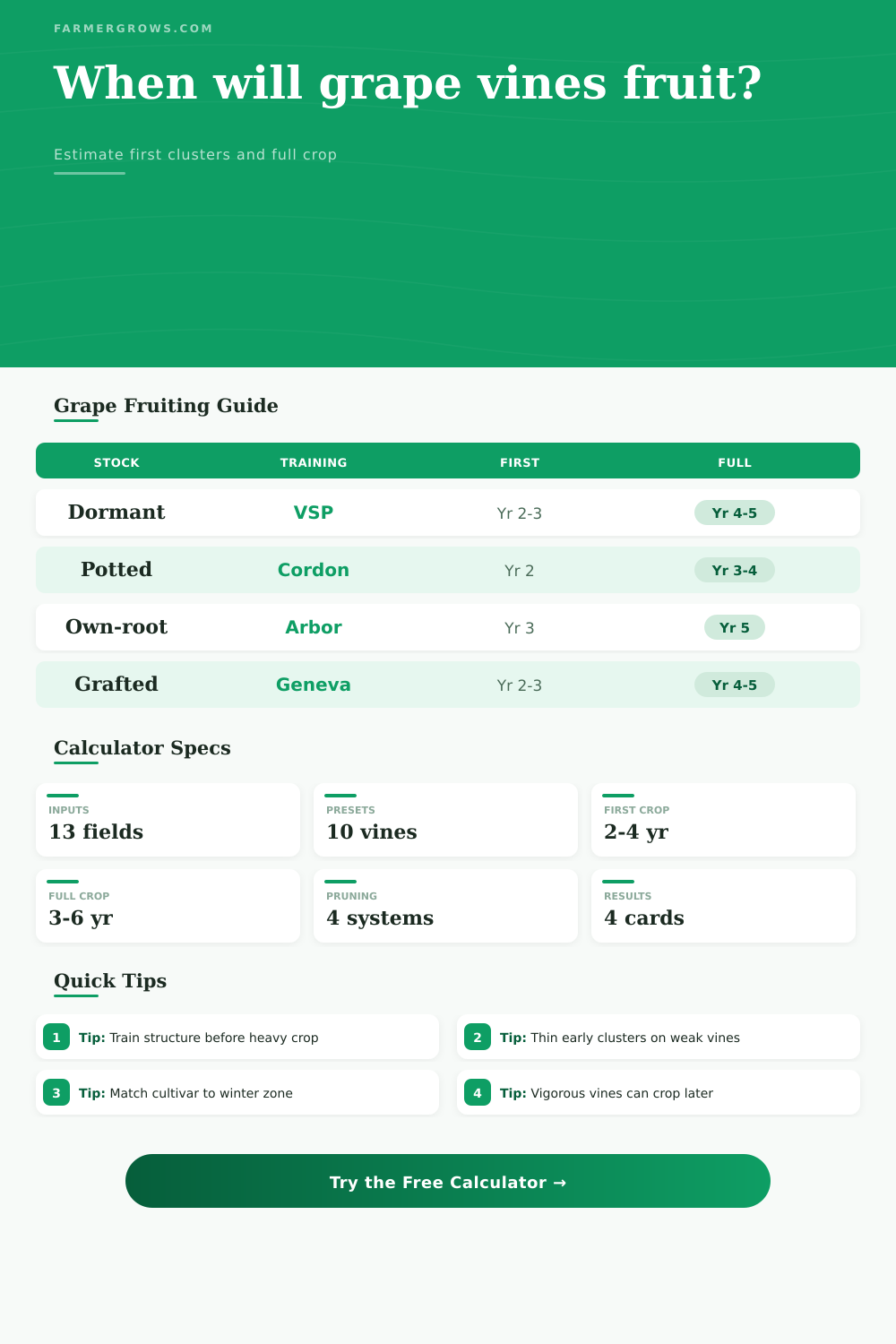
Grape Vine Time to Fruit Calculator
Estimate when a grape vine may set its first clusters, when the first useful crop should be allowed, and when full production begins from planting stock age, training system, cultivar vigor, hardiness zone, pruning method, cluster thinning, and current vine growth.
Load a realistic grape planting profile, then tune the planting date, nursery stock age, training structure, variety vigor, zone, winter injury, pruning system, cluster thinning, and vine growth.
A strong 2-year potted vine may carry a small crop sooner than a dormant 1-year bare-root vine that must first rebuild roots and trunk structure.
VSP and cordon systems can crop once trunks and cordons are formed; arbors and divided canopies often need more wood before heavy clusters are sensible.
Low-vigor vines may be too weak to crop early, while very vigorous vines can spend extra time filling trellis space before fruiting cleanly.
Young vines often benefit from cluster removal or light thinning so roots, trunks, cordons, and renewal spurs mature before full production.
Estimated Grape Fruiting Window
Adjust the inputs and calculate to estimate first bloom, first allowed crop, full crop season, and fruiting confidence.
| Planting stock | Typical first clusters | First useful crop | Full crop expectation |
|---|---|---|---|
| 1-year dormant bare-root | Often year 2 if growth is strong | Year 2 to 3 after planting | Year 4 to 5 for many trained vines |
| Strong potted 2-year vine | May flower the first or second season | Usually year 2 if structure is ready | Year 3 to 4 with balanced pruning |
| Own-root cutting or liner | Usually later because roots are small | Year 3 is common | Year 5 or later if establishment is slow |
| Dug mature transplant | Depends on root loss and dieback | Often delayed one to two seasons | Full crop returns after structure rebuilds |
| Training system | Why it affects timing | First crop caution | Full crop signal |
|---|---|---|---|
| VSP single trunk | Moderate framework size | Keep clusters light until trunk is pencil-thick or better | Fruiting wire filled with renewal positions |
| Bilateral cordon | Cordons need time to fill wire | Crop after permanent arms are established | Even spur positions along both cordons |
| Geneva or Lyre | Divided canopy needs more structure | Do not rush crop before the canopy is divided | Balanced shoots across both curtains or arms |
| Arbor or pergola | Large overhead framework delays full cover | Let shade structure develop before heavy clusters | Fruitful wood spread across the arbor |
| Cultivar group | Typical vigor | First crop pattern | Timing risk |
|---|---|---|---|
| European wine grape | Low to medium depending site | Usually year 3 for a useful crop | Cold injury and short seasons can delay harvest |
| Cold-hardy hybrid | Medium to vigorous | Often crops young if buds survive | Overcropping can reduce cane hardiness |
| Seedless table grape | Medium to high | Sample clusters may appear early | Cluster sizing and cane maturity matter |
| Muscadine | Very vigorous in warm zones | Needs warm-site fit and strong trellis growth | Cold limits and sex/pollination can change crop |
| Pruning or thinning choice | Effect on first crop | Effect on full crop | Best use |
|---|---|---|---|
| Remove all young clusters | Delays eating grapes | Can speed root and cordon strength | Weak or first-year plantings |
| Small sample crop | Allows a taste without heavy load | Usually neutral if growth remains strong | Healthy second-year vines |
| Balanced crop to growth | Best for trained young vines | Supports reliable mature timing | Year 3 and older vines |
| Renovation pruning | Can remove near-term fruiting wood | Restores productivity over several seasons | Old, damaged, or tangled vines |
Build the vine before loading it. A few clusters can be harmless on a strong young vine, but a heavy crop before trunks and cordons mature can delay the full-crop year.
Separate bloom from harvest. Grape vines may flower before they are ready to carry a useful crop; the calculator estimates the first allowed crop, not just first blossoms.
Winter injury resets the clock. Bud loss, cane dieback, or trunk damage can move fruiting later even when the planting date suggests the vine is old enough.
Crop thinning protects next year. Leaving fewer clusters on a young or stressed vine helps canes ripen, which improves winter survival and next season's fruiting wood.
This calculator gives planning estimates from common grapevine bearing ranges. Local cultivar genetics, rootstock, disease pressure, irrigation, soil fertility, frost, pollination, and pruning skill can move actual dates.
When you plant a grapevine, the expectation is that it will bear its first crop in year three. But it might just produce leaves in year two, and that’s about it. Why? Because the vine doesn’t always know whether to invest in fruit or root production. It’s a disguised resource allocation problem, not gardening at all.
It’s why most gardeners fail; it’s not for want of love, but for failure to understand the plant’s internal clock. After you enter your training system and stock age into calculator above, it tells you whether your setup needs patience or some kind of action.
Why Your Grapevine Has No Fruit Yet
Everything else begins with your starting stock. A dormant, bare-root one-year-old vine is basically a baby without any money in the bank. Its first year will be spent establishing roots, not trying to push upward into the fruiting wood. Unless they’re really precocious, which isn’t common, you won’t get much from them in year 2; they’re too busy surviving.
Compare that to a potted vine you’ve purchased at nursery, maybe a couple gallons big, whose roots are already in place and might even have some small cordon growth. When that guy goes into the ground he brings structural credit, meaning he’s skipping the “survival” year and going directly toward expanding his canopy. The bigger the nursery stock you buy, the more you’re paying for time, the time you’re saving the vine from having to go through that stage itself.
How fast that happens depends on your training system. With vertical shoot positioning (one trunk plus later added horizontal arms), there is no point in expecting fruit to make sense until that one trunk matures. Full production must wait until that skeleton has become solid. Try forcing some clusters onto a puny trunk and it will bend or break beneath the strain. The page’s reference table spells all this out, including how divided-canopy systems such as open Lyre or Geneva double curtain require even more woody structure before they can bear heavy loads.
Those two kinds of systems don’t forgive rushing things. Build the structure first; then invite the guests over for dinner.
Another factor many beginners don’t realize is how important cultivar vigor is when it comes to timing. Compact vines may appear ready to go early, but may not have enough leaf surface to support next-year’s bud formation or sugar development. The other side is this: Very strong vines push hard at growing, chasing wall space on the trellis, and end up delaying flowering even farther down the road. Balanced vine vigor. Medium-vigorous selections, help you avoid the delays caused by the extremes.
Why? Because you want to match your variety selection to where you live and what kind of soil you have (as much as labels suggest otherwise). Pruning decisions act as the throttle on this engine. If you want grapes today, it’s counter-intuitive to cut out all of the clusters in the first or second year, yet doing so is frequently best in the long run because it compels the plant to spend each calorie on developing roots and growing a thicker trunk. Thick trunks bear more wood; more wood means more renewal spurs. So it establishes a self-sustaining system of fruitfulness.
Keeping a heavy crop on the plant too young stunts the structure and leaves nothing but a vine that appears fruitful one year and then fails the next. No matter when you plant, if you get a winter injury it can wipe the clock all the way back again. If your bud freezes or is damaged somehow, you force the vine to resprout a fruiting cane from further down. This delays bloom and harvest by another entire year, since there is no way for that young wood to produce flowers that season.
That’s a rude reminder if you’re a grower in a marginal zone. Summer’s growing degree days aren’t the only thing you need to figure on when planning for your first usable crop; you also have to factor in winter survival. Whether or not those budding bunches ever mature depends on sunlight and air flow. You may have a partially shaded vine that blooms right on time, but no ripe grapes because the sugars haven’t had a chance to build up. Your tool takes your sun exposure into account and tweaks the confidence levels accordingly.
It’s not just how many hours of full sun (though full sun is certainly involved). It’s also the quality of light reaching down through the canopy. Without it, there are only leaves. There are no grapes.
That’s all there is: patience. No force-feeding (or fertilizer) can trump biology. Your job is simply to direct where the plant puts its energy, in a sense, train it… By being careful about how you prune. Let the structure come together first. When the vine is sufficiently confident to share its resources, it’ll have that fruit. Begin at the roots. End on the clusters, and it all fits in-between.