Grape Vine Growth Time Calculator
Estimate how long a grape vine needs to fill its trellis target from current cane length, cultivar vigor, rootstock influence, pruning severity, water stress, training system, and useful season length.
Load a realistic vine scenario, then tune cane length, trellis target, cultivar vigor, rootstock, pruning, water stress, and season length for your site.
Low-vigor wine grapes may extend slowly, while Concord, table grapes, and muscadines can fill wire quickly in warm weather.
Vigorous rootstocks can add cane length where roots are healthy. Weak or drought-limited roots shorten the useful growth window.
Hard renewal pruning creates strong shoots but also removes starting length, so the target may be reached later than expected.
VSP asks for a shorter trained cane path than high cordon, pergola, Geneva double curtain, or a long muscadine wire.
Grape Vine Growth Estimate
Estimate will appear after calculation.
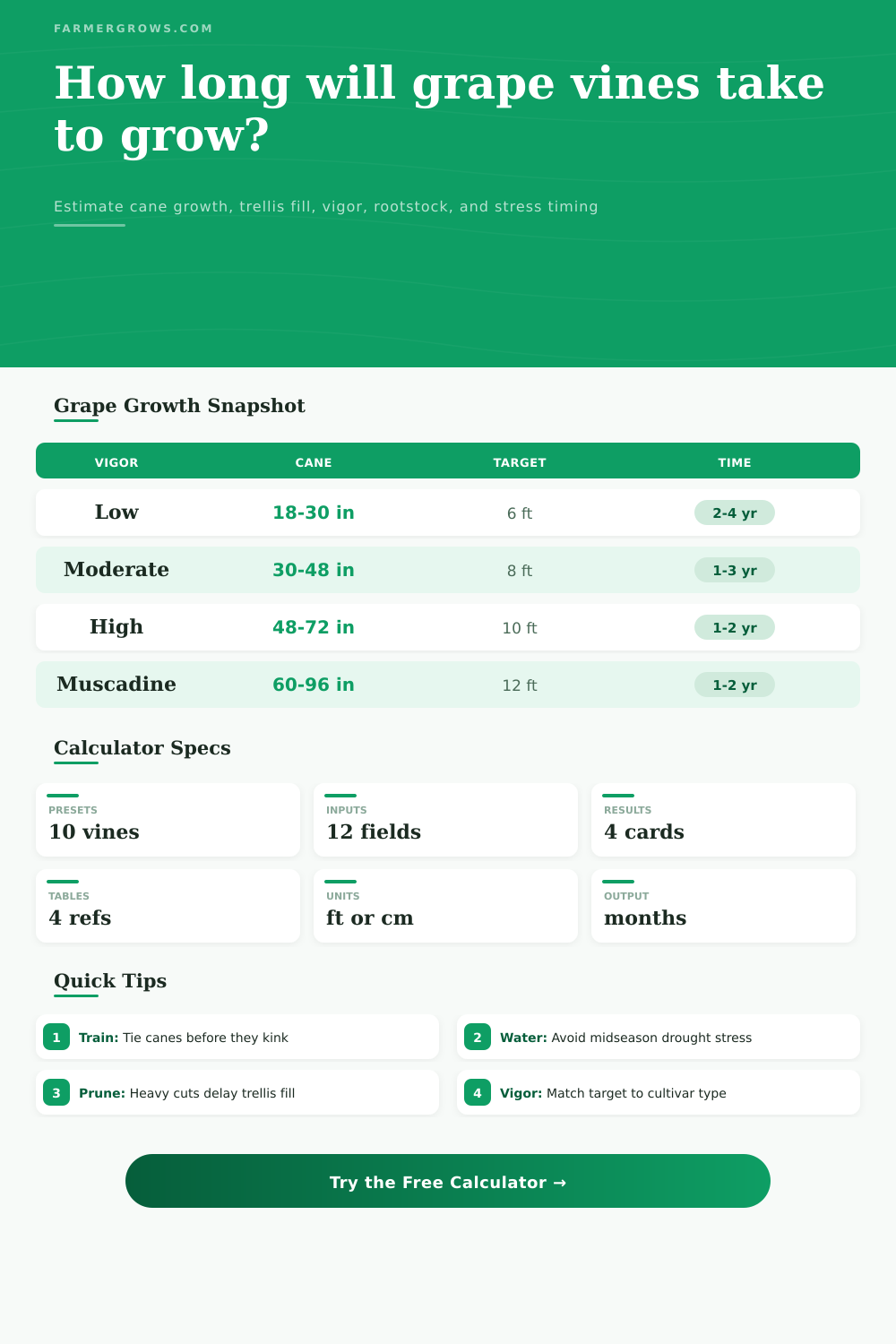
| Cultivar class | Typical usable cane growth | Best-fit trellis target | Growth timing note |
|---|---|---|---|
| Low-vigor wine grape | 18 to 30 inches per season | Short VSP cane, small cordon, or head-trained spur system | Can be excellent for fruit balance, but trellis fill may take extra seasons. |
| Moderate wine grape | 30 to 48 inches per season | VSP cordon, bilateral cane, or compact backyard trellis | Often fills a normal training target in 1 to 3 growing seasons. |
| Vigorous table grape or hybrid | 48 to 72 inches per season | High cordon, Lyre, pergola, or longer in-row wire | Can reach length quickly, but shoot positioning and thinning still matter. |
| Concord or juice grape | 42 to 66 inches per season | High cordon or divided canopy | Usually steady once established, especially on deep soils with moisture. |
| Muscadine | 60 to 96 inches per season | Single wire or large arbor | Very vigorous in warm regions; target length should be generous. |
| Container or restricted vine | 12 to 30 inches per season | Small patio trellis, fan, or short cordon | Root volume and summer watering usually set the ceiling. |
| Root system | Calculator effect | When it helps | Watch item |
|---|---|---|---|
| Own-root vine | Baseline growth multiplier | Home vineyards, cold regions, or non-grafted plantings | Root health still depends on drainage and soil depth. |
| Balanced grafted rootstock | Slight vigor lift | Typical vineyard grafted vines where growth is neither weak nor excessive | Match rootstock to soil pests, lime, drought, and vigor goal. |
| Vigorous rootstock | Faster cane extension | Weak soils, replant sites, or larger canopy targets | Too much vigor can shade fruit and delay wood maturity. |
| Drought-tolerant rootstock | Protects growth under drydown | Dry summers, slopes, and regulated irrigation | Still needs moisture during establishment. |
| Weak or damaged roots | Large slowdown | Use after transplant stress, gopher injury, rot, or shallow soil | Fix the root problem before expecting normal cane extension. |
| Container root zone | Moderate slowdown | Patio vines, pots, tubs, and restricted beds | Water and root temperature swings are the main limits. |
| Training system | Common target length | Structural goal | Timing cue |
|---|---|---|---|
| VSP cane or cordon | 6 to 8 feet | Fill the fruiting wire while keeping shoots vertical and spaced. | Often ready once one or two pencil-thick canes reach the wire. |
| High cordon | 8 to 10 feet | Build a permanent cordon on a high wire for trailing shoots. | Needs stronger shoots before permanent arms are kept. |
| Geneva double curtain | 10 to 12 feet | Divide canopy into two curtains for vigorous vines. | Length comes fast, but full structure may need another pruning cycle. |
| Open Lyre | 9 to 11 feet | Spread shoots into a split canopy with a clear fruit zone. | Extra arms increase the training target compared with simple VSP. |
| Pergola or arbor | 10 to 14 feet | Cover overhead wire, walkway, or shade structure. | May need several ties as shoots extend and harden. |
| Muscadine single wire | 12 to 18 feet | Train long cordons along a strong single wire. | Warm-season vigor often fills wire quickly after establishment. |
| Factor | Fast condition | Slow condition | Why the calculator adjusts time |
|---|---|---|---|
| Pruning severity | Light training cuts that keep usable length | Hard renewal, trunk replacement, or severe heading | Heavy pruning can restart the trained length even if shoots are vigorous. |
| Water stress | Even moisture through early and midseason growth | Midseason drought, heat stress, wet feet, or root rot | Cane tips slow or stop when water supply and root oxygen are poor. |
| Season length | Long warm season with 150 or more active growth days | Short cool season with fewer than 100 active growth days | The same vine may need another calendar year when active days run out. |
| Vine age | Established roots after year two | New bare-root vines or recent transplant shock | Young roots spend part of the season establishing before pushing long canes. |
Measure usable trained length. A long shoot only counts if it is healthy, well attached, and can be tied to the wire without cracking or kinking.
Do not chase length at the expense of wood quality. Very lush late growth may fail to harden before winter, especially in short-season areas.
Separate vigor from target size. A low-vigor cultivar can be perfectly healthy but still needs a shorter cordon target or more seasons to fill wire.
Water stress changes the calendar quickly. Even strong vines can pause shoot tips during drought, heat, or waterlogged soil, which pushes trellis fill into the next season.
This calculator estimates vegetative cane growth for training and trellis fill. Actual timing changes with cultivar, rootstock, soil depth, pests, winter injury, crop load, nutrient balance, and local weather.
In May, your recently planted grapevine appears as nothing more than a stick. The holes are dug, the trellis built, and now there’s budbreak. What happens next? Will the vine ever fill wire, or is it dead? It is most likely neither; or both, depending on if you realize vines grows on their own timetable.
That timetable is a combination of environment and genetics. The root system has more impact than most growers recognize on the shoot tip aboveground. Planting a vigorous cultivar such as Concord may be the right move. However, roots will has to fight it out in waterlogged or compacted clay, and you’ll see that stress reflected in canopy. Adjusting expectations for growth based off your kind of root helps visualize the link: A slow start mean a weak root zone, no matter what the variety description says. We often fault scion; the trouble lies underground.
Why Your Grapevine Grows Slowly
This process is governed by water availability. Even with ideal pruning and soil, a hot and dry summer in July can prevents cane extension. To predict when it will reach your desired size, the calculator takes into account water stress levels. Steady growth mean your plants has had just the right amount of moisture; too much or too little causes bottlenecks. That way, you know if you’re better off fixing the situation or simply waiting another year.
When the soil’s bone dry, patience might be your best friend. When growth stalls because the soil is saturated, you’ve got a drainage issue that won’t wait. Another stumbling block for beginners are pruning severity. On one hand, severe pruning can encourages vigorous sprouting; on the other, it takes away the trained length you’ve invested in so far. In other words, you hit reset button on your cane measurement.
Different training systems calls for different target lengths. That’s where the reference tables comes in to help. A high cordon requires more footwork then a head-trained spur system. Half the battle is understanding that distance gap. Nature takes its own good time, so don’t hurry it along.
Wine grapes are naturaly low-vigor plants that want to make balanced fruit, not giant canopies. If you’ll simply let them be they’ll grow up to match their modest goals eventually. Pushing a fragile Riesling to grow as if it were a feral Muscadine tends to yield poor wood maturation and winter kill.
Entering your parameters into the calculator provides a reality check. It tells you if you should of expect fruit next year or if you need to train for two more years. It’s all about matching the plant’s biology to what you expect of it. If you know its growth is limited by livig in a pot or having a short growing season, you stop trying to fight it and start working with it. Tie the canes lightly, water regularly, and let the wood set up.
Most importantly, don’t get impatient. No hurry here; this is a matter of creating a lasting structure. Check your roots, measure your cane, and listen to the numbers to tell you when it finaly starts to pay off.