Grain Protein Calculator
Compare wet basis and dry basis protein, convert nitrogen to protein, and estimate blend share so grain decisions stay clear and consistent.
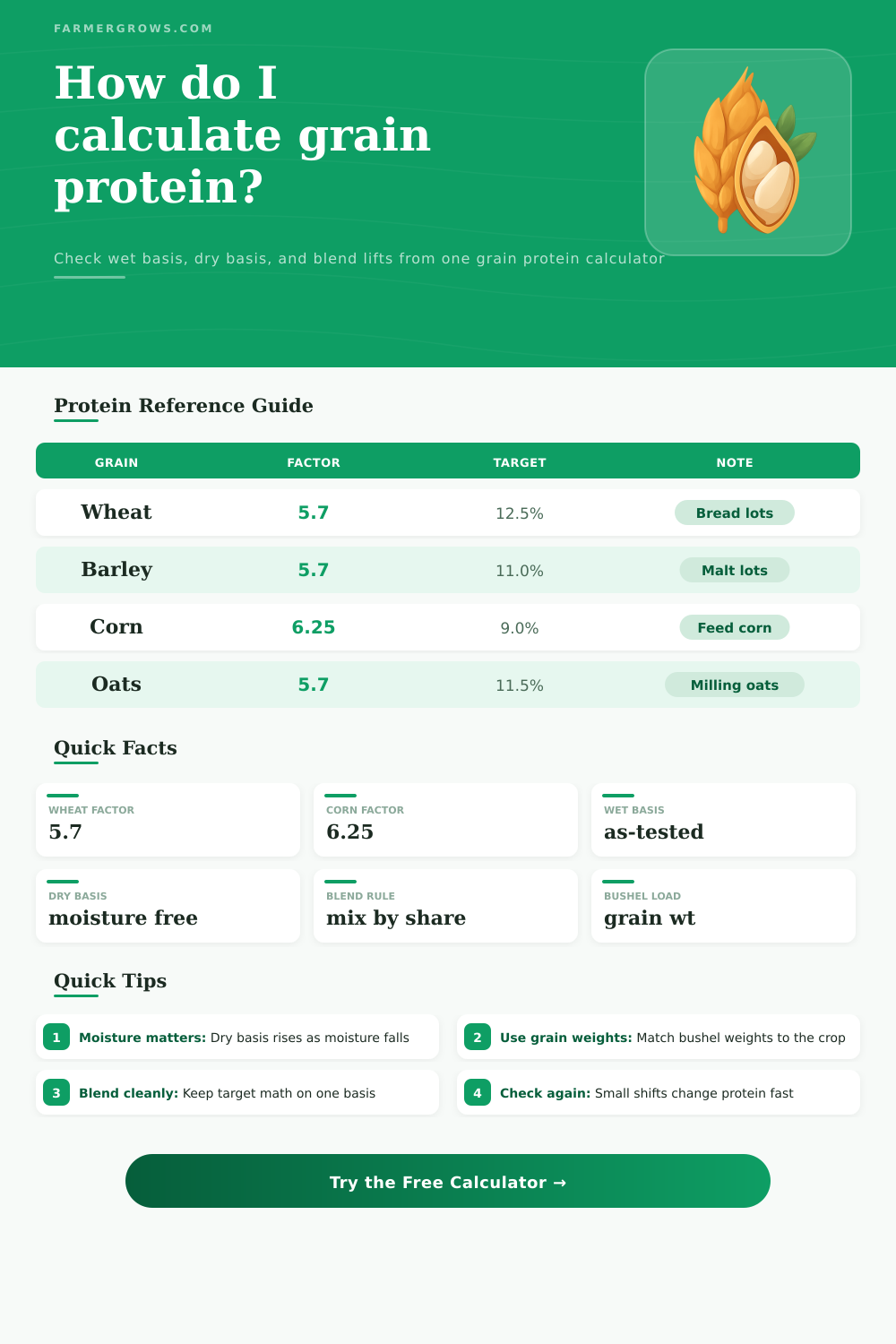
| Grain | Factor | Target | Note |
|---|---|---|---|
| Wheat | 5.7 | 12.5% | Bread lots |
| Barley | 5.7 | 11.0% | Malt lots |
| Corn | 6.25 | 9.0% | Feed corn |
| Oats | 5.7 | 11.5% | Milling oats |
| Moisture | Dry matter | Wet basis lift | Note |
|---|---|---|---|
| 12% | 88% | 1.136x | Cool bin |
| 14% | 86% | 1.163x | Base case |
| 16% | 84% | 1.190x | Damp lot |
| 18% | 82% | 1.220x | Recheck |
| Grain | lb/bu | kg/bu | Note |
|---|---|---|---|
| Wheat | 60 | 27.2 | Standard |
| Barley | 48 | 21.8 | Light |
| Corn | 56 | 25.4 | Standard |
| Oats | 32 | 14.5 | Light |
| Current | Target | High lot | Share |
|---|---|---|---|
| 10.0% | 12.0% | 18.0% | 25% |
| 11.0% | 12.5% | 16.0% | 30% |
| 12.0% | 13.0% | 17.0% | 20% |
| 9.0% | 10.0% | 12.0% | 50% |
Hard red wheat
Use a 5.7 factor, watch moisture closely, and compare the lot against the bread-wheat target before storage or sale.
Malting barley
Protein targets are tighter here, so dry basis conversion and lot blending can matter as much as the analyzer reading.
Feed corn
Corn often uses a 6.25 factor. Even a small nitrogen change can move the protein result enough to change the grade.
Oats and rye
These lots are often compared by moisture-adjusted protein so the result stays fair when bins are not equally dry.
Higher moisture lowers the dry matter share of the lot, so the same protein percentage may represent less true protein in the grain. This calculator keeps the math on one basis so the result is easier to trust.
For blend planning, the target and the stronger grain must use the same basis. If the stronger lot is not above the target, the blend share will not be feasible.
Grain protein content is a measurement of nitrogen in the grain; this value indicate the quality of the grain and its price. Many buyer use this value to determine the value of the grain. For example, high protein content is beneficial in the formation of bread, as protein content determine the baking strength of wheat.
Barley contain protein content that indicates its potential for malting. The nutritional value of corn is dependent upon the protein content of the corn. The nitrogen content of the soil is the source of the protein content in the grain.
Measuring Grain Protein and How to Blend It
To measure the amount of protein in the grain, laboratories multiply the nitrogen measurement by a specific factor. For wheat, the factor is 5.7; multiplying the nitrogen measurement by 5.7 will reveal the percentage of protein content in the wheat. The moisture level in the grain can impact the protein measurement that is provided to the buyer.
A protein measurement can be taken with high moisture level or dry levels. A protein measurement with high moisture levels will dilute the protein content in the grain. The protein measurement on a wet basis will include the weight of the water in the grain, but the protein measurement on a dry basis will not include the weight of the water in the grain.
The farmer must convert the wet-basis protein measurement to a dry basis protein measurement. For instance, a measurement of 12% protein on a wet basis will have a protein measurement of 13.6% on a dry basis. In determining the value of the grain, the measurement should always be converted to a dry basis measurement to accurately value the grain.
Blending is used to determine the percentage of protein in the grain to reach a desired target. Each lot of grain contains a different level of protein. To reach a target protein level for the buyer, another lot of grain with a higher percentage of protein must be blended in with the main pile of grain.
The blend ratio is the factor that determines the amount of high-protein grain that must be mixed with the main pile to reach the target protein level. For instance, if the main pile of grain has an 11% protein level but the target protein level is 12.5%, a high protein level of 14% will be blended in with the main pile. The gap between the target level and the current level of protein is divided by the spread between the high protein level and the current level of protein to find the blend ratio.
The protein levels of the grain that will be blended must be measured on the same basis. If one lot of grain has a high protein measurement on a wet basis and the other lot of grain has a high protein measurement on a dry basis, the blend calculation will be incorrect. Different crops require different percentages of protein level to be beneficially used for specific purposes.
Wheat that will be used to create bread must contain at least 12.5% protein because the protein in the wheat is gluten, which will provide the dough with the strength to stretch into bread loaves. Barley that will be used for malting requires a protein level of approximately 11% because higher levels of protein will interfere with the malting process of the barley. Corn that will be used as animal feed contains a protein level of around 9% because the protein is used to support the growth of the livestock that will eat the corn; in corn, the factor that determines the amount of protein is 6.25 because the proteins in corn are of a different structure than the proteins in wheat.
Oats that will be used for milling into breakfast cereals need to have a protein level of 11.5%. The moisture and weight of the grain can impact the calculation of the value of the grain. The percentage of protein levels will be 19% more higher on a dry basis if the moisture level of the grain at harvest is 16%.
When calculating the tonnage of grain being shipped, the weight of each bushel of grain must be considered. For instance, wheat weighs 60 pounds per bushel but barley weighs 48 pounds per bushel. These different weights must be accounted for in blending calculations; the weight of each lot of grain must be matched with the weight of the grain itself, regardless of the size of the truck or trailer that will transport the grain.
Blending can help the farmer to avoid making errors in the percentage of protein levels of the grain. To create the correct blend, a calculator can help the farmer to determine the proper share of each type of grain that should be blended together. The high protein level must be high enough to reach the target level; otherwise, incorrect calculations will result.
The protein level of the blend can be incorrect if the high protein level of one lot of grain is measured on a wet basis and the other lot of grain is measured on a dry basis. It is also possible for the protein level of the grain to change after it is harvested; different elevators can provide different measurements of protein content of the same type of grain. For example, the angle of the probe used to sample the grain can affect the protein measurement that is provided.
Therefore, another measurement of the protein level should of be made after the blending process is complete. The nitrogen content of the grain is directly related to the protein content of the grain through the use of mathematical factors. If the test results of the grain contain only the measurement of nitrogen content, it is necessary to multiply that number by a specific factor to determine the percentage of protein content of that grain.
For example, if the measurement of nitrogen in the sample of wheat is 2.19%, multiplying that value by 5.7 will equal the protein level of 12.5%. If the value of protein that is determined is based on the dry basis of the grain, that dry basis measurement can be used to calculate the value of grain that will be stored for an extended period of time. During long-term storage, the dry basis measurement will ignore any loss of water that may occur in the grain over time.
Many people make errors when they dont account for the moisture in the grain or the protein basis of the measurement. For instance, farmers may sell their grain with a wet basis protein measurement but lose money when the buyer calculates the price of the grain with a dry basis protein measurement. Other farmers attempt to blend their grain but dont ensure that the protein basis of each lot of grain is the same; they may lose money if the protein levels of the blended grain are not high enough to meet the target protein level.
A small percentage value can create massive changes in the total value of the grain. For instance, a change in the value of the protein level from 12% to 13% in a load of grain valued at $100,000 will create a change in the value of the load of grain of $10,000. Using a preset protein level on a scale or using the bin averages of the grain can save the farmer from any typing errors in the protein percentage calculations and ensure that the calculations are set up in a way that will result in the correct amount of each type of grain to be blended.
The protein level of the grain is also related to the management of the farm itself. High applications of nitrogen to the soil will increase the protein level of the grain; however, high applications of nitrogen will also decrease the yield of the grain. Using soil tests to determine how much nitrogen to apply to the soil will create a balance between the desired protein level of the grain and the yield of that grain.
Farmers can use these methods to scout their fields and select which fields will contain which types of grains. Blending strategies for the fields can also be implemented. Maintaining the dry storage of the grain will allow the farmer to have options regarding the use of that grain.