🌾 Grain Pile Calculator
Estimate volume and weight of any grain storage pile by shape and grain type
⚡ Quick Presets
⚙️ Calculator Settings
🌾 Grain Weight Reference
📏 Volume Conversion Table
| Grain | lbs/bu | bu/cu ft | lbs/cu ft | kg/m³ |
|---|---|---|---|---|
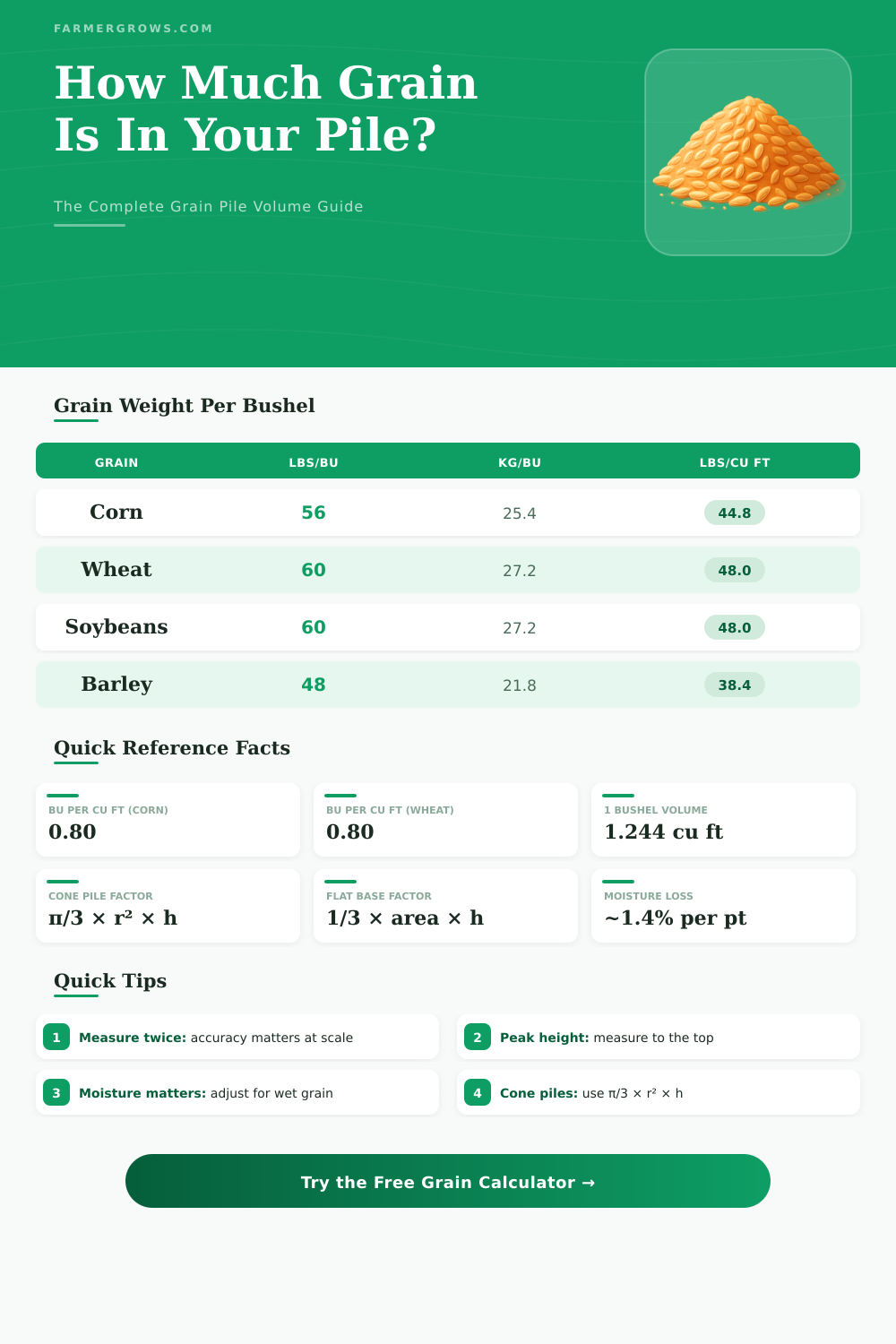
| Corn | 56 | 0.803 | 44.97 | 720 |
| Wheat | 60 | 0.803 | 48.18 | 772 |
| Soybeans | 60 | 0.803 | 48.18 | 772 |
| Barley | 48 | 0.803 | 38.54 | 617 |
| Oats | 32 | 0.803 | 25.70 | 412 |
| Milo/Sorghum | 56 | 0.803 | 44.97 | 720 |
| Sunflower | 25.8 | 0.803 | 20.72 | 332 |
| Canola | 50 | 0.803 | 40.15 | 643 |
📐 Cone Pile Volume by Diameter (at 45° slope)
| Diameter (ft) | Height (ft) | Cu Ft | Bu (Corn) | Tonnes (Corn) |
|---|---|---|---|---|
| 10 | 5 | 131 | 105 | 2.7 |
| 15 | 7.5 | 442 | 355 | 8.9 |
| 20 | 10 | 1,047 | 841 | 21.1 |
| 25 | 12.5 | 2,045 | 1,642 | 41.3 |
| 30 | 15 | 3,534 | 2,838 | 71.4 |
| 40 | 20 | 8,378 | 6,727 | 169.3 |
| 50 | 25 | 16,362 | 13,143 | 330.8 |
📋 Common Grain Pile Scenarios
| Scenario | Shape | Cu Ft | Bushels (Corn) | Tons |
|---|---|---|---|---|
| Small farm pile | Cone 20ft dia | 1,047 | 841 | 23.6 |
| Medium farm pile | Cone 30ft dia | 3,534 | 2,838 | 79.5 |
| Large farm pile | Cone 50ft dia | 16,362 | 13,143 | 368.2 |
| Flat pad 40x30x8 | Flat rectangle | 3,200 | 2,570 | 72.0 |
| Windrow 100x20x8 | Half cylinder | 5,027 | 4,037 | 113.1 |
| Elevator annex | Flat 60x40x12 | 9,600 | 7,709 | 216.0 |
Measuring grain pile is necesary to determine how many truck a person will need to transport the grain and how much storage space will be required. Grain piles are not in the standard shape with consistant dimension. Due to the slumping nature of grain piles, they can slump into cone, ridges, or flat piles of grain.
The shape of the grain pile can change based on the type of grain that is being piled and the moisture content of that grain. To account for these varying shape, specific mathematical formula are used to determine the volume of the grain in the pile. Should a person incorrectly guess the volume of the grain in a pile, they will either lose time or they will lose money.
How to Measure Grain Piles
The mathematical calculations that are used to calculate the volume of a grain pile change based on the shape of the grain piles. If the grain pile form a cone, such as when grain is dumped from a wagon, there is a specific formula to calculate the volume of the cone. You must measure the diameter of the base of the cone shaped grain pile and the height of the peak of that cone.
The height of the peak is important because the volume of the grain pile will be calculated incorrectly if that measurement are incorrect. If the grain pile forms flat pile on top of the ground, a different calculation is made for those flat piles of grain. You must calculate the area of the rectangular base of the flat pile of grain and the triangular top of the flat grain pile.
Finally, if the grain is laid in long row, the rows are referred to as windrows and are in the shape of a half cylinder. You calculate the volume of the windrow by multiplying the length of the windrow by the semi-circular cross-section of the windrow. The type of grain that is in the pile will also play a role in the weight that the grain will register on a scale.
Densities of different type of grain change the weight of the grain. For instance, corn is denser than oat so a given volume of corn will weigh more then the same volume of oats. Each type of grain has market standard that refer to the test weight of the grain.
These test weights help to determine the number of pound or tons of grain is in a given volume of grain. Finally, the moisture content in the grain will add to the weight of the grain but will not add to the value of the grain. The higher the moisture content in the grain the more the grain will weigh.
If the moisture content in the grain is above 14 percent the grain will weigh more due to the water content in the grain. You should dry the grain before you sell the grain because selling wet grain mean that you are selling water instead of grain. When you calculate how much grain is in a pile, you should include a buffer for the calculations.
Grain piles are rarely constructed in perfectly rounded shape; the wind or the way the tractor moved across the field may have caused the formation of these heaps with void in the center of the piles. To account for this, it is common to calculate 10% more grain than you think is in the pile. Furthermore, you should calculate the volume of the grain pile with an understanding of the moisture content of the grain.
Grain freshly harvested from the field typicaly has a higher moisture content than grain sitting in storage for several day. There are several way that a person can make mistake when calculating the volume of a grain pile. One of the most common mistake is measuring the diameter of the grain pile at the wrong spot.
Most people will take the tape measure or laser ranger to measure the diameter of the grain pile at the base of the heap. The best way to do it is to place the tool horizontally through the center of the pile, measuring from the side of the pile to the side of the pile. Another mistake is to take the height of the grain pile from the wrong place.
Instead, you should use a tape measure or laser ranger to measure the height of the peak, not from the ground. Furthermore, the grain pile should be covered in a tarp as soon as possible due to the evaporation of the water in the grain. The weight of the grain will decrease with evaporation.
The third mistake happen with the dirt beneath the grain pile. Dirt beneath the grain pile may compact with the weight of the grain pile, which may cause the grain pile to collapse. The volume of grain in a pile has an impact on several factor.
The weight of the grain will determine what size tarp must be used to cover the grain pile. A tarp of one and a half time the area of the base of the grain pile is recommended. The weight of the grain will also have an impact on the amount of ventilation that is necessary for the grain pile.
Ventilation require the movement of oxygen into the grain pile. Furthermore, if the grain is to be sold, the market will pay for the bushels of grain at a specific moisture level. If the grain is not dry enough to reach that moisture level, the market will apply a discount to the price of the grain.
Finally, another factor to consider regarding the volume of grain in a pile is hot spot in the grain. Hot spots can form when the fine particle and water in the grain move downward through the grain pile and onto the ground. This can cause problem for the grain pile.