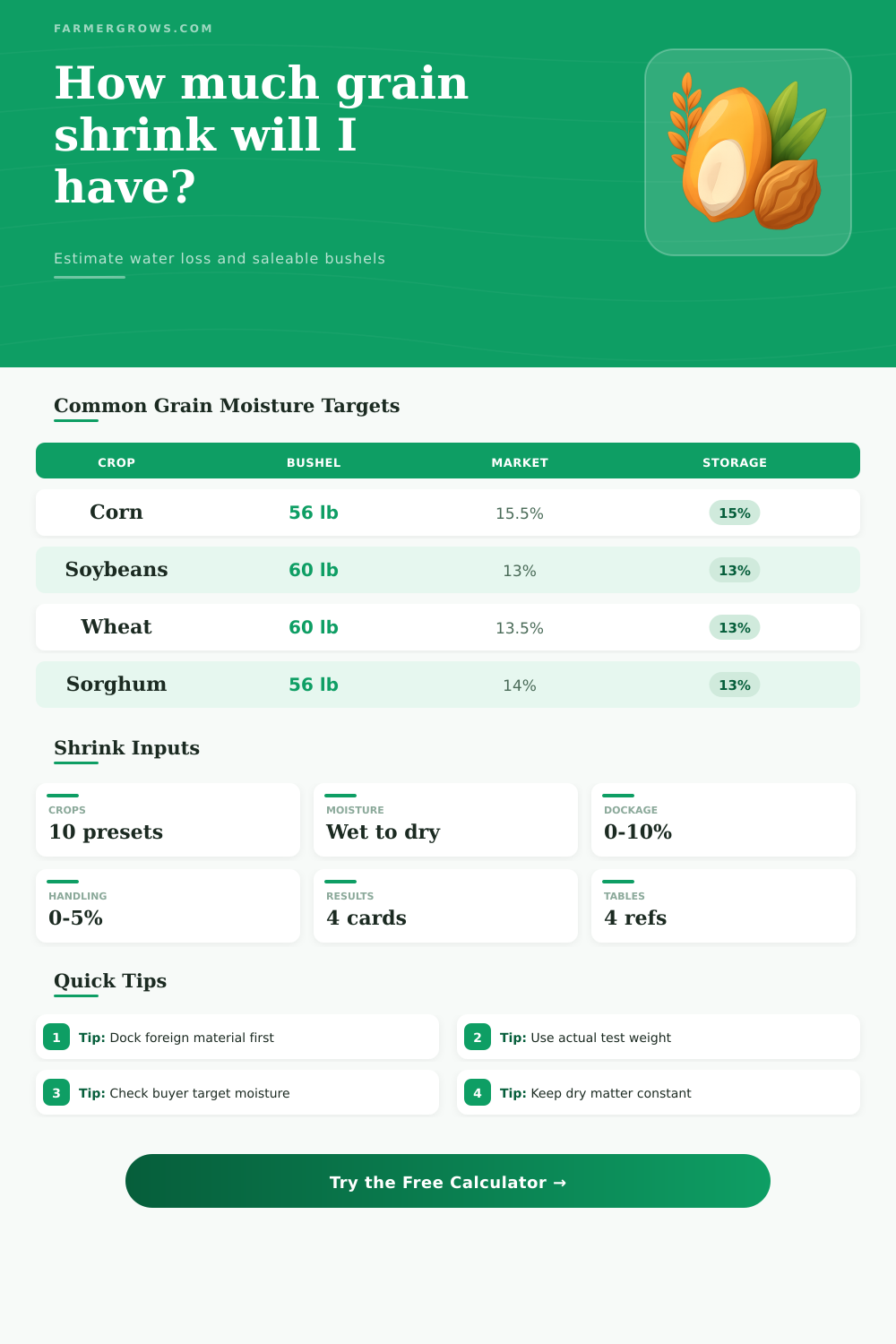
Grain Moisture Shrink Calculator
Estimate moisture shrink, dockage, handling shrink, dry matter, water removed, and saleable bushels for corn, soybeans, wheat, and other farm grains.
This calculator keeps grain dry matter constant, removes dockage before drying, then applies moisture and handling shrink. Buyer schedules can differ, so match the final moisture, dockage, and shrink factors to your local elevator contract.
| Crop | Short bin holding | Long storage target | Field note |
|---|---|---|---|
| Corn | 15.5% or less | 13% to 15% | Lower target for warm weather or long storage |
| Soybeans | 13% or less | 11% to 13% | Overdry beans can lose saleable weight quickly |
| Wheat | 13.5% or less | 12% to 13% | Aeration matters when grain enters the bin warm |
| Barley | 13.5% or less | 12% to 13% | Malt contracts may use tighter moisture targets |
| Oats | 13% or less | 12% to 13% | Low test weight lots need careful spoilage checks |
| Canola | 10% or less | 8% to 10% | Small seed heats fast when moisture is high |
| Crop | Standard lb/bu | Typical market moisture | Calculator use |
|---|---|---|---|
| Corn | 56 | 15.5% | Dry saleable weight divided by 56 |
| Soybeans | 60 | 13% | Dry saleable weight divided by 60 |
| Wheat, rye | 60 | 13% to 13.5% | Use buyer target for final moisture |
| Barley | 48 | 13.5% | Helpful when comparing feed and malt loads |
| Oats | 32 | 13% | Test weight changes scale pounds per wet bushel |
| Grain sorghum | 56 | 14% | Usually handled close to corn bushel weight |
| Canola | 50 | 10% | Oilseed contracts may specify different limits |
| Rough rice | 45 | 12% to 12.5% | Use rough rice weight unless contract states milled basis |
| Example lot | Moisture move | Water shrink only | What it means |
|---|---|---|---|
| Corn | 22% to 15.5% | 7.69% | About 41,500 lb water from 10,000 bu at 54 lb/bu |
| Corn | 28% to 15.5% | 14.79% | High-moisture harvest has a steep water removal load |
| Soybeans | 15% to 13% | 2.30% | Small moisture moves still change settlement bushels |
| Wheat | 16% to 13.5% | 2.89% | Dockage and handling can exceed the water shrink on clean wheat |
| Canola | 12% to 10% | 2.22% | Small seed needs close moisture and temperature control |
| Target | Use it when | Typical setting | Risk to watch |
|---|---|---|---|
| Market moisture | Direct delivery or nearby sale | Buyer limit, often 13% to 15.5% | Loads above target may face shrink or dock |
| Short storage | Cooling grain for weeks or a few months | At or slightly below market | Warm grain pockets can spoil even at target |
| Long storage | Holding through warm months | 1 to 2 points below market | Overdrying adds cost and reduces sale weight |
| Seed grain | Protecting germination and quality | Crop-specific seed target | Too much heat can damage vigor |
| Feed grain | On-farm feeding or rolling | Contract or ration target | Wet grain may bridge, heat, or mold in storage |
Check the order: Dockage is usually removed before moisture shrink because foreign material does not carry the same dry grain value as clean crop weight.
Use the contract: Elevators may apply their own shrink table, drying charge, moisture discount, or minimum shrink, so use this as a farm estimate before settlement.
Grain contain a significant amount of water when the grain is harvest from the field. The water in the field add to the weight of the grain. When buyers purchases the grain, they pay for the dry matter of the grain, not for the total weight of the grain.
Grain buyers do not pay for the weight of the water that evaporate during the drying process of the grain. As the water evaporate, the weight of the grain decreases. One way to determine the weight loss of the grain due to the evaporation of water is by calculate the moisture shrink of the grain.
How to Calculate Grain Moisture Shrink
The moisture shrink must be calculated correctly because the amount of water that is removed from the field change the final weight of the grain, which ultimately impact the amount of money that will be earned from the sale of that grain. Moisture shrink is based on the premise that the dry matter of the grain do not change during the drying process. Regardless of the amount of water that is removed from the field, the dry weight of the grain will remain the same.
For instance, if the initial moisture level of the grain is twenty-two percent and the target moisture level for the grain is fifteen and a half percent, the moisture shrink calculator will calculate the amount of weight that the grain will lose to reach that target moisture percentage. The farmer can input the initial moisture rate, the target moisture rate, and the total size of the grain lot into the calculator. The calculator will output the number of pounds of water that will be removed from the field, as well as the number of saleable bushel of grain that will remain after the field drying process is complete.
Dockage must be accounted for prior to calculating the moisture shrink of the grain. Dockage consist of foreign material, fines, and chaff that is mixed with the grain. The value of the dockage is not the same as the value of the saleable grain.
Buyers will typically subtract the weight of the dockage prior to calculating the moisture shrink of the remaining grain. If the moisture shrink is calculated prior to removing the dockage, the weight of the dockage will be included in the calculation of the moisture shrink. Therefore, the dockage must be subtracted prior to calculating the moisture shrink of the saleable grain.
After the moisture shrink is calculated, the handling loss of the grain can be accounted for. Handling loss occur when the grain is moving through the auger to the storage bins, when the grain is dropping into those bins, or when the grain is moving through the scales to measure the weight of the grain. Some estimated handling loss is one-half percent.
This factor can be accounted for in the calculation of moisture shrink. Adding this factor after calculating moisture shrink will account for the loss of grain due to handling. If the handling loss is not accounted for in the final calculation, the total weight of the grain will be less than the amount of weight that was initially expected after the drying process.
The test weight of the grain impact the total weight of the grain. A bushel of grain with a light test weight will contain less pounds of grain than a bushel of grain with a heavy test weight. The moisture shrink calculator will convert the initial weight of the grain, whether it is in units of bushels or scale weight, into pounds before applying the moisture shrink.
Different type of grain have different standard bushel weight and different target moisture level. For example, corn is typically sold at a rate of fifty-six pounds per bushel when the moisture content of the corn is fifteen and a half percent. Soybeans are typically sold at a rate of sixty pounds per bushel when the moisture content is thirteen percent.
Wheat is typically sold at a rate of sixty pounds per bushel at a moisture content of thirteen and a half percent. These rate can be found in the reference tables included with the moisture shrink calculator. The rate for each different type of grain can be referenced to determine the moisture shrink of that specific type of grain.
If the grain is overdried, the weight of the grain will be lost. The weight of the water that is removed from the grain beyond the amount that is required to reach the target moisture level will not be gained back by the farmer. The moisture shrink calculator indicate the number of saleable bushels of grain that will be lost due to overdrying the grain.
This number can be used to make a decision regarding whether or not to continue drying the grain. If there is too much moisture left in the grain, the buyers may apply a discount to that price for the grain or may even reject the grain all together. These outcome can be avoided by using the moisture shrink calculator to determine the moisture level of the grain prior to hauling it to the destination.
Moisture shrink is the sum of three separate type of weight removal from the grain: dockage, water, and handling. Each of these three factor must be accounted for in the correct order to determine the true weight of the grain that will be sold. Once the dockage, water, and handling loss are accounted for separately, the difference between the initial weight of the grain and the final weight of the grain that will be paid for can be determined.
This ability to accurately calculate the final weight of the grain allow the farmer to treat the payment for the grain as a routine business calculation.