🌽 Grain Dryer Calculator
Estimate energy use, propane consumption, drying time & moisture removal for any grain type
BTU/bushel values are per percentage point of moisture removed. Actual usage depends on dryer efficiency and ambient conditions.
| Grain Type | Safe Storage MC% | Lbs per Bushel | Max Drying Temp (°F) |
|---|---|---|---|
| Corn (Maize) | 15% | 56 lbs | 180°F (seed: 110°F) |
| Wheat | 13% | 60 lbs | 140°F (seed: 110°F) |
| Soybeans | 13% | 60 lbs | 130°F (seed: 110°F) |
| Rice (Rough) | 14% | 45 lbs | 110°F |
| Barley | 13% | 48 lbs | 130°F (seed: 110°F) |
| Grain Sorghum | 14% | 56 lbs | 160°F (seed: 110°F) |
| Canola / Rapeseed | 8% | 50 lbs | 120°F |
| Oats | 14% | 32 lbs | 130°F |
| Fuel Type | Energy Content | Typical Dryer Efficiency | Unit |
|---|---|---|---|
| Propane (LP) | 91,502 BTU | 75–80% | per gallon |
| Natural Gas | 1,020 BTU | 78–85% | per cubic foot |
| Electric | 3,412 BTU | 90–95% | per kWh |
| Diesel | 138,700 BTU | 70–78% | per gallon |
| Initial MC% | Final MC% (Corn) | Shrink Factor | Water Removed (lbs/bu) |
|---|---|---|---|
| 18% | 15% | 3.5% | 1.96 lbs |
| 20% | 15% | 5.9% | 3.29 lbs |
| 22% | 15% | 8.2% | 4.59 lbs |
| 25% | 15% | 11.8% | 6.58 lbs |
| 28% | 15% | 15.1% | 8.45 lbs |
| 30% | 15% | 17.6% | 9.88 lbs |
| Grain | Min Airflow (cfm/bu) | Recommended (cfm/bu) | Static Pressure (in. H₂O) |
|---|---|---|---|
| Corn | 1.0 | 1.25–1.5 | 2–4 |
| Wheat | 1.0 | 1.25 | 3–5 |
| Soybeans | 0.75 | 1.0 | 1.5–3 |
| Rice | 1.25 | 1.5 | 3–5 |
| Canola | 2.0 | 3.0 | 5–8 |
Grain drying require careful planning because several factor impact the drying process, including fuel consumption, equipment time, and grain shrinkage. If a person harvests corn at 25% moisture, that person will have to dry the corn to 15% moisture or less. The only way to reduce the moisture in the corn is to use heat to remove the water from the corn.
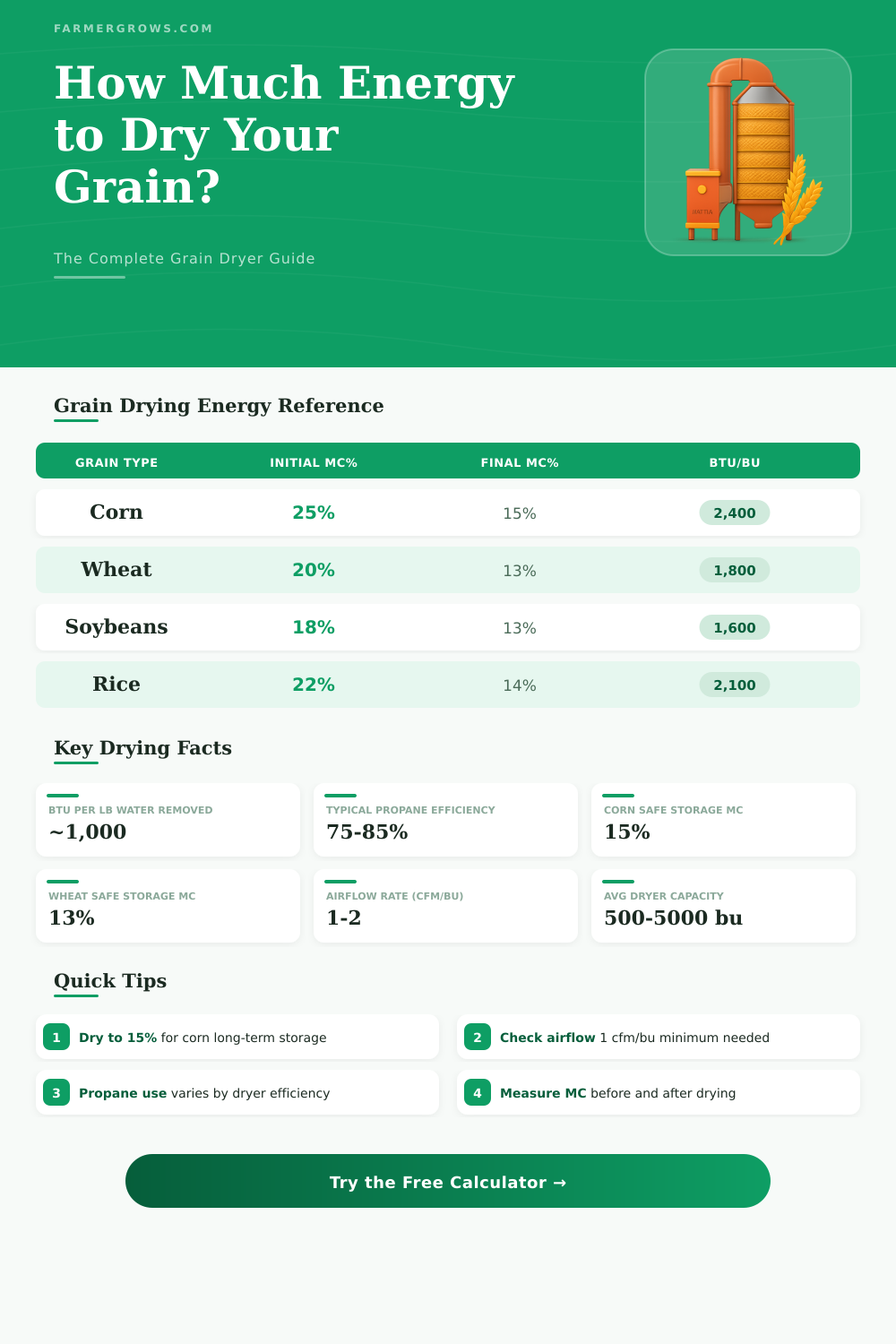
Depending on the types of grain, a different amount of energy is required to dry that specific grain. Corn requires 2,400 BTUs of heat per bushel of corn for every percentage point of moisture removed. Wheat, on the other hand, require 1,800 BTUs of heat per bushel of wheat for every percentage point of moisture removed during the drying process.
Grain Drying Basics: Fuel Use, Weight Loss, and Simple Tips
Grain shrinkage will occur during the drying process. The reason for this shrinkage is that the weight of the water removed from the corn has dried out of the corn. If a farmer dries corn from 25% moisture to 15%, the corn will lose 12% of its wet weight.
Therefore, 5,000 bushels of corn with high moisture levels will shrink to approximately 4,400 bushels of dry corn. Other grain, like soybeans and canola, will also shrink. However, canola requires an aim for shrinkage to be closer to 8% because the higher moisture levels can cause the oil in the canola to become rancid.
Farmers should account for shrinkage in the profit calculation for the grain that they grow. Depending on the type of dryer used to dry the corn, the fuel efficiency and drying speed will change. For example, high-temperature continuous flow dryers can dry 500 bushels of corn per hour.
High-temperature dryers, however, usually have an efficiency rate of only 75% because the hot air passes quick through the corn. Low-temperature natural air dryers move at a much slower rate and can take several days to dry a load of corn. The ambient temperature outside impact the efficiency of the dryer.
For example, if the ambient temperature is 60 degrees or less outside, fuel costs will increase for the farmer to dry the corn because the dryer will have to work harder to dry the corn with the cold air. Another factor to consider during the grain drying process is the type of fuel to use. The fuel to use depend on the availability of different energy sources in the area.
For example, propane contain 91,500 BTUs per gallon of propane fuel. However, the efficiency of the dryer may only be 75% to 80%. Natural gas may be more efficient if available through a pipeline, but propane and natural gas are the most common fuel for dryers.
Using electric power allow for more precision when drying the corn. However, using electric power will result in higher bills for the farmer. A calculator will help determine how many gallon, cubic feet, or kilowatt-hours of each energy source will be used to dry the corn.
Airflow is another factor in the drying process. Airflow will remove humid air from the dryer. To dry corn, there needs to be at least one cubic foot of air per minute for every bushel of corn.
Canola seeds are smaller and pack together in tight groups so more airflow is needed to avoid static electricity building up between the seeds. Without proper airflow during the drying process, the drying process will stall. There are some mistake farmers should avoid when drying the corn.
One mistake to avoid is ignoring shrinkage because that will result in an overestimation of the total sales of the corn. Another mistake is to not aim for the proper moisture level for the destination of the corn. For instance, if a farmer grows corn to use as seeds, the moisture level could go to 13%.
However, 15% moisture is sufficient for the corn to last during storage. Each percentage point of moisture removed will cost money for the farmer. There are several method to manage the drying process of the corn.
For instance, batch drying methods allow more control for grains of mixed load of corn. Continuous flow drying methods are better for drying more corn because it is more efficient with the moving of the corn. Another method farmers can use is a multi stage drying method.
Using a rough dry to 18% moisture and drying the remainder of the corn at a low temperature will result in 20% to 30% fuel consumption saved on high-moisture corn.