Grain Bin Aeration Calculator
Estimate bin airflow, CFM per bushel, floor loading, perforation velocity, static pressure risk, and fan run time for cooling, holding, or light in-bin drying.
Use the result as a planning estimate, then verify the selected fan on its published fan curve at the calculated static pressure. Fines, grain depth, floor condition, ducts, and transitions can change the real airflow.
Aeration snapshot
Enter bin size, crop, airflow target, pressure, floor open area, and run hours to estimate fan requirements.
| Crop | Typical test weight | Bulk density used | Bushel volume check | Aeration note |
|---|---|---|---|---|
| Corn | 56 lb/bu | 45 lb/cu ft | 1.24 cu ft/bu | Fines and high moisture raise resistance quickly. |
| Soybeans | 60 lb/bu | 47 lb/cu ft | 1.28 cu ft/bu | Use gentler airflow for dry beans to limit splits. |
| Wheat | 60 lb/bu | 48 lb/cu ft | 1.25 cu ft/bu | Small kernels and dockage increase pressure. |
| Rice | 45 lb/bu | 36 lb/cu ft | 1.25 cu ft/bu | Drying often uses higher airflow and close monitoring. |
| Oats | 32 lb/bu | 26 lb/cu ft | 1.23 cu ft/bu | Low density gives high volume for the same bushels. |
| Goal | Common CFM/bu target | Typical run pattern | Best fit | Watch point |
|---|---|---|---|---|
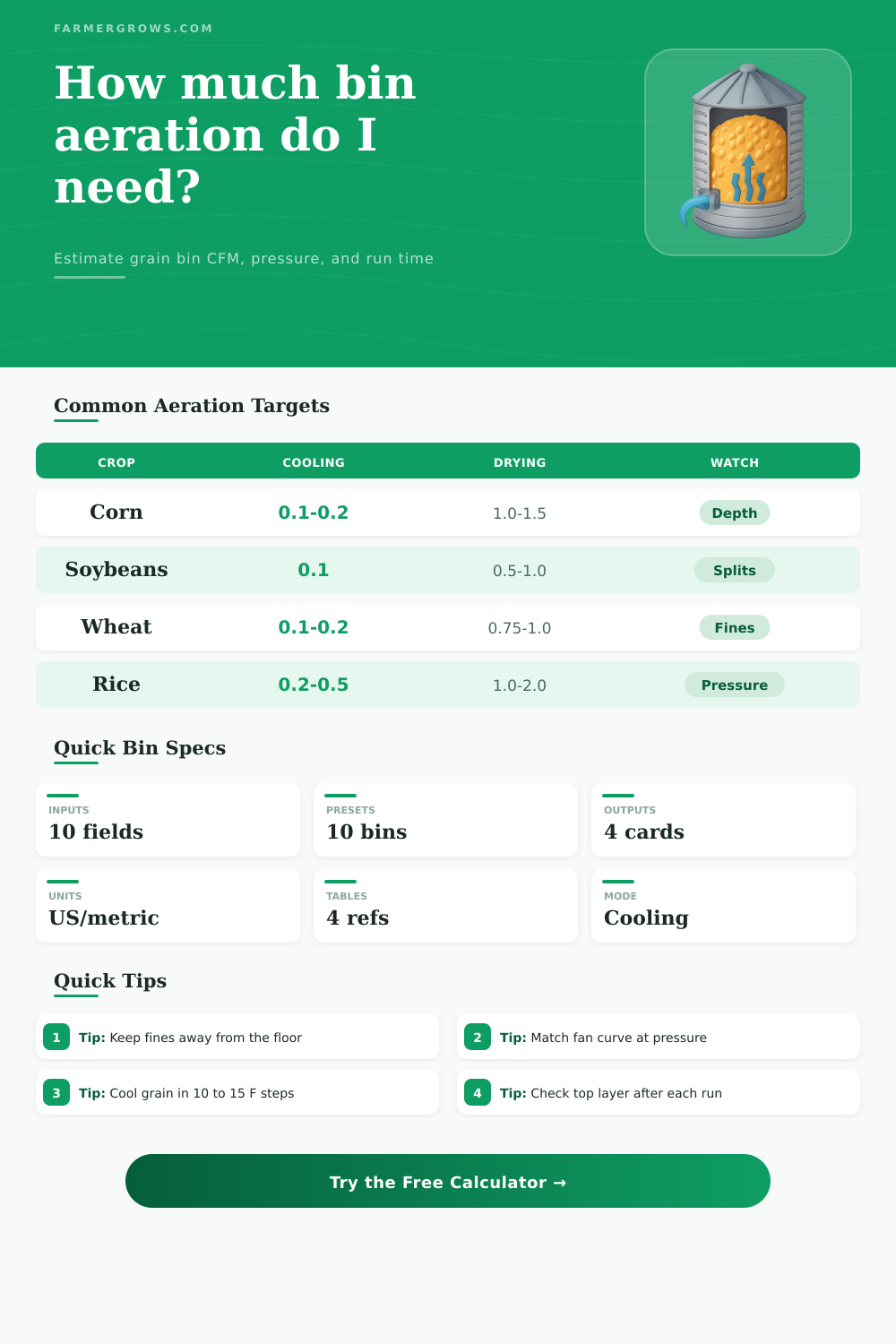
| Storage cooling | 0.1 to 0.2 | Long weather windows | Dry grain at safe moisture | Stop after the cooling front exits. |
| Temperature equalizing | 0.05 to 0.15 | Short periodic runs | Preventing hot spots | Do not pull damp air into cold grain. |
| Holding wet grain | 0.2 to 0.5 | Nearly continuous | Short-term harvest delays | This is not a substitute for drying. |
| Natural air drying | 0.75 to 2.0 | Weather controlled | Moderate depth and warm dry air | High depth may exceed fan capacity. |
| Low-temp drying | 1.0 to 1.5 | Extended seasonal runs | Corn and small grains | Track top-layer moisture closely. |
| Estimated static pressure | What it suggests | Common cause | Fan check | Field response |
|---|---|---|---|---|
| Under 2 in. water | Easy airflow | Shallow depth or low CFM/bu | Many axial fans fit | Confirm floor and transition losses. |
| 2 to 4 in. water | Moderate resistance | Typical cooling depth | Use curve, not nameplate HP | Clean fines and check roof vents. |
| 4 to 6 in. water | High resistance | Deep grain or drying airflow | Centrifugal fan may be needed | Reduce depth or airflow target if needed. |
| 6 to 8 in. water | Very high resistance | Fines, wet grain, small kernels | Fan output may collapse | Core the bin and verify airflow. |
| Over 8 in. water | Special design territory | Deep drying or plugged floor | Engineer or dealer review | Do not assume fan will deliver CFM. |
| Moisture and temperature goal | Airflow guidance | Temperature front cue | Moisture cue | Practical check |
|---|---|---|---|---|
| Fall cooling | 0.1 to 0.2 CFM/bu | Cool in steps as outdoor air drops | Grain already near safe storage | Check top center last. |
| Winter holding | 0.05 to 0.1 CFM/bu | Run during stable cold dry air | Avoid condensation cycles | Watch roof underside and vents. |
| Wet holding | 0.2 to 0.5 CFM/bu | Run continuously if weather allows | Only short-term protection | Plan a drying path. |
| Natural air drying | 0.75 to 2.0 CFM/bu | Front moves slowly through depth | Top layer determines finish | Sample grain, do not guess. |
| Equalizing | 0.05 to 0.15 CFM/bu | Small temperature difference | No active drying expected | Use binside cables if available. |
Before sizing the fan: Match the needed CFM at the estimated static pressure, not at free air. A fan can look large on paper and still underperform in deep grain.
Before long runs: Core fines from the center, open enough roof vents, and sample the top layer. Airflow math assumes air can move evenly through the grain mass.
Grain bin aeration are a process that is used to manage the temperature and moisture level of the grain that is stored within a grain bin. Grain bin aeration is used to even out the temperature of the grain, and to prevent mold from develop within the stored grain. Grain bin aeration is also helpful in manage grain if the moisture levels within that grain is high, or if the growing season are short and there are short harvest windows.
Air does not always move even through a grain bin due to the settling of fine particle within the grain and the different ways in which the grain packages within the bin; the static pressure within the bin increases as a result of these factors. The grain bin aeration calculator require that you input parameters related to the grain bin, the depth of the grain within the bin, the type of crop that is being stored in the bin, and the target airflow that you would like within the bin. Each of these parameter helps to calculate the total CFMs that the bin will require to move the air within the grain, the airflow rate in relation to the square foot area of the floor of the bin, and the static pressure within the bin.
How to Use a Grain Bin Aeration Calculator
Static pressure within the bin indicate the resistance of the grain against the airflow. Even if the fan is of a high horsepower, high static pressure will reduce the amount of airflow that the fan can create. The calculator will determine the static pressure within the bin based on the depth of the grain, the airflow within the grain, and the open area of the floor of the bin.
This calculated static pressure will allow you to compare the static pressure of the grain within the bin to the static pressure ratings of the fan that you are to utilize within the bin. If the static pressure of the grain is higher than the fans capacity, the fan will not be able to move enough air to reach the top layer of the grain within the bin. In this case, either the depth of the grain within the bin will have to be reduced, or a different type of fan will have to be utilize within that bin; one that is capable of overcoming the static pressure of the grain.
In addition to the parameters that is required for the calculator, there are other factor within grain bin aeration systems that are important to consider. Such factors include the floor open area of the bin, and the perforation velocity of the airflow within that bin. The floor open area determines how much air can exit the bin; if the area is too small for the amount of airflow that is required, the perforation velocity will be too high for the bin.
High velocities of air moving through the perforations in the floor will increase the static pressure of the air prior to it entering the grain within the bin. The calculator will calculate the CFM per square foot of open area to indicate whether the open area of the bins floor is creating any static pressure prior to the entry of the air into the grain within. Another important factor in grain bin aeration is the reference table that are available to those who use the calculator.
These tables indicate the airflow rates that should be utilized based off the goals for the grain within the bin. For example, if the goal is to cool dry grain, lower airflow rate will be required. However, if the goal is to aerate the grain to perform natural air drying, higher airflow rates are required to remove moisture from the grain.
Certain crops contain more fines than other, which increases the static pressure within the bin; rice and wheat are two of those crops. The grain bin can experience certain complication that are outside of the calculations of the calculator. For example, the layering of fines within the grain can increase the resistance of the grain against the airflow.
Furthermore, if the grain bin has roof vent, the humidity of the air outside of the bin may restrict the outflow of air from the bin. Sensors that are located within the bin can monitor the temperature of the grain, which will allow individuals to monitor whether the aeration process within the bin was working correct. The calculator will provide a “planning” number for airflow, static pressure, and time to aerate the grain, but the temperature of the grain will have to be measured to ensure that this planning number was the correct number for the grain that is being store within that bin.
Finally, grain within the bin should be aerated in a series of small run over time, rather than one long run of aerating the grain. By monitoring the weather, individuals will be able to ensure that the fan is matched with the static pressure of the grain within the bin. Furthermore, aerating the grain will allow the cooling front to reach the surface of the grain; at this point, the aeration process should be stopped.
This will save money on the energy cost of aerating the grain, and will prevent humid air from the aerated grain from being pulled into the cooled grain within the bin. In other words, while the calculator is helpful in determining the size of the fan that will be needed for the bin, monitoring the grain will ensure that the aeration process is working correct within the bin. Its going to be a lot of work, but it should of help you avoid mistakes.
You’ll want to make sure you dont miss any steps when your setting up the moddern system.