
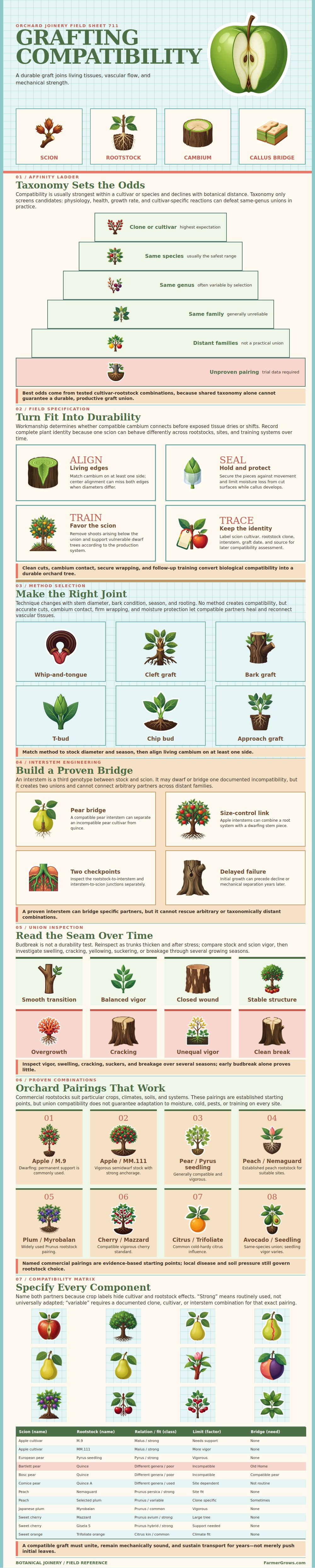
The quiet weeks just before leaf-out are grafting make-or-break time. Hours of careful alignment of bark, of taping the join, can be wasted unless plants themselves hook up biologically. Grafting is surgery on living tissue; it needs to be both mechanically sound and chemically compatible.
To know whether a piece of an apple tree (the scion) will mate with one of a rootstock, look at its family relationship (chart above). The odds are set by taxonomy. Typically, members of the same species will accept each other. Crossing genera? Gamble. Don’t try to graft any stone fruit onto another stone fruit and think it’s going to work.
How to Make Grafting Work
Genetics aren’t everything; physiology and health count too. A weak scion can be overgrown by a vigorous rootstock. That means youve got a mismatched trunk, in hard wind the trunk might simply snap. People focus on the cut and ignore the power dynamic between the two partners. They focus on the cut and ignore the power dynamic between the two partners.
How you do it is less important than how well you do it. Always make sure you have cambium-to-cambium contact. At least one side has to be touching for vascular flow. Edges don’t line up if cuts are sloppy, tissue dries before healing. Wrap well. It holds things together. It maintains moisture until the callus bridge forms. That is the glue that makes it one whole tree instead of two separate ones.
When do you require a middle man? An interstem connects incompatible partners. Put a compatible variety of pear between a European pear scion and quince rootstock. Voila: that addresses particular compatibility concerns. In some cases, it imparts dwarfing traits as well. But it makes things more complicated. Watch two unions; if one connection fails, the whole tree will fail. Usefully so. It is not connecting close botanical cousins, either. Still needs a good biological connection there.
Truth comes out, eventually, with inspection: First-year budbreak isn’t the test of durability. Lots of grafts jump up and go strong one season. Then they weaken gradually, or perhaps mechanically fail later on. Check for swelling where the two join. That’s your sign that the stock is straining itself too much. Monitor for cracks at the joint. It’s your sign that the structure of the bond wasn’t stronger. If it’s hourglass-shaped, you know it was incompatible from the start. Look for a clean break at the graft line. Those signs don’t develop overnight; patience is needed.
Start with selections that have a track record. For example: Pairing apple cultivars with M.9 rootstock results in dwarfing. Using MM.111 provides vigor. That’s not guesswork; it’s based on experience. It’s been applied over many years of different seasons. In the end, the decision is informed by local factors; climate, soil type; and disease pressure. With one variable removed, you know that a compatible, proven pair will work and you can concentrate on caring for tree itself.
Grafting’s all in the connecting. The cuts must be exact. They must be securely covered. You have to respect the biological nature of trees. When it works, no one will ever know. Sap rushes through. Limbs harden. One tree emerges from two. You planted two things, and now here is this whole thing.