Goats Per Acre Brush Clearing Calculator
Estimate how many goats per acre are needed for brush clearing from paddock area, brush dry matter, browseable share, goat demand, browsing days, rotation rest, waste, and safety buffer.
Pick a starting scenario, then adjust area, brush type, goat class, browsing window, move timing, rest days, and access factors for your field.
Brush Clearing Stocking Estimate
Your brush clearing estimate will appear here.
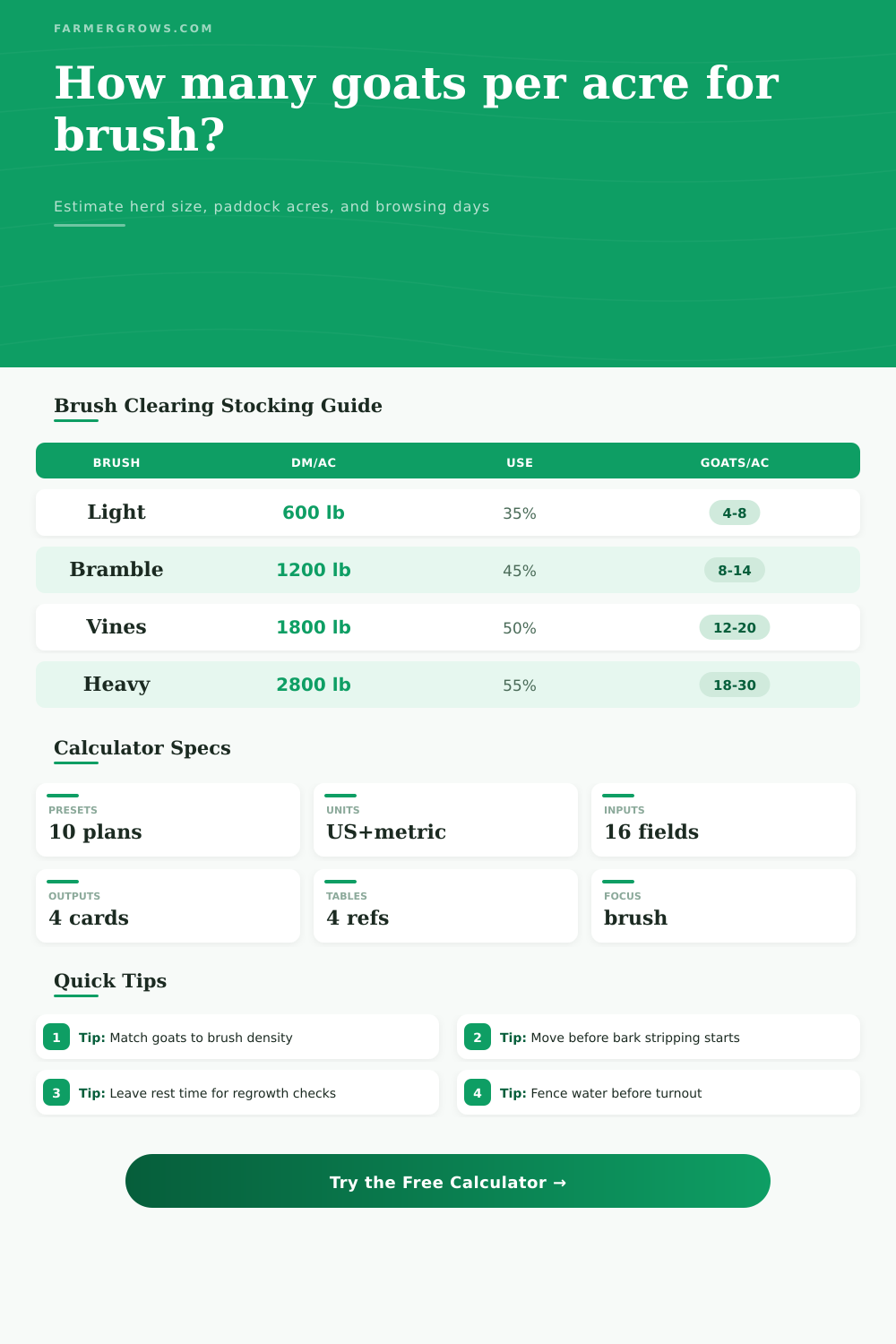
| Brush situation | Dry matter basis | Typical target use | Planning range | Best use |
|---|---|---|---|---|
| Light weeds and low brush | 400 to 800 lb DM/ac | 30% to 40% | 4 to 8 goats/ac | Maintenance, seedhead control, and cleanup after mowing. |
| Blackberry or bramble thicket | 900 to 1,500 lb DM/ac | 40% to 55% | 8 to 14 goats/ac | First-pass defoliation with repeat grazing after regrowth. |
| Honeysuckle, grapevine, or kudzu | 1,400 to 2,200 lb DM/ac | 45% to 60% | 12 to 22 goats/ac | Leaf stripping and vine weakening before mechanical follow-up. |
| Heavy woody understory | 2,200 to 3,500 lb DM/ac | 45% to 60% | 18 to 32 goats/ac | Short-duration browsing where access and water are controlled. |
| Goat class | Typical weight | Daily intake | Brush diet share | Planning note |
|---|---|---|---|---|
| Yearlings and light goats | 55 to 80 lb | 3.8% to 4.2% BW | 55% to 70% | Useful for lighter brush, but total demand per head is lower. |
| Mature wethers | 80 to 110 lb | 3.2% to 3.8% BW | 60% to 80% | Common brush-clearing group with steady maintenance demand. |
| Dry does | 90 to 125 lb | 3.0% to 3.5% BW | 55% to 75% | Use moderate pressure and monitor body condition. |
| Lactating does | 100 to 140 lb | 4.0% to 5.0% BW | 45% to 65% | Higher nutrition need; avoid forcing poor-quality woody browse. |
| Large meat goats | 120 to 170 lb | 3.0% to 3.6% BW | 55% to 75% | Higher body weight increases herd demand and clearing pressure. |
| Move pattern | Days in paddock | Rest target | Pressure level | Management note |
|---|---|---|---|---|
| Quick strip graze | 0.5 to 2 days | 30 to 45 days | High | Good for dense regrowth when fence and water moves are ready. |
| Short browse paddock | 2 to 4 days | 35 to 60 days | Moderate high | Often fits bramble, vine, and fence-row clearing projects. |
| Open lot browsing | 5 to 10 days | 45 to 75 days | Moderate | Works when brush is mixed with grass and plenty of escape cover. |
| Maintenance pass | 10 to 21 days | 60 to 90 days | Low | Better for suppression than a hard first-pass knockback. |
| Project | Area basis | Brush basis | Typical herd | Expected use |
|---|---|---|---|---|
| Half-acre blackberry patch | 0.5 acre | 1,200 lb/ac at 50% | 10 to 16 goats for a week | Strong leaf removal with follow-up regrowth pass. |
| Two-acre vine edge | 2 acres | 1,800 lb/ac at 55% | 25 to 45 goats for 7 days | Good pressure if fence keeps goats on the target strip. |
| One-acre sapling understory | 1 acre | 2,600 lb/ac at 45% | 20 to 32 goats for 5 days | Useful defoliation, but stems may need cutting afterward. |
| Three-acre regrowth block | 3 acres | 900 lb/ac at 40% | 18 to 30 goats for 10 days | Maintenance browsing after mechanical clearing or mowing. |
Base the count on edible dry matter. Goats strip leaves and tender stems first, so coarse stems, inaccessible thickets, and old cane should not be counted as fully usable feed.
Use short pressure, then rest. A hard brush pass works best when goats move before they overbrowse desirable plants, ring trees, or start pushing weak fence.
When your land has been overrun with brambles, you may find yourself panicking. What was supposed to be a woodland stroll turns into a gauntlet of harmful vines. Sure, you can spend money on an expensive mechanical removal process; or make a racket while doing so. With goats, however, it’s a grazing job: managing the landscape like you’re running a farm.
Of course, there are plenty of critters willing to chow down on the scrub. The question isn’t what eats the stuff; it’s how many goat do you deploy to clean up this mess?
How Many Goats Do You Need?
“With the calculator it’s more than just a head count; it translates what the field looks like into how many to stock. Most folks grossly overestimate the dry matter content on thick brush. A thicket might look like an acre of greenery, but much of that mass is tough, woody stem that a goat will ignore. This is why we ask you to project the percentage that is browseable; that makes a big difference. Guessing everything is edible means you’ll have too few animals for the job. The goats will chomp through the tender foliage in a couple of days and never touch undesirable vines. You’ve got to have enough numbers to keep constant pressure throughout.
Species and species type is very important: For example, light weeds don’t last long at all with even one goat. Thorny brambles or dense kudzu call for more goats. Heavy brush generally need eighteen to thirty goats per acre, as the table of references show. That sounds like a lot, but keep in mind, goats are selective browsers. They will eat the best first. Because of this, you want lots of goats… Enough to force them into less desirable stems by their combined eating power.
Time is money. Treat it as such. To get the best results, goats work best on newly regrown vegetation and when they’re hungry. The calculator accounts for rotation rest and browsing days. How long is long enough? How long is too long? You need them in a paddock long enough to make some damage. But not so long that they start degrading the remaining forage or stripping bark. Three days is usually ideal. That keeps ‘em interested. It makes sure they don’t bypass the thornier stuff. Leave ‘em any longer than that and they become accustomed to being uncomfortable. They begin to avoid the brush you paid them to remove.
Fencing, water. Regardless of how great your stocking rate is, if the animals can’t get to water without walking through unbrushed areas, you’ve got problems. Electric fences work well because they can accommodates odd shapes. Use that access factor on the tool. Goats don’t work very efficiently in steep areas or rocky outcrops. Plan for less productivity in those areas when deciding your herd size.
Better to be a little overstocked then understocked. More animals will clear sooner. Then off they go, and let the land recover.
That’s where the followup comes in, the art of it. An old bramble patch doesn’t come clean with one pass. Weaken the plants by stripping their leaves again and again. That’s what the calculator will help you plan for: your rotation. When the goats return, after a few weeks, they have something tender to get at. You’re turning a big project into doable events. It’s a rhythm. Consistent pressure changes how the plant community work, rather than just getting rid of brush.
Safety buffers and goat class can become difficult variables. Remember: keep it simple. Feed the animals according to their appetites. Match the animal’s appetite to the plant’s defense. Give the goats too much room, and they’ll get bored or destructive. Give them too little, and the brush has the upper hand. The goal becomes balancing the two. That’s when you create a sustainable pasture by managing stocking rates and rotation to make sure the goats do the work for you.
If you provide the correct environment, one day you will walk back onto an acre. The pathway’s cleared. All you hear is a contented herd chewing.