Goat Gestation Calculator
Estimate a doe's due date range, likely kidding window, kidding kit deadline, CDT booster window, dairy dry-off date, and next heat return checks from one breeding date.
Gestation varies by breed, doe age, litter size, nutrition, and individual history. Use this as a planning calendar and confirm herd health decisions with a goat-experienced veterinarian.
Kidding Date Estimate
Dates are calculated from breed-group gestation norms, then adjusted for age, litter size, and doe history.
| Breed group | Planning due date | Common range | Calendar note |
|---|---|---|---|
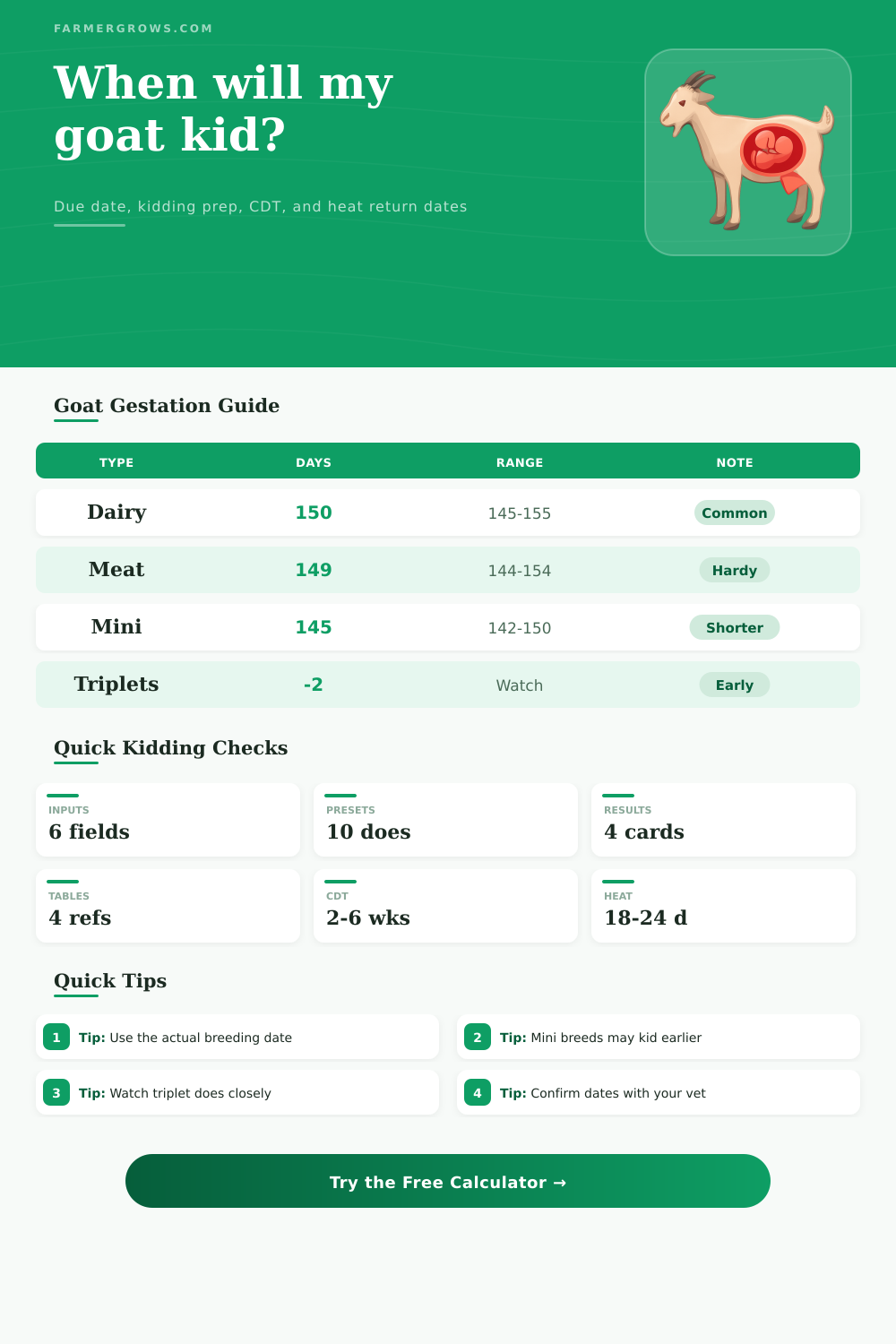
| Dairy breeds | 150 days after breeding | 145 to 155 days | Use for Alpine, Nubian, LaMancha, Saanen, Toggenburg, Oberhasli, and similar dairy does. |
| Meat and range breeds | 149 days after breeding | 144 to 154 days | Use for Boer, Kiko, Spanish, Savanna, Myotonic, and mixed meat does. |
| Miniature breeds | 145 days after breeding | 142 to 150 days | Use for Nigerian Dwarf, Pygmy, and compact mini crosses, then watch early. |
| Unknown breeding | Use the last observed service | Check 18 to 24 days later | If a doe returns to heat, reset the calendar from the newer breeding date. |
| Litter and age factor | Adjustment used | Why it matters | Planning action |
|---|---|---|---|
| Single kid expected | Add 1 day | Some single pregnancies carry slightly longer than herd average. | Keep the normal watch range, but avoid panic at day 150. |
| Twins expected | No change | Twins are common and match most gestation charts. | Use the calculated due date as the main barn calendar date. |
| Triplets or more | Subtract 2 days | Large litters often need closer monitoring before the average due date. | Move kidding supplies and close checks earlier. |
| Yearling doe | Subtract 1 day | First fresheners deserve extra observation, especially with multiples. | Start udder and ligament checks before the range opens. |
| Senior doe | No date change | Older does vary by body condition and previous kidding history. | Track appetite, comfort, and udder change carefully. |
| Calendar item | Timing from due date | Calculated by this tool | Farm note |
|---|---|---|---|
| Kidding kit ready | 30 days before due date | Yes | Restock gloves, towels, iodine, bulb syringe, lube, and kid warming supplies. |
| CDT booster window | 2 to 6 weeks before due date | Yes | Many herds booster does in this window so kids receive antibodies in colostrum. |
| Dairy dry-off | 6 to 10 weeks before due date | Yes | Eight weeks is a common target for milking does unless the herd plan differs. |
| Close kidding watch | 5 days before early range | Yes | Move the doe to a clean, visible pen when her body signs agree with the date. |
| Heat return check | Days after breeding | What to watch | Calendar action |
|---|---|---|---|
| Early heat check | 18 days | Flagging, tail wagging, calling, discharge, standing for the buck. | If she returns, note a possible missed conception. |
| Average cycle check | 21 days | The most common return-to-heat checkpoint for many does. | Mark the calendar and observe twice daily if possible. |
| Late heat check | 24 days | Some does cycle a little later, especially under seasonal stress. | If no heat appears, keep the pregnancy calendar active. |
| Second cycle check | 42 days | A later return can happen if early pregnancy is lost. | Recheck body condition, buck exposure, and herd records. |
Use doe history: A doe that repeatedly kids on day 146 or day 153 should override the breed average in your barn notes. The calculator gives the framework; your records refine it.
Watch the doe, not only the date: Udder fill, softened tail ligaments, behavior change, discharge, appetite, and nesting matter more as the early kidding date approaches.
A goat gestation calculator is an tool that you can use to plan for the birth of you’re kids. The tool use the breeding date to provide you with a estimation of when various task with the does and kids will occur. The breeding date is the most important date that you can enter into the calculator.
The calculator utilize that date along with other factors to adjust the timeline for the kid to be born. Some of those factor are the breed group of the does, the age of the does, and the size of the litter that the does will have. For instance, yearling does with twins will likely kid earlier than does that is mature and have single kids.
Plan goat births with a gestation calculator
Does that have triplets will kid even earlier than the yearling does with twins. The calculator account for these small offsets automatically so that you dont have to calculate them yourself. In addition to accounting for factors like breed, age, and litter size, the calculator also account for the individual history of each doe.
Does that always kid early can be account for in the calculator, as can does that always kid late. This allows the calculator to take into account the individual does in your herd and prepare a plan based off there history. The calculator will prepare you for several different date.
For instance, it will provide you with an estimated date upon which the does will give birth to there kids. In addition to the date for each doe’s kids to be born, the calculator can also provide you with the likely kidding range for the does. Finally, the calculator can prepare you with the dates upon which you should prepare a kidding kit, administer a CDT booster to the does, and dry off does that will be milked.
Knowing when to dry off does is important in that it will protect the body of the does and the quality of there next lactation. Breed differences can impact when does kid. For instance, dairy goats take longer to cycle through gestation than does of the meat and range breed.
Breeds like Nigerian Dwarfs and Pygmies will go through gestation even earlier than dairy breed. Because of this, any plan that you create using the calculator will allow for the early observation of these does (before the due date is calculated), as they may give birth prior to the due date. The calculator make sure that these distinction between breeds are visible to the user.
External variable may impact kidding dates. For instance, the nutritional status of the does, the level of stress in the herd, the climate in which the does live, and the body condition of each doe can all impact the variable kidding dates. Because of these variable, the calculator should be used in conjunction with observing the does each day.
For instance, you should observe the goat for their ligaments, udder fill, and behavior. The calculator offer a window of time for kidding; observing the does will allow you to ascertain when that window open. Many people make mistakes when using a due date to prepare for kidding.
For instance, most individuals will use the due date as a deadline for kidding, when it is actualy the middle of the kidding date range. Additionally, many individuals will skip early heats when they believe the doe is pregnant. These mistake occur in that people want to have certainty in the kidding dates; however, the goat gestation calculator is a tool that will reduce that uncertainty.
The calculator do not eliminate the need for you to keep watch over your does. The goat gestation calculator will allow you to make a variety of small decision in your barn. For instance, you will know when to move does to a visible pen.
You will know when to have towel and iodine on the shelf in each pen. You will know when a dry doe need extra attention to her body condition. Thus, the goat gestation calculator will allow you to avoid scrambling to prepare for kidding; you will be prepared in advance.
If a doe returns to heat, the goat gestation calculator can help you to adjust your plan accordingly. For instance, it is possible to mark early, average, and late date for kidding. This allows for your calendar to be updated if a doe does not conceive.
While a missed conception is still a setback in relation to your breeding season, catching it early in the cycle will allow you to prevent the remainder of the breeding season from drifting from your planned date. Thus, the goat gestation calculator make resetting your plan after missing conception an easier task. While the calculator can automate most of the task associated with determining kidding dates, your records and observations of the does each day will allow you to prepare a workable schedule for kidding.